|
Nonprofit, investigative journalism on a mission to hold the powerful
to account.
|
Donate
|
|
|
|
|
|
|
|
It’s difficult to put yourself in the place of Cherise Doyley, a pregnant mother of three who found herself facing a judge while in labor at the University of Florida Health hospital in downtown Jacksonville. |
| |
|
She arrived overnight at the hospital after her water broke. Doctors told her they were concerned about the risk of uterine rupture, a potentially deadly complication for her and her baby. She understood the risk to be less than 2% and repeatedly told doctors she wouldn’t consent to a cesarean without trying to have a vaginal delivery first. The doctors appeared to relent, leaving her to labor for several more hours. Then a nursing supervisor wheeled a tablet up to her bed and informed her she was in court. The reason? Failing to agree to a C-section.
When advocates for pregnant women say that you shouldn’t lose your constitutional rights just because you conceived, this is the kind of situation they’re talking about.
I’m a reporter based in Alabama, and throughout my career, I’ve focused on women facing the consequences of the state’s fetal personhood policy. That’s the idea that fetuses should have the same legal status as children. My investigation shows how a similar theory played into the cases of two women in Florida: Cherise Doyley and Brianna Bennett, who experienced eerily similar situations in Florida. In both cases, they found themselves fighting for their rights to make medical decisions because they were pregnant.
I obtained a video recording of Doyley’s court hearing. Watching her argue her case from her hospital bed shocked me. Even though courts have found time and time again that you can’t force someone to undergo medical treatment — even if it could save someone else’s life — the video underscored for me how pregnant women are the rare exception. In several states, judges have ruled pregnant patients can be forced to receive blood transfusions or remain on bed rest if it is in the best interest of the fetus. In Doyley’s case, a court would force her to undergo surgery.
ProPublica has already investigated how abortion restrictions can lead to pregnant women being denied lifesaving care. Experts worry that the opposite problem, forced treatment, could also become more common in states like Florida that have fetal personhood policies. Doyley signed a waiver allowing the hospital to discuss her case with ProPublica, but a spokesperson for University of Florida Health in Jacksonville would not comment, citing patient privacy.
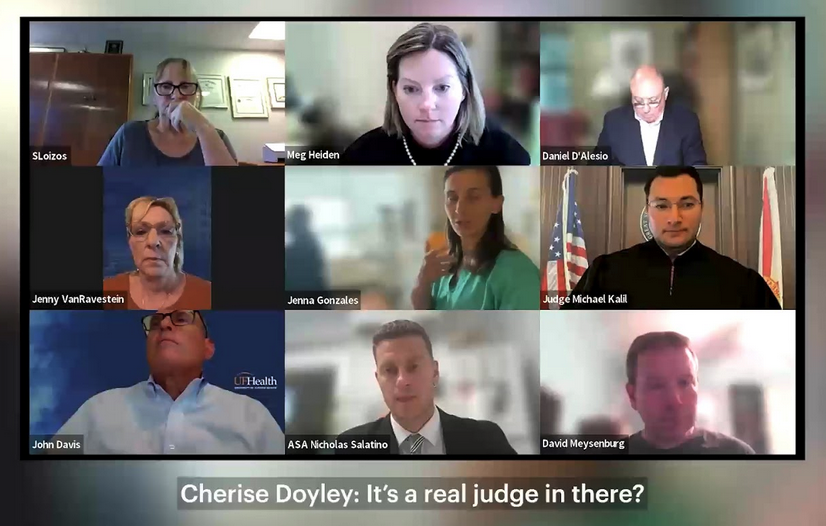
By sharing and examining Doyley’s case with her consent, we aim to show you what forced medical treatment can look like. And, while we encourage you to read the full investigation, we wanted to highlight three moments from the Zoom court hearing so you can see for yourself what happened. |
|
|
You can see the confusion on Doyley’s face as she realizes she’s being taken to court over her medical decisions. She asked for a lawyer, or at least a patient advocate. Florida courts don’t require lawyers for pregnant women in hearings about their medical decisions and the hospital didn’t provide an advocate, so Doyley had to go it alone.
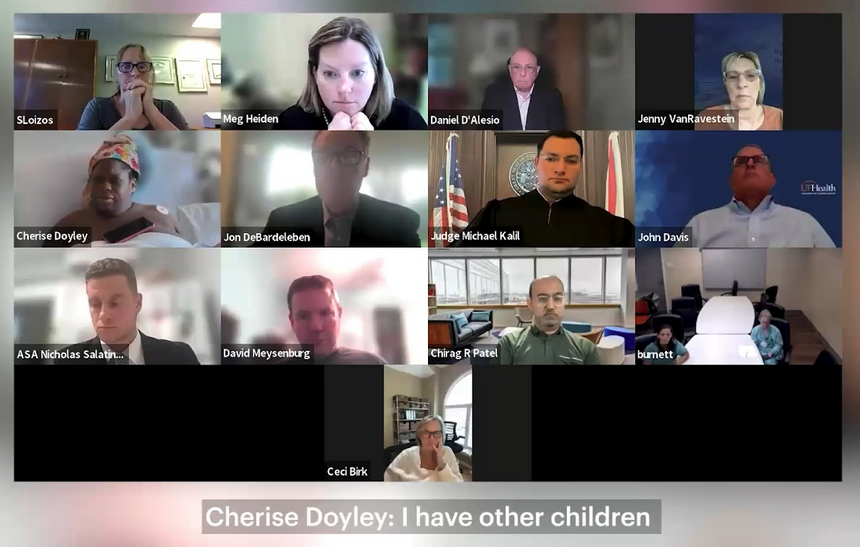
Judge Michael Kalil is there in his black robe. Doyley, a Black woman, is lying in a hospital bed, hooked up to IVs and monitors and covered by a sheet. She is surrounded on the screen by nearly a dozen doctors and lawyers, most of them white, who offer a lot of testimony about what could happen to Doyley’s baby if she continued to refuse a C-section.
Dr. Erin Burnett said during the hearing that she did not think Doyley could successfully give birth vaginally. A long labor could increase the risk of uterine rupture, which could kill Doyley and the child, she said. Dr. John Davis, the chair of the obstetrics and gynecology department, said in the hearing the hospital had been recognized for its low C-section rate and did not perform unnecessary surgeries. Doyley’s condition required intervention, he said.
"Everybody was very concerned about the baby's welfare," Jenny Van Ravestein, director of women’s services at the hospital, said during the hearing.
Burnett and Davis did not respond to requests for comment, and the hospital declined ProPublica’s requests to interview them and others involved in Doyley’s care.
The research on the risks of uterine rupture after prior C-sections is unclear. Studies have found that 0.15% to 2.3% of these labors resulted in a rupture, depending on a number of factors such as body mass, a history of successful vaginal births and whether the labor began spontaneously or had to be induced. Either number felt pretty low to Doyley.
What the testimony doesn’t include, though, is much about the downsides Doyley faced from having another C-section, which could entail a long recovery, infection and other complications, along with the risk of death.
But she couldn’t explain her reasoning until the judge decided to unmute her. |
|
|
Doyley had her reasons to want to avoid major abdominal surgery: She had difficult recoveries from her previous C-sections. A hemorrhage after a prior C-section had sent her back to the hospital for almost a week. She worried that she wouldn’t be able to care for her children if she was struggling with recovery from the surgery itself and potentially also with complications. She wondered aloud in the hearing if her other children’s lives — and her own — mattered to the hospital and doctors.
Kimberly Mutcherson, a law professor at Rutgers University, said that women who want to opt for care that seems risky to doctors often face accusations of not caring about their babies.
“You're somebody who is a bad mother, right?” Mutcherson said. “Which is a huge part of what the thought process is here. This is not what mothers do. Mothers sacrifice, including allowing somebody to cut you open.”
Obstetricians care for two interconnected patients — the mother and her fetus. Sometimes their needs conflict. When that happens, the ethical guidelines for the American College of Obstetricians and Gynecologists say the doctor should prioritize the wellbeing of the mother. However, these cases show that doctors sometimes elevate the welfare of the fetus over the mother, said Elizabeth Kukura, a law professor at Drexel University.
“It reflects a deep understanding of women as the incubators,” Kukura said. “Women in their role as childbearers.” |
After nearly three hours of testimony as Doyley lay in her hospital bed, the judge did not order an immediate C-section, but he said the hospital could perform one in an emergency without her consent.
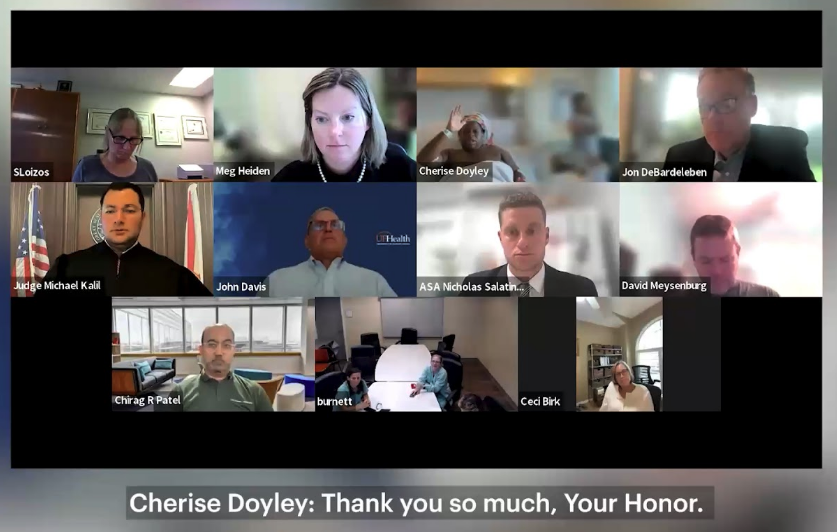
Doyley later said she did her best to maintain her poise and composure. And at the end, she even thanked the judge and highlighted how absurd the whole thing felt to her.
“I appreciate you spending two hours on a Sunday going through my medical history and fighting for my vagina and my baby,” she said.
Overnight, doctors said the baby’s heart rate dropped for several minutes. They rushed Doyley into surgery, and she, once again, gave birth via C-section.
In response to questions from ProPublica, Kalil wrote in an email that the judicial code of conduct prohibits judges from commenting on cases. “These ethical standards exist to protect the integrity of the judicial process, ensure fairness to all parties, and preserve the Court’s neutrality,” he wrote.
For a year, Doyley and her family tried to forget about the case and move on. But she couldn’t shake the feeling of violation. She said if the hospital could force her to undergo surgery, it could happen to anyone.
“When we use the courts to basically strong-arm, bully someone into an unnecessary medical procedure against their will, it's akin to torture, in my eyes,” Doyley said.
Doyley’s case may be extreme, but she’s not alone. We know there are more women who have had C-sections against their will, and we want to better understand their experiences. Please reach out to amy.yurkanin@propublica.org. |
|
|
Was this email forwarded to you from a friend? Subscribe. |
|
|
|