Hello and welcome to Eye on AI. In this edition…Anthropic sues the Pentagon over supply chain risk designation…Yann LeCun raises $1 billion for his new startup…Some reassuring and not so reassuring news about AI agents’ propensity for illicit scheming…and why it may be too soon to turn all coding over to AI agents.Two of the questions I get most frequently when I tell people that I cover AI and wrote
a book on the subject is: am I going to lose my job? And, what should my kids study?
These questions are difficult to answer. I often fall back on saying that I doubt there will be mass unemployment, which is not the same thing as saying your particular job is safe. And I say that it is important to teach kids to be lifelong learners, which isn’t a very satisfying response.
So far, few people have lost their jobs directly due to AI. Even some of the layoffs that companies have ascribed to AI, such as the recent
draconian layoffs at the payments firm
Block, seem to be, at least partly, “AI-washing”—attributing layoffs to AI, because it makes a company look tech savvy, when the real reason is due to business headwinds or unrelated bad decisions. Block, for example, tripled its workforce during the pandemic, and many suspect it is simply trying to slim down a bloated workforce. (Block’s CFO Amrita Ahuja
told my Fortune colleague Sheryl Estrada that this was not true and that AI was rapidly improving employee productivity.)
Every previous technology has, in the long-run, created more jobs than it has destroyed. But still, some insist that AI is different because it is being adopted so broadly and so quickly across different industries, and because it is hitting at the core of our competitive advantage over machines—our intelligence. As to the second question, about what kids should study, that’s tough too because while previous technologies have created more jobs than they’ve eliminated, exactly what those new jobs will be has always been difficult to predict in advance. It wasn’t obvious, for instance, when smartphones first appeared, that social media influencers would be a viable career.
A new
research paper from economists Maxim Massenkoff and Peter McCrory at the AI company Anthropic assesses how exposed various professions are to AI by looking at the percentage of tasks in that field that the technology could potentially automate. They also try to gauge the gap between this total possible exposure, and the extent to which AI is currently being used to automate those tasks, a measure they call “observed exposure.”
Potential AI exposure vs. ‘observed exposure’The paper got a lot of attention on social media because the researchers included an eye-catching radar plot-style chart that highlights just how jagged AI’s impacts are, especially when it comes to observed exposure. That chart is here:
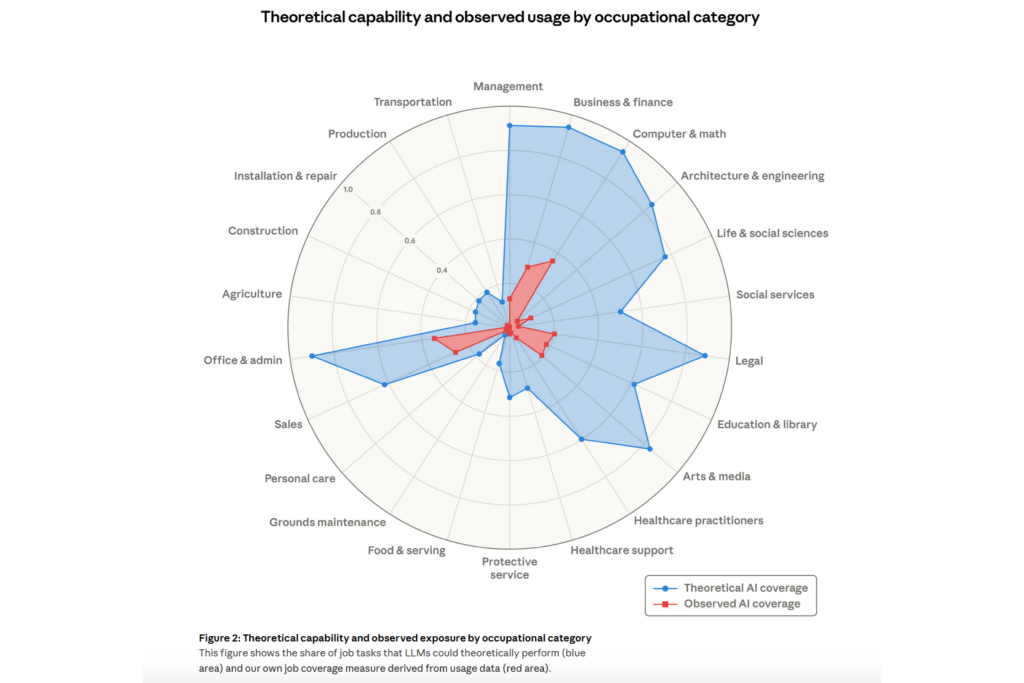 Anthropic/”Labor market impacts of AI: A new measure and early evidence”
For instance, AI is having relatively large impacts on fields involving office administration and computers and math, but relatively little on things like life sciences and social sciences or healthcare, even though those two areas have relatively high potential exposures. Then there are those areas with very low potential exposure, such as construction and agriculture, where, in fact, Anthropic finds the observed exposure is, indeed, almost nil. Comparing the observed exposure findings to projections of job growth from the U.S. Bureau of Labor Statistics, the Anthropic researchers found that there was a correlation between higher observed AI exposure and lower BLS job growth forecasts for those fields.
I somewhat question the agriculture finding given that predictive AI and robotics are potentially quite disruptive to agriculture and these technologies are already making inroads into farming. It’s just that this tech is different from the large language model-based systems that Anthropic is focused on. That said, maybe it isn’t bad advice for your kids to apprentice to a plumber, become an electrician, or try their hand at farming. The Anthropic paper notes that about 30% of American workers are not covered by the study because “their tasks appeared too infrequently in our data to meet the minimum threshold. This group includes, for example, Cooks, Motorcycle Mechanics, Lifeguards, Bartenders, Dishwashers, and Dressing Room Attendants.”
Even in fields where the total potential exposure is high, such as those involving computers and math, where theoretical exposure is 94%, the actual number of tasks being automated today is far lower, in this case 33%. Office administration had the highest observed exposure at about 40%, against a total theoretical exposure of 90%. (Although it is important to note that these are average figures across broad categories. When it comes to more specific job titles, the observed exposure is a lot higher: 75% for computer programmers, 70% for customer service representatives, and 67% for data entry jobs and for medical record specialists.)
How fast will the gap close?The big question now is: how fast will the gap between observed AI exposure and theoretical AI exposure close? I think the answer is that it will vary a lot between different professions. The idea that the same levels of automation that has hit software developers in the past six months is about to hit every other knowledge worker in the next 12 to 18 months seems off to me. I think it is going to take substantially longer. The Anthropic paper notes that so far, there’s very little evidence of job losses, even in the fields where the observed AI exposure is greatest, such as software development, although they do highlight
a study from Stanford University that we’ve discussed in Eye on AI before, that showed there were some signs of a hiring slowdown among younger software programmers and IT professionals. (Still, even that study could not entirely disentangle that slowdown from the possible unwinding of overhiring during the pandemic years.)
McCrory and Massenkoff highlight a few of the reasons why observed AI automation may be lagging behind its potential. In some cases AI models are not yet up to the tasks involved, they write. But in many others, they note, AI “may be slow to diffuse due to legal constraints, specific software requirements, human verification steps, or other hurdles.” As I have pointed out previously, in many fields, there simply aren’t good ways to automate and scale verification, and this is definitely holding back AI’s deployment.
The potential AI impact is also not uniform across the population: women are significantly overrepresented in AI exposed fields compared to men; exposed workers are more likely to be white or Asian, and they are also more likely to be highly educated and higher paid. Given that such groups are also often better able to organize politically, if we do start to see significant job losses among these workers, we may see a significant political backlash that could slow AI adoption.
The Anthropic economists also note that economists’ track records when it comes to predicting occupational change is poor. For instance, they call out previous research that found that about a quarter of U.S. jobs were susceptible to offshoring, but a decade later, most of those job categories had seen healthy employment growth. They also note that the U.S. government’s occupational growth forecasts have been right directionally, but have had little specific predictive value.
In the end, the most honest answer to both questions—will I lose my job, and what should my kids study?—may be: I don’t know, and no one else does either. But it might not be a bad idea to learn something about plumbing.
With that, here’s more AI news.
Jeremy Kahnjeremy.kahn@fortune.com@jeremyakahn
