| | In today’s edition: Aramco says Hormuz shutdown is oil industry’s biggest ever crisis, Gulf airlines͏ ͏ ͏ ͏ ͏ ͏ |
| |  | Gulf |  |
| |
|
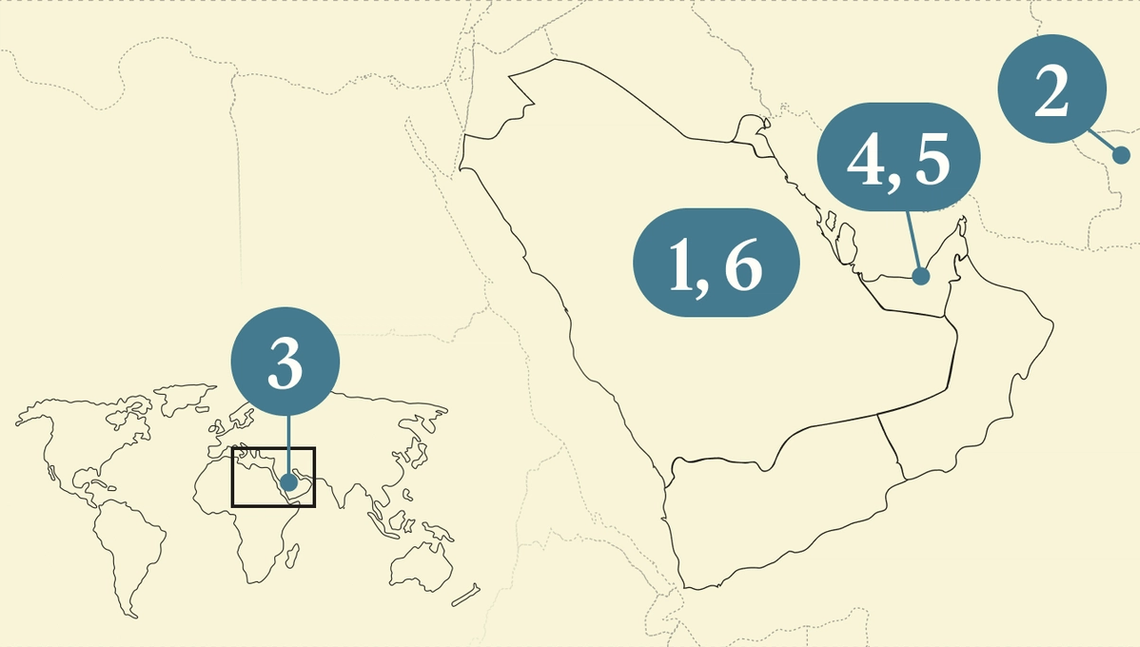 - ‘Catastrophic consequences’
- Expats killed in Iran strikes
- Gradual resumption of flights
- UAE tweaks bank data rules
- Judan dealmaking
- Markets don’t believe $150 oil
 In 2017, Qatar carried out a bovine airlift. Now it’s the horses’ turn. |
|
 The war isn’t over, despite US President Donald Trump telling CBS News it’s “very complete, pretty much.” His remarks helped reverse a surge in oil prices that sent crude to nearly $120 a barrel on Monday, but didn’t stop the violence. Trump also warned that Tehran would be hit “much, much harder” if it tries to block oil supplies, adding to the mixed messaging that has become a feature of this conflict. Israeli Prime Minister Benjamin Netanyahu said his country isn’t “done yet” and still has aspirations for regime change, or for the Iranian people to “cast off the yoke of tyranny.” In Tehran, the message is even starker. A senior Iranian foreign policy adviser told CNN that diplomacy is effectively off the table. Iran’s strategy, he suggested, is to continue applying economic pressure — primarily by striking Gulf countries — until they force Washington and Israel to halt the war. For Gulf states, the events of the past 10 days have validated their long-standing push for de-escalation and diplomacy. They still hold that position and would prefer to end the conflict without further damage, but the barrage of missiles and drones has undoubtedly broken whatever little trust they had in the Iranian regime. According to The National, an Emirati official said any future deal with Tehran can no longer focus only on nuclear limits. “Missiles are now center stage, because missiles now are not seen as self-defense,” the official said. |
|
 Saudi Aramco’s CEO warned of “catastrophic consequences” for the world economy if oil exports through the Strait of Hormuz continue to be blocked. The state-controlled oil company is using storage facilities around the world to meet customer demand as it deals with “by far the biggest crisis the region’s oil and gas industry has faced,” Amin Nasser said on an earnings call. It is also ramping up oil flows through its East-West pipeline to get its crude out to customers through the Red Sea, bypassing the Strait of Hormuz. The world’s biggest oil exporter declined to comment on current production levels but suggested it was reducing output due to the lack of export routes. Production could be ramped back up in days, Nasser said. Aramco is also restarting its biggest refinery after a drone strike on the Ras Tanura plant led to a shutdown, but it continues to face attacks on its facilities. The company announced an increase to its base dividend, despite reporting a 12% drop in profit to $104.7 billion. That will bring the minimum payout to shareholders to $87.6 billion this year, most of which will go to the Saudi government. — Matthew Martin |
|
Foreign workers bear the brunt |
 Foreign workers are disproportionately paying the ultimate price in Iran’s strikes on the Gulf. At least nine civilians have been killed so far across the region — one each in Bahrain, Kuwait, and off the coast of Oman; two in Saudi Arabia; and four in the UAE — and only one was a Gulf citizen. Among the dead was an 11-year-old Iranian girl in Kuwait, killed by falling shrapnel from her own country. Soldiers have also died in Kuwait and the UAE. The pattern reflects the Gulf’s demographics. Foreigners make up around half the region’s population, and account for the vast majority of residents in Qatar and the UAE. Low-wage workers who live in crowded housing and hold jobs that can’t be done remotely — such as delivery, retail, and sanitation — are the most exposed, compared to richer expats who can shelter or leave. — Mohammed Sergie |
|
Airlines grapple with the cost of war |
 Services are gradually picking up at the Gulf’s main airports, though a fresh barrage of Iranian drones could quickly force them to close again. The uncertainty of war is prompting some airlines to put expansion plans on hold while they assess the financial impact of the conflict, Bloomberg reported. There are wider ramifications too. The aviation industry has been one of the Gulf countries’ most visible branding tools but, like the oil now unable to reach export markets, planes have been stranded assets during the war. Even when peace is restored, super-connectors like Emirates and Qatar Airways will likely find it harder to persuade passengers to transit via their hubs. Of those that do, fewer are likely to consider stopovers, which will hit their countries’ hospitality sectors. In the meantime, fuel and insurance costs have spiked, presenting a further challenge to operations. One small silver lining amid the disruption: Planes stuck at foreign airports have at least avoided the higher insurance premiums they would have incurred if back at base in a warzone. — Dominic Dudley |
|
UAE banks move data abroad |
 The main branch of the UAE Central Bank. Ben Job/Reuters. The main branch of the UAE Central Bank. Ben Job/Reuters.The Central Bank of the UAE has allowed banks to use foreign data centers, after Iranian attacks on the country’s digital infrastructure caused widespread disruption to operations. The UAE regulator sent out short-term no-objection certificates to allow banks to move some data offshore, The Banker reported. The UAE and other Gulf countries usually have strict rules about keeping customer data onshore — a common source of complaints from international banks, which have to replicate data warehousing across the region. There have been no similar moves to loosen data sovereignty rules elsewhere in the Gulf. UAE banks suffered service outages after an Amazon data center in the country was hit by drones; a data center was also struck in Bahrain. Those strikes have raised concerns about the wider risk to Gulf efforts to become a global artificial intelligence hub. |
|
Judan ups Abu Dhabi AI stakes |
 Dado Ruvic/Illustration/Reuters Dado Ruvic/Illustration/ReutersAbu Dhabi Deputy Ruler Sheikh Tahnoon bin Zayed is pushing ahead with deals in the US to meet his emirate’s massive appetite for AI. The new $237 billion financial services holding company Judan, which he helms, is buying a majority stake in Alpha Wave Global, a Miami-based alternative asset manager and investor in Anthropic, OpenAI, and SpaceX. Judan will take a 50.1% stake in Alpha Wave and help launch its AI-native life insurance business, the firms said. The financial terms of the deal were not disclosed. Judan subsidiary Chimera already partners with Alpha Wave on a tech fund. Sheikh Tahnoon’s sprawling conglomerate, International Holding Co., created Judan last month, consolidating its banking, insurance, investment, and financial technology interests under one firm. The Alpha Wave acquisition suggests the Gulf’s biggest dealmakers aren’t flinching at opportunities in the US or being slowed by the war in Iran. Last week, Qatar Investment Authority also made a move in the US, buying into clean energy supplier AES. — Kelsey Warner |
|
View: What’s preventing even higher oil prices |
  Ann Wang/Reuters Ann Wang/ReutersBrent crude broke through $100 a barrel on Monday for the first time in years, but so far traders are pricing in a crisis, not a catastrophe, independent energy commentator Wael Mahdi wrote in a column for Semafor. Qatar’s energy minister has said crude could hit $150 within a few weeks, but this week the market stopped below $120 before dipping back. That pause is the real story, Mahdi said. The distance between $100 and $150 a barrel is a probability assessment, and right now the market is making a deliberate bet on what prevents the worst from happening. High global inventories provide a cushion that can absorb weeks of disruption before supply chains fracture, but any significant strikes on Saudi oil infrastructure could quickly change assumptions. |
|
 Semafor Washington, DC is expanding to twice a day, with an afternoon edition of the must-read email briefing. This new edition harnesses the expertise and intelligence of our extremely well-sourced Semafor Washington, DC team, now strengthened by new congressional reporter Nicholas Wu. Delivered to inboxes every weekday around 4:30 pm ET, the afternoon edition delivers a sharp snapshot of the day’s developments driving Washington and a clear-eyed preview of the narrative shaping the next 12 hours. Sign up for our twice-daily briefing here. |
|
 - Bloomberg: Goldman Sachs, Morgan Stanley, and Citigroup are among the Wall Street banks that have given UAE employees the option to relocate temporarily and work remotely as firms rush to solidify contingency plans.
- CNN: A top foreign policy adviser to the office of Iran’s supreme leader warned that the government is prepared for a long war with the US. In an interview, Kamal Kharazi said Tehran is willing to continue attacking Gulf countries as a way to apply pressure on President Donald Trump.
- New Lines Magazine: An exploration of what sort of new regional order may emerge after the war ends, and the uncomfortable realities facing Gulf states.
- Sky News: In his first interview since Iran’s attacks on the Gulf, Qatar’s Prime Minister Sheikh Mohammed bin Abdulrahman Al Thani called Tehran’s actions a “dangerous miscalculation,” and warned the war could escalate.
- The Wall Street Journal: Before being torpedoed by a US submarine off the coast of Sri Lanka, an Iranian navy crew was on a trip to India, where they took in the Taj Mahal, sampled biryani, and participated in a military gathering alongside the US and Russia.
|
|
|


