| | In today’s edition: The UAE weighs up its options against Iran, locals battle flight disruptions to ͏ ͏ ͏ ͏ ͏ ͏ |
| |  | Gulf |  |
| |
|
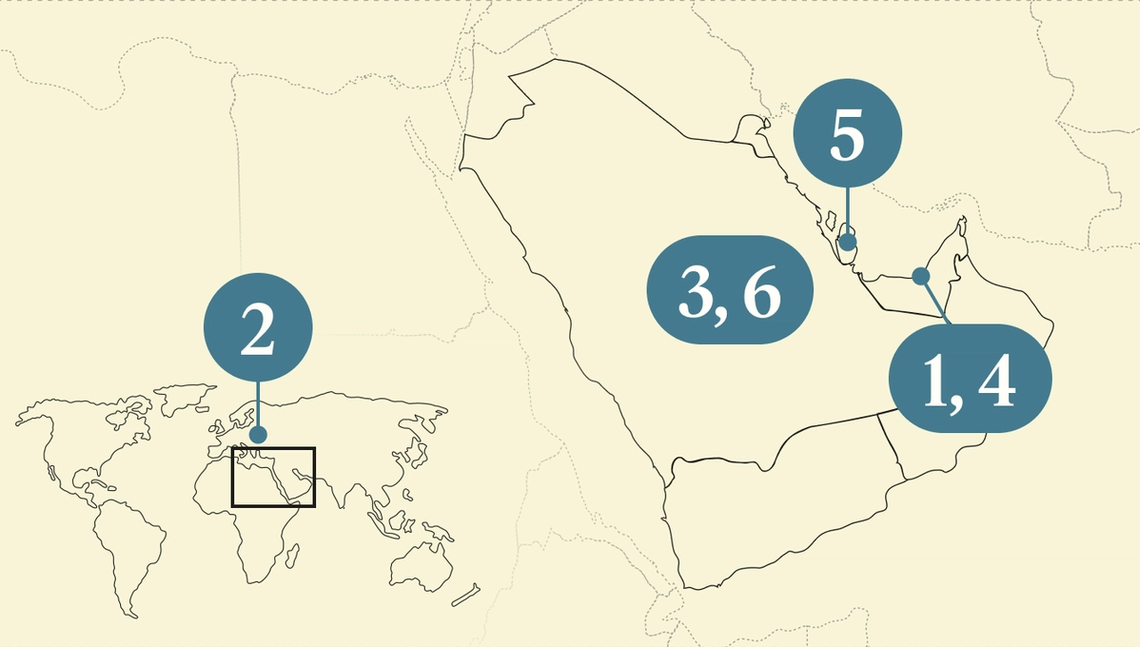 - UAE considers Iran measures
- US, Gulf look to Kyiv for help
- Canceled flights in Riyadh
- Locals return to the Gulf
- Stock market risk and resilience
- ‘Most precious commodity’
 Someone bought a $115 million Dubai penthouse this week. |
|
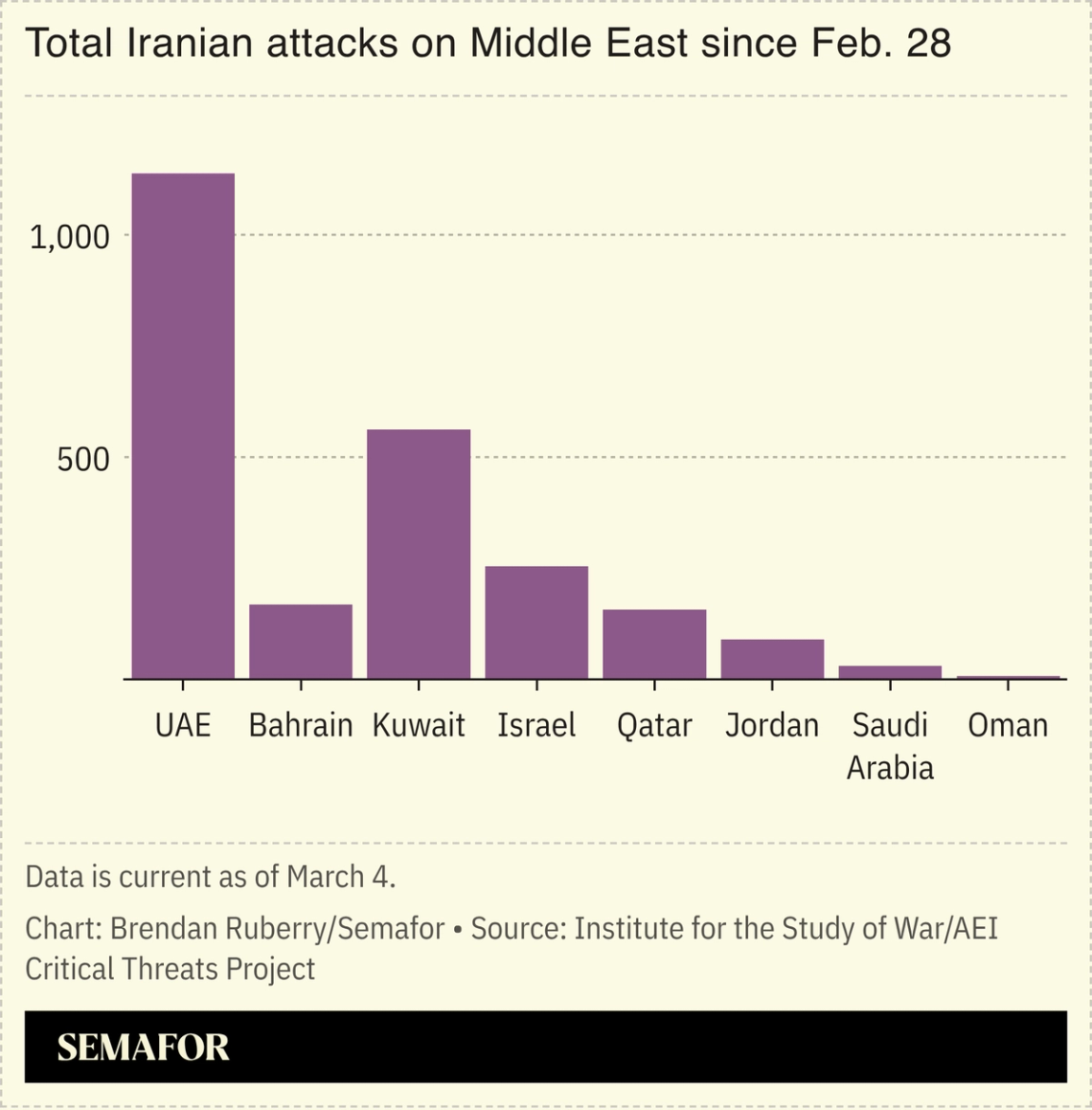
 The threat posed by Iran to the Gulf has existed for decades. But for everyone living here actual strikes felt improbable, something the Islamic Republic would never do because … well, for so many reasons that don’t matter now. Dubai built the world’s tallest tower, Abu Dhabi styled itself the “Capital of Capital,” Doha hosted the men’s soccer World Cup, and Riyadh shed its austere Islamic posture to transform its economy and society. All the while, Tehran focused on centrifuges, missiles, and proxies, at the expense of its economy and people. A week ago, our top headline was “Region preps for US strikes on Iran.” It was clear this was coming. What few expected was the scale — or direction — of Tehran’s response: more than 1,000 ballistic missiles, cruise missiles, and drones launched toward the Gulf. Most targeted the UAE, which is Iran’s second-largest trading partner. Even Oman, long Tehran’s back channel to the West, was struck. While most of the Gulf’s ire is directed at Iran, there’s a growing frustration — including from billionaires and princes — that the US and Israeli Prime Minister Benjamin Netanyahu, have dragged the region into a war it neither chose nor wanted. Many question why Washington doesn’t consider the Gulf’s security and economic interests despite trillions flowing from the region into the American economy. While the grumblings ring true, the alliance and investments did buy the Gulf an umbrella. A few deaths and dozens injured after a week of such intense firepower is a testament to the region’s air defenses, and that protection wouldn’t be possible without the US. The alternative? Look to the devastation of defenseless cities in Gaza, Lebanon, or much of Syria. The week has shattered assumptions about the Gulf. But one constant likely remains: The region will continue to stand with Washington against a weakened, but still deadly, Iran. It doesn’t have much choice. |
|
UAE weighs financial squeeze on Iran |
 Morteza Nikoubazl/NurPhoto via Reuters Morteza Nikoubazl/NurPhoto via ReutersThe UAE and other Gulf states have urged de-escalation with Iran, concerned that a broken country of that size could be an even more dangerous neighbor if the conflict ends without a durable settlement. They have so far avoided military retaliation despite being targeted with missiles and drones, but are reportedly considering financial measures. Officials in Abu Dhabi are mulling freezing billions of dollars in Iranian assets held in the UAE, as well as targeting accounts linked to the Islamic Revolutionary Guard Corps and companies tied to Tehran’s sanctions-evasion networks, according to The Wall Street Journal. Other tools could hit currency exchanges that move illicit funds, and Iran’s “shadow fleet” of oil tankers. The UAE government hasn’t commented on the WSJ’s story. Dubai in particular has long faced criticism for allowing trade with Iran’s regime. Last year, the financial center was forced to suspend companies linked to Iranian oil trader Hossein Shamkhani after a Bloomberg story exposed the network. If the name sounds familiar, it’s because he is the son of Ali Shamkhani, a close adviser to Iran’s late supreme leader who was killed alongside his boss in the initial US-Israeli strikes on Saturday. — Mohammed Sergie |
|
US, Gulf seek Ukraine’s help |
 The US and the Gulf are turning to Ukraine to help fend off Iranian attacks, even as the Middle East conflict depletes American munitions that Kyiv urgently needs for its own defense. Iran is increasingly using Shahed drones in its Gulf strikes, and the Pentagon is reportedly looking to buy Ukraine’s cheap drone interceptors, which Kyiv mass produces to destroy Russian versions of Shaheds in the Ukraine war. Gulf nations are relying on expensive US Patriot missile systems to intercept Iranian strikes, but those stocks are dwindling, prompting Kyiv to suggest a weapons exchange. The Gulf would also benefit from Ukraine’s guidance on defending energy infrastructure, a subject in which, as Semafor’s energy editor wrote, “No country in the world has as much experience as Ukraine.” |
|
Riyadh airport stabilizes ripples |
 Flight status in Riyadh on March 6. Flightradar24. Flight status in Riyadh on March 6. Flightradar24.Saudi Arabia’s airports have felt the effects of regional airspace disruptions, even as the kingdom has been one of the few viable routes in and out of the Gulf. At Riyadh’s King Khalid International Airport, employees told Semafor that most flights were cancelled last night as airspace restrictions and threats took hold. Operations have since largely returned to normal, with staff working through a backlog of delayed flights. Domestic routes to Dammam in the east and Najran near the Yemen border remain affected, but passengers are still using Riyadh as a route out of the region. The disruption has been modest compared with elsewhere in the Gulf. Airports in Kuwait and Qatar remain shut, while operations in Abu Dhabi and Dubai were halted for several days before a limited service resumed on Thursday. Against that backdrop, Oman and Saudi Arabia have become the fallback option for anyone wanting to travel. An unwelcome discovery for many is that their travel insurance won’t cover new flights or longer hotel stays, as most policies exclude war-related claims. — Manal Albarakati |
|
Some Gulf residents race to return |
 Raghed Waked/Reuters Raghed Waked/ReutersAs tens of thousands heed their governments’ warnings and flee the Gulf, some local residents and citizens who were abroad on holiday or business are heading in the opposite direction. One UAE resident who works for commodities trading giant Glencore told Semafor he chose to fly from London to Oman and then drive to Dubai, in order to be close to his family rather than be stuck abroad. In Saudi Arabia, where the airspace is still open, repatriation is simpler. But locals are still scrambling to catch flights while they can. The instinct to head back to a war zone may seem puzzling, but the reality on the ground generally isn’t as dire as the headlines suggest. Air defenses have held, and states like Saudi Arabia and the UAE are ranked among the top five globally in the Edelman government trust index. Patriotism is also a factor, and expressions of fear can be seen as undermining a nation under attack. — Manal Albarakati |
|
UAE stock markets fall, but others rebound |
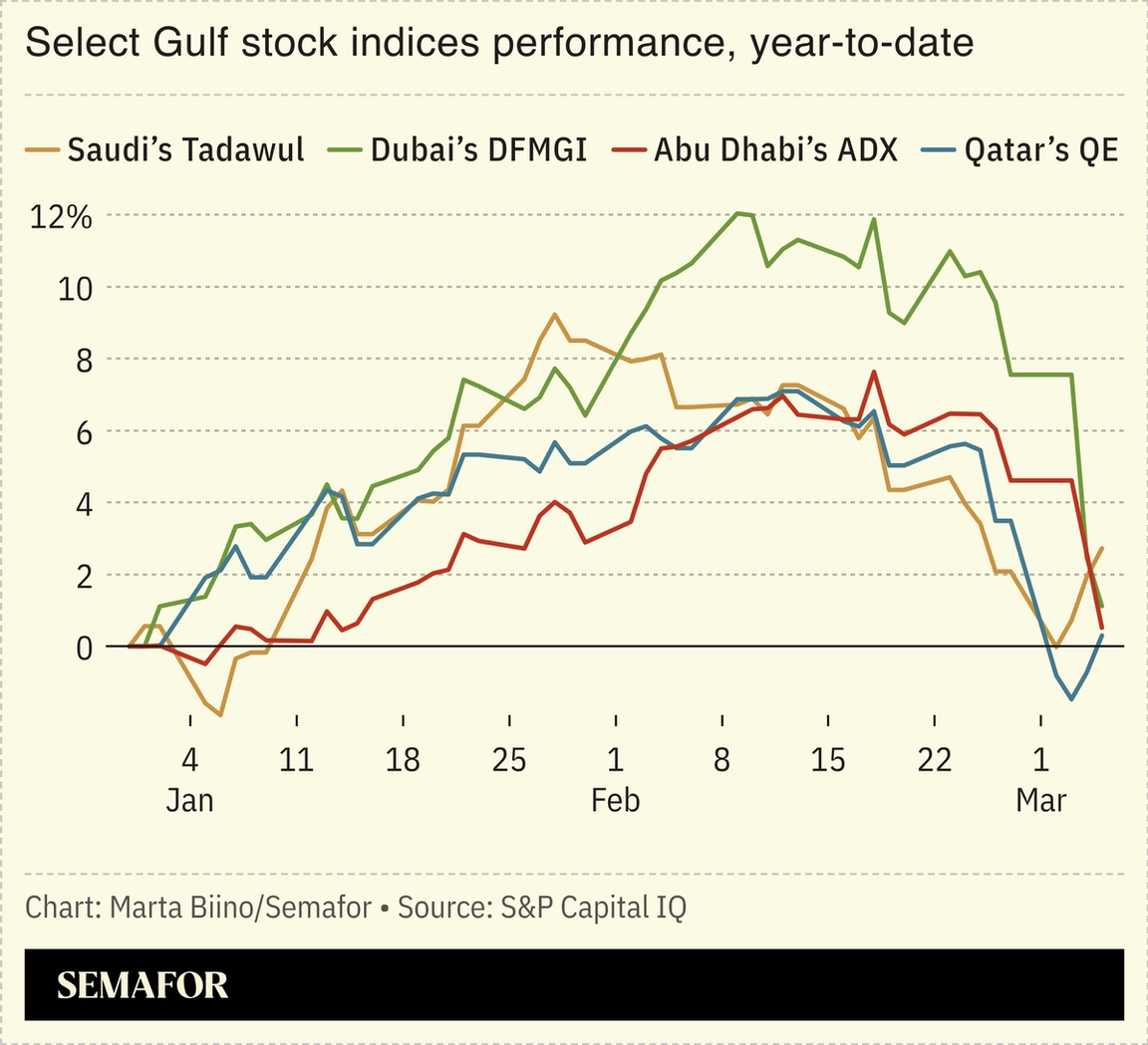 Gulf stock markets swung down this week as traders tried to price in the impact of a war which has quickly escalated, but there were marked differences in performance. Abu Dhabi, Bahrain, and Dubai posted the worst falls, but others proved more resilient: In Kuwait, Oman, and Qatar, markets initially fell before recovering some ground, while Riyadh’s Tadawul All-Share Index ended the week slightly up. That variety reflects a range of factors. The UAE has been hit harder by Iranian drones and missiles than its neighbours, and its economy looks vulnerable on several fronts: Its oil reserves can’t be exported, and international investors and residents may be rethinking their commitment to the country, at least in the short term. Saudi Arabia has a larger domestic market, kept its airspace largely open, and has Red Sea ports to export crude from. Individual company performances also play a role. On the Tadawul, shares in Al Moammar Information Systems shot up after it announced an AI data center contract. On the ADX, investment firm Aram Group put dividends on hold to ensure it could support its operations. In Qatar, dairy firm Baladna postponed a planned capital increase, citing market volatility. — Dominic Dudley |
|
 The percentage of Riyadh’s drinking water produced by a desalination plant in Jubail, according to a 2008 US diplomatic cable resurfaced by Bloomberg’s Javier Blas. Saudi Arabia has since reduced this single point of failure, Blas noted, but the Gulf’s reliance on desalination for something so essential to human life leaves the region vulnerable if Iran targets these facilities. Millions of people would be forced to evacuate. So far, there have been few direct hits on the more than 400 desalination plants across the region, but the danger is clear: The facilities are large, located near the coast, and powered by oil and gas, making them highly flammable and difficult to defend. |
|
 - AGBI: The amount of oil sitting in tankers stuck in the Gulf has hit record levels, while onshore inventories are also rising quickly — storage capacity could run out fast unless the Strait of Hormuz is reopened. The global food chain is also being affected: The waterway handles a third of the world’s fertilizer shipments.
- Bloomberg: Abu Dhabi National Oil Company Chief Executive Sultan Al Jaber has warned Japan’s prime minister during a visit to Tokyo that it will not be able to deliver oil and gas while the Strait of Hormuz is shut.
- FT: The fiscal pressures caused by the war could prompt some Gulf states to rethink their overseas investment strategies.
- FT: Qatar’s energy minister said oil and gas production in the Gulf may halt within weeks, and it could take months for normal LNG deliveries to resume even after the fighting stops.
- The National offers a run-down of the Kurdish groups in Iran and Iraq that Washington is reportedly urging on to confront the Tehran regime.
- WSJ: Iran’s underground missile bunkers are proving a point of weakness rather than strength, with the US and Israel hitting launchers when they emerge and then dropping heavy bombs on the entrances to entomb what remains inside.
- Zawya: The UAE property sector is facing a stern test, as Iranian drones shatter the Gulf’s reputation for stability, with the share prices of real estate developers taking a hit.
|
|
 Aman Dubai, slated for handover by the end of 2028. Courtesy of Aman. Aman Dubai, slated for handover by the end of 2028. Courtesy of Aman.Could Dubai’s luxury market defy war? One data point says yes. An off-plan apartment at |
|
|


