|
 |
For Solo Chiefs—creatives, solopreneurs, and lone leaders orchestrating AI, humans, and chaos with no one to save their ass.



 |
If your value stream starts with a customer order, you’ve already lost.
Most value stream examples begin with a request and end with delivery. Extend yours from first signal to proven impact, or watch competitors eat your lunch.
Last Monday, March 2, at 5 pm, I had a conversation with Al S. Brown about the challenges of solopreneurs, lone managers, and other solo chiefs. One of the action items my AI note-taker sent me an hour after the meeting was this one:
⏹️ “Describe your criteria for choosing which AI to use (e.g., integration, skills, personality vs. ambient access) and publish guidance so readers can decide which AI fits their context.”
The algorithm picked up a signal in our conversation.
On Wednesday, around 3 pm, I published the post “Which AI Should I Use?“ with a nice tongue-in-cheek flowchart depicting a decision tree and brief descriptions of fifteen leading AI models. A few hours later, at 6:22 pm, Alex responded:
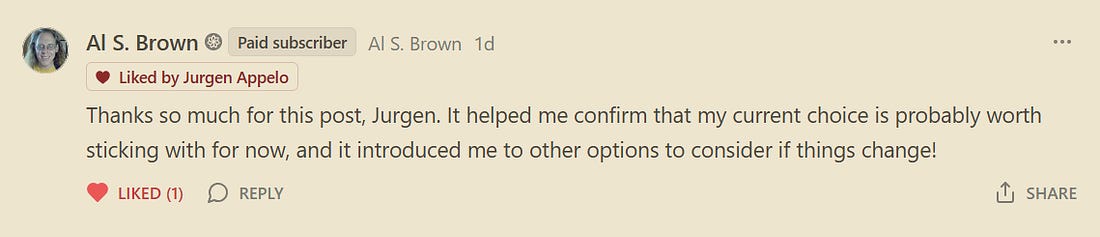 |
Exactly two days after our meeting, the reader validated the value of my writing.
From signal to impact: 48 hours.
Common Value Stream Examples
A value stream is a way of describing the work we do to delight our customers. Toyota embraced the concept of value streams decades ago with their Toyota Production System (TPS). Since then, value stream mapping has become a foundational practice in Lean literature, and the Agile community happily adopted the term as well.
I’ve come across several definitions of value streams, and they all boil down to the same thing:
A value stream is the set of actions needed to fulfill a value proposition from a request (order) to realization (delivery).
Here are some often-cited value stream examples:
Order-to-Cash (Customer order fulfillment) — From a customer placing an order, through fulfillment and delivery, to receiving payment. This one gets labeled “Order to Cash” or “Order Fulfillment” in most textbooks.
Project Request to Completion — From a stakeholder submitting a project or change request, through planning and execution, to delivery and closure.
Procure to Pay (Procurement) — From recognizing a need to buy something, through supplier selection and ordering, to receiving goods/services and paying the invoice.
These are perfectly fine value stream examples. But the problem is that they’re too short. We should extend the concept of the value stream in both directions.
Expanding the Value Stream Left: Start with Signal, Not Request
My first issue with the traditional description is that the value stream begins with a request or order from a customer. This is way too late! If you sit around waiting for customers to place an order with your company, you’ll soon be out of business.
In the age of AI, it’s becoming easier than ever to detect trends, intent, and desire long before a customer is even ready to place an order. In fact, while you sit there with your arms folded, waiting for the next request to come in, your competitors are using AI to steer intent and to create desire (toward their product, away from yours) long before the customer even realizes they want something.
When the customer finally understands the value of what the market offers, placing an order should be nothing more than a logical next step in the value stream they’re already in. Without them even knowing it. And you want them flowing through your value stream, not your competitor’s.
If you just wait for customer orders, you’ll soon be out of business.
This means the standard value stream definition is outdated. We should extend the concept to the left to include the customer acquisition funnel all the way to the first signals in the market. The earlier you detect potential value for a customer, the better.