|
Katie Castellani, Michael P. Norton
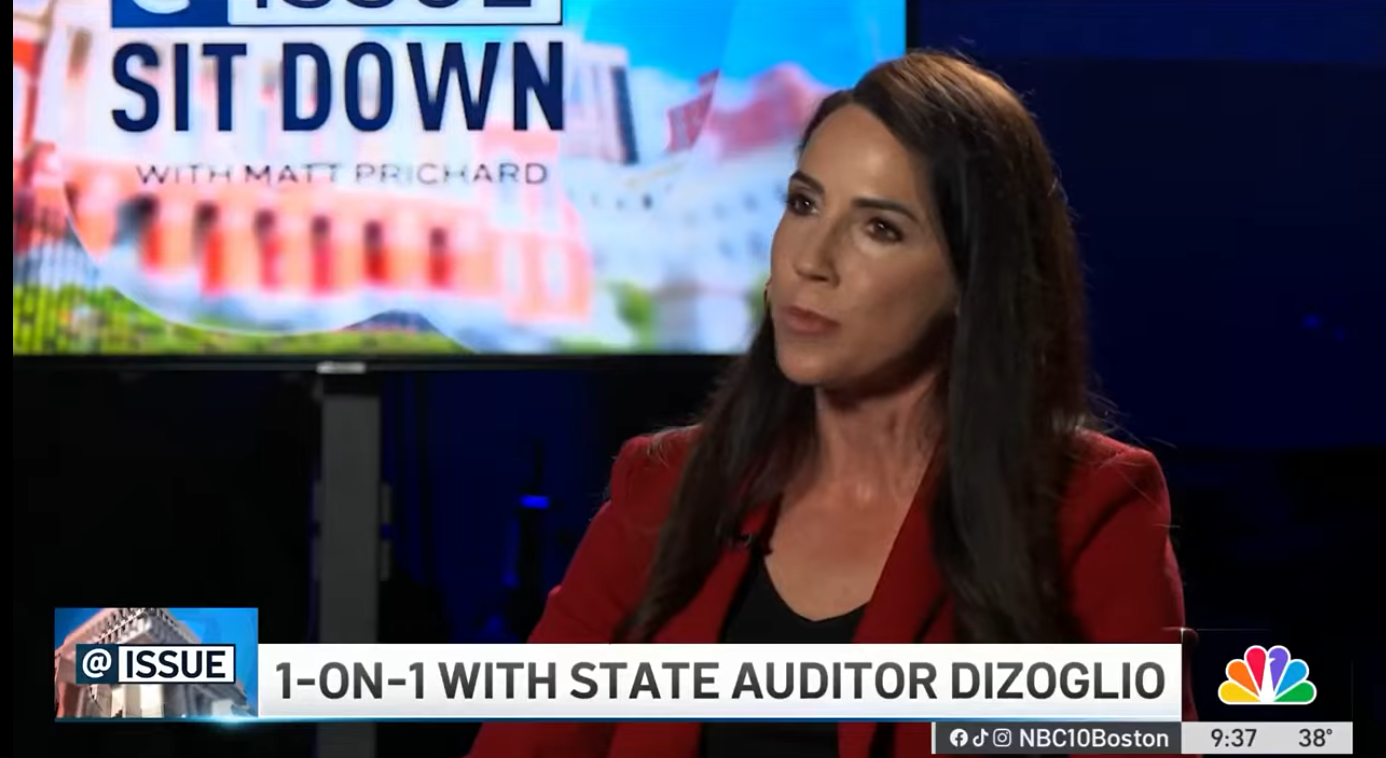
State House News Service Sen. Cindy Friedman banged the gavel multiple times, but it didn’t stop simmering tensions between lawmakers and Auditor Diana DiZoglio from flaring Tuesday. Lawmakers and DiZoglio have been at odds over whether the Legislature should open its books under a voter-approved audit law. Now, DiZoglio is trying to access the documents through a ballot initiative that would subject most records held by the Legislature or governor's office to the state's public records law (H 5004). Members of the Special Joint Committee on Initiative Petitions grilled DiZoglio about the proposal, quizzing her about what documents would be subject to the law and who could access them. The conversation turned contentious as DiZoglio and committee members exchanged personal attacks. “You are here to answer the question, and I would just like to say that we on this committee - please don't accuse us through your your words or your tone, that we are doing anything but trying to understand what you have written,” Friedman, the Senate co-chair of the committee, said after the second time she banged the gavel to stop a back and forth between DiZoglio and lawmakers. DiZoglio said the measure seeks to make basic administrative and business records available to the public to help ensure trust in lawmakers. “Contrary to what some of you might think, I want people to trust this legislature,” she said. “It is really beyond past time that this get done. This is an easy one for the Legislature.” She said the measure is being presented as an “alternative to this legislature's inaction for decades.” DiZoglio also noted that the Senate’s legal team sent a letter to Attorney General Andrea Campbell on behalf of the branch questioning the constitutionality of the proposed ballot question. “Sorry, not sorry about my tone,” DiZoglio said, addressing Senate members of the committee. “You've already been on the record opposing this. So, why waste everybody's time and money and resources coming today to talk about a decision you've already made.” DiZoglio referenced a Aug. 15 letter Senate Counsel James DiTullio wrote to Campbell and Assistant Attorney General Erin Fowler asking that she decline to certify the petition. The crux of his argument is that the measure should have been submitted as a constitutional amendment, and that the ballot question as written would not have the power to alter constitutional provisions, even if it alters the law. He said that it "seeks to infringe" on the Legislature's ability to control its own rules of procedure, and its own record, "without interference from other branches of government." The attorney argued that the Constitution provides a wide latitude for the House and Senate to manage their own proceedings, including appointing its own officers and determining its own rules. "Adoption of these rules is a clear and unambiguous demonstration that procedures related to recordkeeping (and the sharing of records with the public) fall within each house of the General Court's exclusive and absolute constitutional authority to determine its own rules as proceedings," he wrote. DiTullio argued that an "intrusion" into their constitutional power to keep their own records is "almost without precedent nationally." Massachusetts is one of only a small handful of states that exempts the governor's office and Legislature from the public records law. However, DiTullio argued that "beyond the state with explicit exemptions, many state legislatures have become effectively exempt from their state public records laws through statutes, court decisions, or legislative rules," citing rules in New York and Tennessee. Friedman and Sen. Ryan Fattman said they were not aware of the letter. A representative for the Senate said the letter was submitted at the invitation of Campbell, who had asked those with a legal interest in the ballot question to weigh in. During a Dec. 23, 2025 appearance on Boston Public Radio Gov. Maura Healey expressed support for the measure, saying that she would vote in favor of it “provided that there are certain exemptions that we’ve talked about in the past." A spokesperson for House Speaker Ron Mariano acknowledged the News Service’s request to weigh in on the proposal, but did not offer an answer. A spokesperson for Senate President Karen Spilka, who was not present at the hearing, said there was a “robust conversation” on the constitutionality of the measure and that she “looks forward to debriefing with members of the committee.” “She has been clear that transparency continues to be a priority for the Senate, which is why she led the Senate to double down on transparency efforts this session in our rules,” Spilka’s spokesperson Gray Milkowski said in a statement. Massachusetts resident and native Jerold Duquette, a Central Connecticut State University political scientist and co-founder of the Massachusetts Law and Politics Project, made a similar argument to DiTullio’s. Duquette testified against the public records measure and said the "constitutional defects" of the 2024 law authorizing the auditor to audit the Legislature are mirrored in the proposal. "Checks and balances expressly distributed among all three branches of the state government in the state constitution," Duquette testified. "But oversight -- an implied power -- is granted exclusively, let me say that again, exclusively to the General Court. There is no equivalent power granted to the executive branch, which is to say, contrary to the assumptions as well as explicit claims of the proponents of the public records initiative, there is absolutely in the constitution no such thing as executive oversight of the legislature. No such thing." "A constitutional amendment is the only legally appropriate mechanism to seek such a change," Duquette said later in his testimony about the public records proposal. He added, "A constitutional amendment could conceivably accomplish the goals that they are seeking to accomplish. That's correct." Under questioning from Fattman, Duquette declined to say if he would support the proposal if it were presented as a constitutional amendment, saying "whether I would support it or not is irrelevant." After his testimony, committee co-chair Sen. Cindy Friedman told Duquette: "I think your testimony was very clear. I'm sorry that the media walked out during it." Duquette also said that Article 48 of the state constitution, which governs the ballot initiative process, "is in fact now in need of very serious and very urgent reform." Earlier in the hearing, Fattman invoked Article 48 while thanking DiZoglio for testifying on the ballot measure. “Article 48 speaks to the fact that when the government ignores the people, when someone ignores the people, they have the right to free petition, and that is why we're here today,” Fattman said. After the hearing, Friedman acknowledged the ballot initiative poses constitutional issues. "I mean, I haven't looked at it completely and I'm not a constitutional lawyer, but I think it raises reasonable and real constitutional issues," Friedman told reporters. "Can the Secretary of State enforce a law on the Legislature, right? Can they do that? They've never been able to do it." Friedman contended that lawmakers would not be able to do their work if everything becomes public. She said opening up records to public scrutiny will prevent lawmakers from having "real conversations" where they can go back and forth. For years, many conversations about legislative affairs have occurred in the open, but also privately, including during regular closed caucuses among members of both branches. "We are not hiding anything," Friedman said. "We are not trying to go and do nefarious, nasty, bad things. We are not spending huge amounts of money on yachts, right? None of that." When asked about her thoughts on the constitutionality of the ballot proposal, DiZoglio said, “I believe that the Constitution is there to protect the people, not the politicians, and I do think that legislative privilege exists. I just think that it can be abused sometimes.” She added that any legal concerns about the proposed measure would be settled in court. “This is a legislative body who understands separation of powers and if we have a legal disagreement about the interpretation of the law, that's for the courts to decide,” DiZoglio said. A high court judge on Tuesday denied DiZoglio's motion that a special assistant attorney general be appointed to represent her in a legal effort to enforce the 2024 legislative audit law, and for an extension of time to respond to Campbell's emergency motion to strike her complaint. "The State Auditor cites no statute, constitutional provision, or other authority that would permit a single justice of the Supreme Judicial Court to appoint a SAAG," the order stated. "Moreover, the State Auditor has not shown good cause for extension. Her opposition to the motion to strike remains due at 4:00 p.m. on March 5, 2026."
|