What matters in U.S. and global markets today

Get full access to Reuters.com for just $1/week. Subscribe now.


Morning Bid U.S.

Morning Bid U.S.

A Reuters Open Interest newsletter

What matters in U.S. and global markets today


By Mike Dolan, Editor-at-Large for Finance and Markets

Asian markets snapped back on Thursday, with South Korea’s KOSPI rising by almost 10%, clawing back a chunk of its drubbing in recent days, and Japan’s Nikkei adding nearly 2%.

The apparent respite amid the ongoing Middle East conflict wasn’t confined to Asia, with U.S. and European stocks also pushing higher on Wednesday as investors took comfort from even the faintest hints that geopolitical tensions might ease.

I’ll get into that and more below.

But first, check out my latest column on why Europe may be able to absorb the Middle East energy shock - for now.

And listen to the latest episode of the Morning Bid daily podcast. Subscribe to hear Reuters journalists discuss the biggest news in markets and finance seven days a week.


Data refreshes every time you open this email. For more U.S. market news, click here. Please send any feedback to morningbid@thomsonreuters.com.


Today's Market Minute

  • Iran’s drone attacks could disrupt the Strait of Hormuz for months, but how long it can sustain its missile barrage is less clear, according to intelligence sources and military analysts.
  • China on Thursday set out a five-year roadmap to turbocharge scientific breakthroughs and embed AI across its industrial economic machine, framing technological dominance as a core national security goal in its sharpening rivalry with the U.S.
  • The U.S.-Israel war with Iran could disrupt supplies of key semiconductor manufacturing materials, a South ‌Korean ruling party lawmaker said on Thursday.
  • The explosion in jet fuel prices in Asia is an indicator that the economic pain of war in the Middle East is about to become reality for energy consumers, writes ROI Asia Commodities and Energy Columnist Clyde Russell.
  • Check out the key charts and data points to keep track of as the Middle East conflagration hits energy markets in this overview by ROI Global Energy Transition Columnist Gavin Maguire.
 

Global markets take a breath

Global markets appear to be catching their breath. The Nasdaq jumped 1.29% on Wednesday in a tech-led rally, while the S&P 500 rose 0.78%, helped along by some upbeat macro prints.

A mix of factors seem to be fuelling this market breather. Traders seemed to take heart in the New York Times’ report yesterday that Iranian intelligence had indirectly reached out to the CIA after Saturday’s attacks to try to reach a resolution. Washington’s plan to help reopen the embattled Strait of Hormuz via navy escorts and insurance coverage may also have raised some optimism.

There was also some positive news on the labour market front ahead of Friday’s payrolls release. U.S. private payrolls printed a higher-than-expected rise for February. ISM's non-manufacturing PMI, meantime, hit a more than three-year high.

But uncertainty still reigns as the Middle East conflagration enters its sixth day and a swift resolution to a clogged-up Strait of Hormuz looks, for now, like a distant prospect.

Indeed, analysts have warned that Iran can keep up drone harassment in the narrow waterway for months, and it's far from clear that tankers would brave the strait even with U.S. naval and insurance support in place.

And other signs point towards this being more than a days-long conflict, as the U.S. Senate failed to block the administration’s campaign against Tehran, giving President Trump largely unbounded power to direct the war.

Oil marched higher on Thursday on the prospect of continued disruption. Both U.S. and Brent crude jumped over 2%, with the latter topping $83 per barrel.

Gold also edged up on safe-haven demand, and the dollar strengthened again after retreating from three-month highs.

Meantime, U.S. stock index futures edged lower ahead of the bell and U.S. Treasuries eased. Investors will have even more to chew on later today with the release of weekly jobless claims, ahead of tomorrow's non-farm payrolls.

Elsewhere, chip designer Broadcom on Wednesday reported a first-quarter revenue rise of 29% to $19.31 billion and projected its AI chip revenue would top $100 billion next year. It’s emerging as a strong competitor in the space as it signs deals to rival those of its dominant competitor Nvidia, including with Meta.


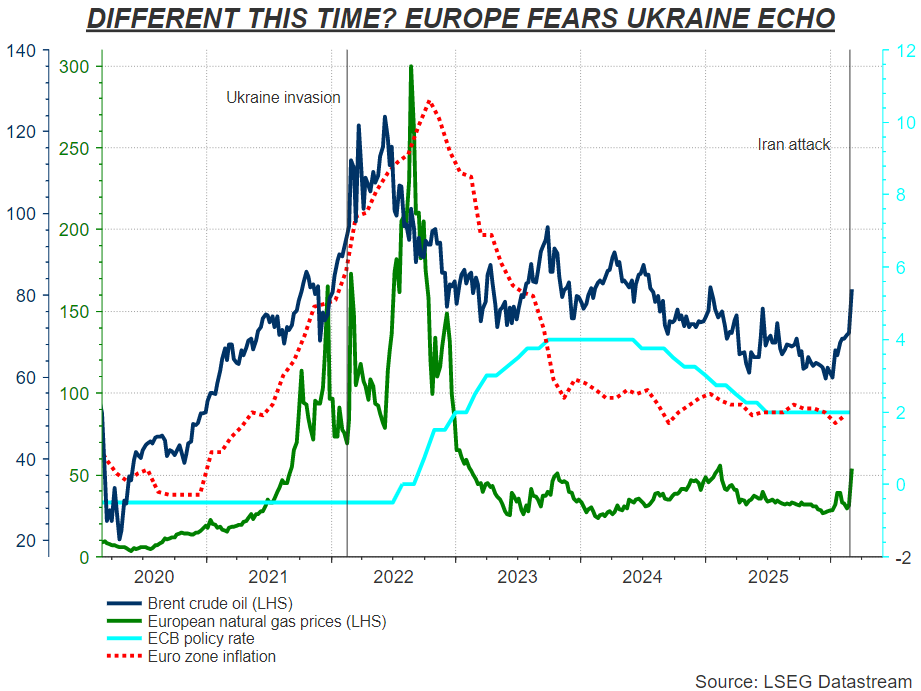
Europe can absorb this Mideast energy hit - but not much more

The energy price jolt from this week's Middle East shock has left Europe fretting about an economic hit akin to the invasion of Ukraine four years ago. But initial fears may be overdone if - and it's a big "if" - futures markets prove accurate.

As the weekend's attacks on Iran marked the start of a full-blown - now region-wide - war that could last several weeks at least, European markets shivered at the prospect of yet another brutal energy squeeze spurring inflation and sapping demand.

Surging oil prices hit markets of big importing economies ‌around the world. But Europe's particular exposure to renewed disruption of natural gas supplies - already severed when Russia invaded Ukraine in 2022 - is a potential double whammy.

Although below Tuesday's peaks, crude oil is still up more than 10% from last week and at its highest levels in more than a year. European natural gas futures are still more than 50% up on last Friday and also at levels seen over 12 months ago.


Graphics are produced by Reuters.

Read the full column