What matters in U.S. and global markets today

Get full access to Reuters.com for just $1/week. Subscribe now.


Morning Bid U.S.

Morning Bid U.S.

A Reuters Open Interest newsletter

What matters in U.S. and global markets today


By Mike Dolan, Editor-at-Large for Finance and Markets

Day three of the escalating Middle East war continues to rattle world markets and there are no signs yet of when or where the widening regional conflict may end - only a running assumption that it will be measured in weeks and not just days.

Energy prices remain the epicenter of the financial transmission, and crude oil is climbing again as shipping, oil and gas installations and military and civilian targets are hit as Iran continues to retaliate to the weekend strikes.

I’ll get into that and more below.

But first, check out my latest column on what’s really driving the recent dollar rally.

And listen to the latest episode of the Morning Bid daily podcast. Subscribe to hear Reuters journalists discuss the biggest news in markets and finance seven days a week.


Data refreshes every time you open this email. For more U.S. market news, click here. Please send any feedback to morningbid@thomsonreuters.com.


Today's Market Minute

  • The U.S. military campaign against Iran has put Chinese leader Xi Jinping on the back foot ahead of an expected summit with U.S. President Donald Trump, who has turned America's military against one of Beijing's close partners.
  • Insurance companies are cancelling war risk coverage for vessels in the Middle East Gulf as the widening Iran conflict disrupts shipping.
  • Three more U.S. cabinet-level agencies moved to cease use of Anthropic's AI products ‌on Monday, joining the Pentagon in switching to rivals such as OpenAI under a new White House directive.
  • The relatively modest jump in oil prices suggests investors are betting that disruption to oil supplies will be short-lived - but that optimism may be misplaced, writes ROI Energy Columnist Ron Bousso.
  • China is the world's largest energy importer, yet any energy-led inflation in the rest of the world will likely not hit China, argues ROI Asia commodities columnist Clyde Russell.
 

Hormuz haze hits markets

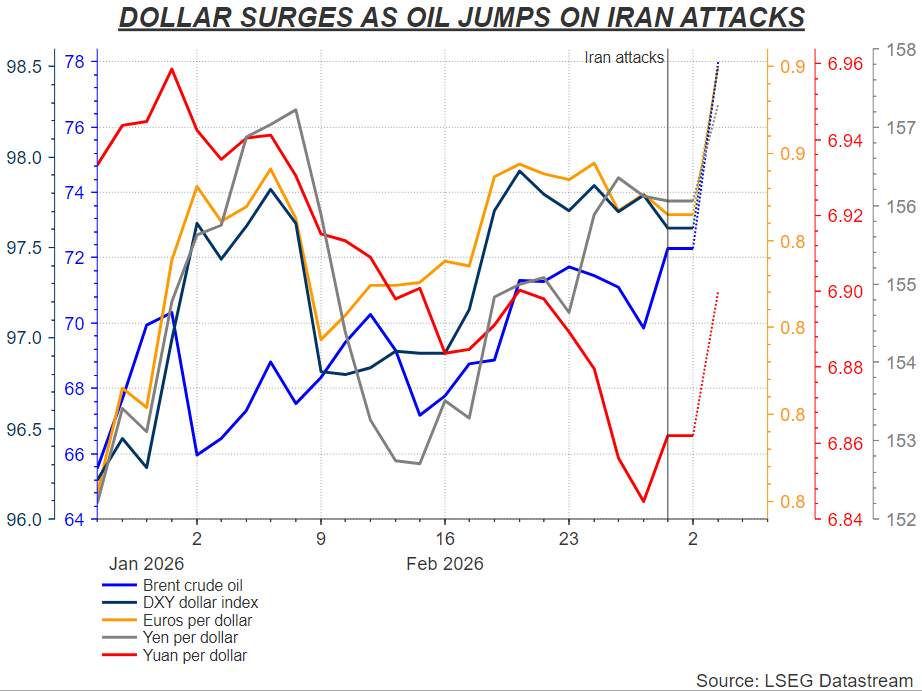
Brent crude hit a 14-month high and, at $82.37 per barrel, it's $10 higher than at Friday's close. U.S. crude hit 8-month highs at $75.55 per barrel, but markets are awaiting a planned government announcement on Tuesday on plans to offset the impact on U.S. consumers.

The details of that are unclear but could include a release of the U.S. Strategic Petroleum Reserve or some form of domestic subsidies.

The bounceback in Wall Street stocks on Monday saw the S&P 500 return to opening levels, led by the tech sector. But that had the feel of programmatic trading hinged on 'buy the dip' models trained on the relatively short-lived energy price spikes seen in recent Middle East conflicts.

And this one looks very different. Wall Street stock index futures are back down almost 2%. Stocks across Europe and Asia tumbled sharply today. Japan's Nikkei, the eurozone Stoxx index, and Britain's FTSE 100 all plunged about 3%, while South Korea's high-flying Kospi plummeted 7% on Seoul's return from holiday on Monday.

Any thought of a safety bid in sovereign bonds has been quickly brushed aside too, with U.S. Treasury yields on the rise across the curve and the 10-year now up 13 basis points from Friday's close.

Markets are now not expecting another Federal Reserve rate cut until September, and there are doubts about whether there'll be a second this year - with just 42bps of cuts priced in by December.

Traders are also busily pricing out any possibility of another European Central Bank rate cut. Aggravating that picture was Monday's report showing U.S. manufacturers already registering a sharp spike in input prices in February to their highest levels since 2022 - even before this latest oil surge.

And ECB-watchers digested a higher-than-forecast flash inflation reading for the eurozone for last month, too.

Elsewhere, the dollar continues to benefit by default on relative energy impact calculations - with the euro down to its lowest point in six weeks on worrying natural gas price gains in the bloc. The region’s benchmark natural gas price hit its highest in three years on Tuesday - up some 30% year-on-year.

The Bank of Japan warned of possible intervention to arrest yen weakness, while the Swiss National Bank said it was more willing to intervene to counter the safe-haven franc's rise. The resulting fallback in the franc tallied with a curious retreat in gold.

With that, onto today's column.


Dollar gets its mojo back - but only by default

While it's tempting to assume the dollar's long-lost "safety" bid has returned since the weekend Iran attacks, it's not as clear-cut as it seems and owes more to relative energy plays. Yet the implications of the market response may be just as powerful.

Ever since Donald Trump's return to the White House last year, the dollar has waned even during periods of market anxiety and volatility, due in large part to U.S. economic policy uncertainty and both domestic and geopolitical upheaval.

Reversing years of dollar over-valuation is a key tenet of the Trump administration's economic plan. But the greenback's diminished haven role in times of ‌global political or financial stress suggests foreign investors - already up to their eyeballs in U.S. assets - have changed their behaviour.

So it was remarkable that the dollar jumped across the board after last weekend's extraordinary bombing campaign by U.S. and Israeli forces against Iranian targets, including the assassination of Supreme Leader Ali Khamenei and the wave of regional violence that's followed.


Graphics are produced by Reuters.

Read the full column