Hello Power Up readers,
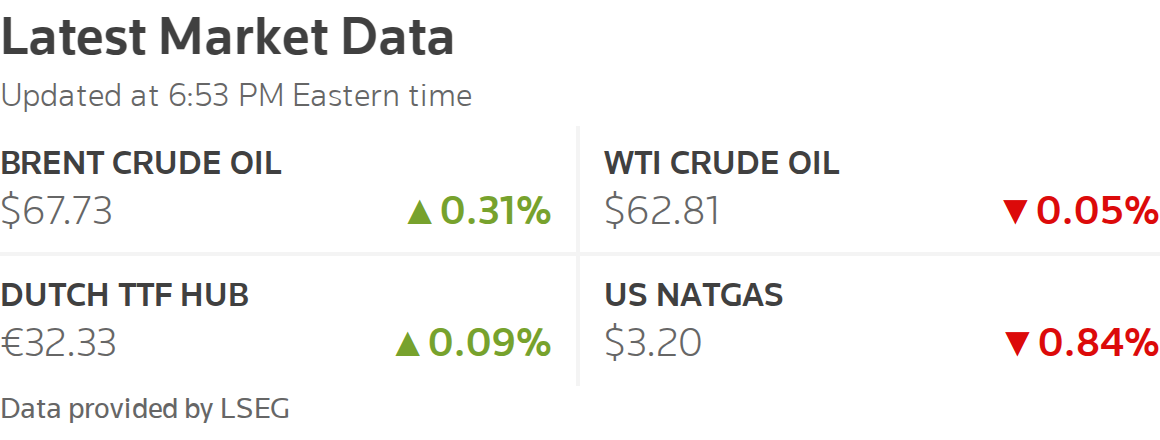
Energy markets were thrown into their biggest crisis in decades after the United States and Israel launched a massive air war against Iran on Saturday, prompting Iranian retaliation across the region. Brent crude prices on Monday initially surged by over 10% to $82 a barrel, the highest in over a year, before receding slightly, while European natural gas prices soared by nearly 30% as investors assessed the impact of the rapidly unfolding events on the world’s most important energy-producing region.
The conflict has already led to what had for a long time been considered the doomsday scenario for energy markets: the suspension of shipping activity through the Strait of Hormuz, a narrow waterway between Iran and Oman that handles nearly 20 million barrels per day of crude oil and refined products, roughly a fifth of global consumption.
Although the strait hasn’t been officially closed, ship operators have halted transit, fearing either being attacked or getting trapped inside the Gulf after at least three tankers have been targeted around or inside the strait.
Other energy infrastructure has also been targeted across the region. Saudi Arabia shut its biggest domestic oil refinery, located in Ras Tanur, after a drone strike, a source told Reuters.
And Qatar, the world’s second-largest producer of liquefied natural gas (LNG) that exports a fifth of global supplies, ceased production of LNG and associated products at its giant Ras Laffan plant due to attacks.
Amid all these geopolitical headlines, OPEC+ on Sunday also agreed to a modest oil output boost of 206,000 bpd for April, which is slightly higher than previously expected. But the decision is probably the least consequential the group has made in nearly a decade of existence, ROI Asia Commodities Columnist Clyde Russell argued today. More on this below.
It is hard to overstate the importance of the developments. For now, the big question is how long the conflict and disruption will last. U.S. President Donald Trump indicated in interviews over the weekend that military operations could last at least four weeks.
The U.S. will most likely try to rapidly re-open transit through the Strait of Hormuz, but that is no easy task. Iran may also try to target other critical infrastructure across the region, including oilfields.
Check out more of my analysis on today’s ‘Morning Bid’ podcast, where I joined host Mike Dolan for a special episode on Iran.
Here are a few more headlines: