|


 |
The crowd lining up to get into Tabitha Arnold’s exhibition in New York City last fall wasn’t full of the older, moneyed types one might expect to find at a Chelsea gallery opening. Instead, the small space was packed with twenty- and thirtysomethings wearing Zohran Mamdani pins, Democratic Socialists of America hats and SEIU T-shirts.
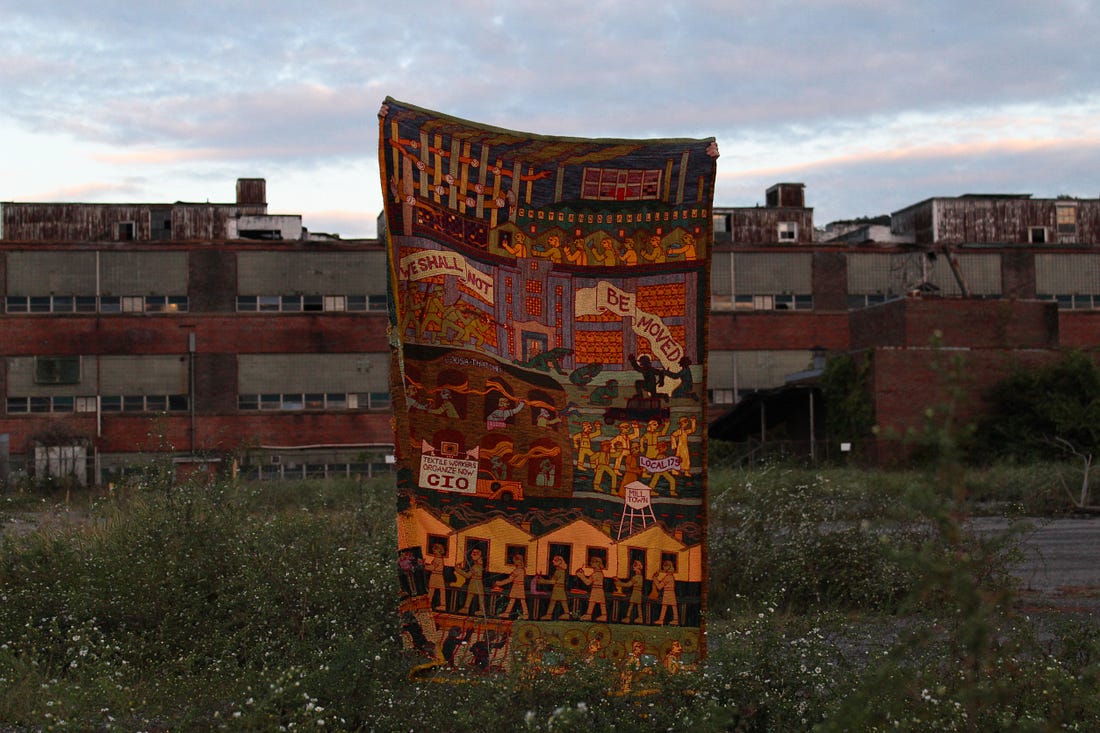
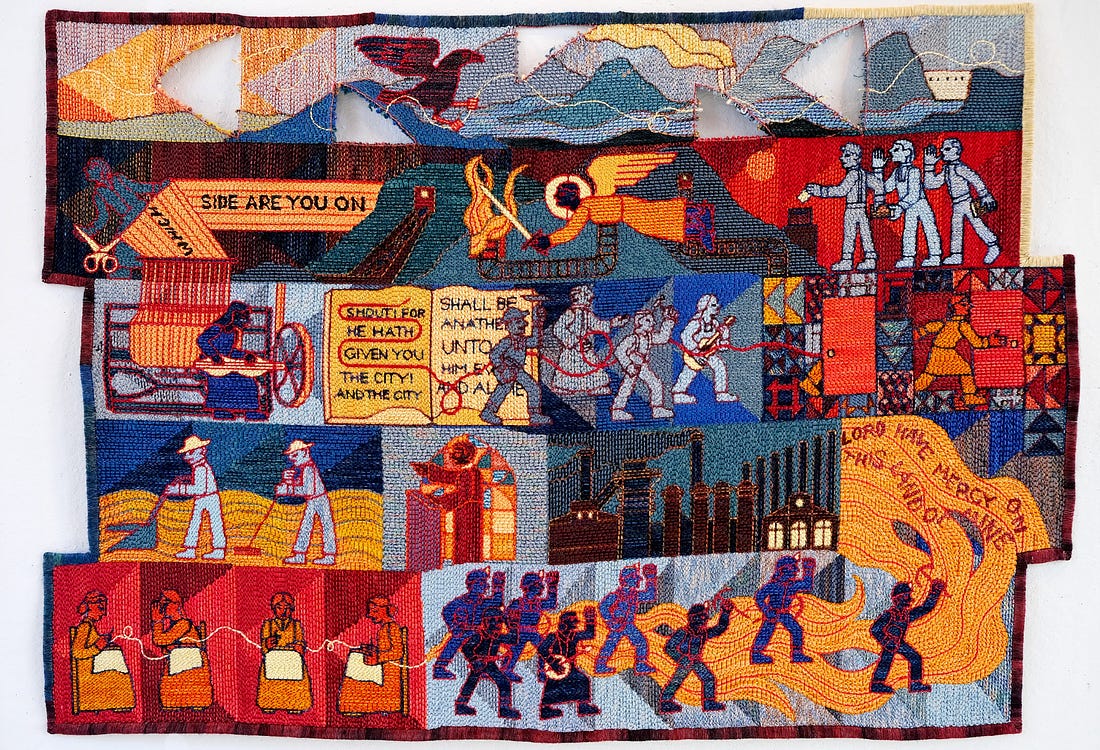
If the crowd might have seemed unusual in the context of the city’s fancy gallery district, they looked right at home next to the art that had drawn them there. The exhibition on display, called Gospel of the Working Class, featured monumental handmade tapestries highlighting working-class struggles from both recent and distant history. In one, textile workers carry bolts of fabric and wield scissors, while people dodge bullets from strike-breakers outside the factory. In another, angels walk behind autoworkers carrying picket signs above a row of hands holding drills and other tools.
The Chattanooga, Tennessee-based artist behind it all, Tabitha Arnold, says her goal is to create art that reflects and inspires organizers and workers. In a pop culture and media landscape littered with stories about the uber-wealthy, Arnold’s pieces focus instead on the working people who make up the 99%. In doing so, she’s garnered plenty of recognition: she was awarded the 2025 Southern prize for visual art, received a prestigious MacDowell fellowship in 2023 and has exhibited her art all over the world.
But what she wants more than anything is for her work to be useful to the people it’s meant to portray. “I think of my work as being for labor organizers,” she said. “I see it as being a source of encouragement for organizers, reflecting and validating what they’re doing back to them.”
 |
My latest piece for the Guardian profiles Arnold, whose work I was put onto by another textile whiz I admire (that would be Emily Fischer of Haptic Lab, maker of a quilt coat that I’ve treasured for years). I’ll tell you something here that I didn’t say in the Guardian: The first time I encountered Arnold’s tapestries, I cried.
I didn’t know much about Arnold before I showed up, but there on the wall was a giant tapestry Arnold had made about a textile workers’ strike. This moved me because the work was incredibly beautiful — calling to mind greats like Diego Rivera and Faith Ringgold — but also because most of my early career in journalism was spent writing about garment workers and their labor conditions. In many ways, garment workers are the reason I became a journalist. The devastating Rana Plaza collapse happened just as I was starting to write about fashion publicly and my desire to see the industry change so something like that never happened again is a big part of why I became a journalist at all.
The garment workers I interviewed over the subsequent years also laid the groundwork for my political education, though neither I nor they necessarily knew that’s what was happening at the time. But you can only be told so many times by a woman in a sweatshop in Los Angeles, USA or Dhaka, Bangladesh that unionizing is the best thing that ever happened to her at work before you start to take unions seriously as an engine for positive change in toxic and dangerous workplaces.
 |
In reporting this story on Tabitha Arnold’s work all these years later, I was reminded that my story — political education and awareness that started with seeing abuses in the garment industry — isn’t unusual. “Textiles are uniquely suited to make comments about labor because textiles were at the heart of the Industrial Revolution and all of the many issues that arose with exploited bodies in systems of mass manufacturing,” professor of art history and archaeology at Columbia University Julia Bryan-Wilson told me. The connection between textile work and radical politics runs deep, she noted: Friedrich Engels, who co-authored The Communist Manifesto with Karl Marx, was politicized in part by seeing what happened in textile mills in Manchester, England.
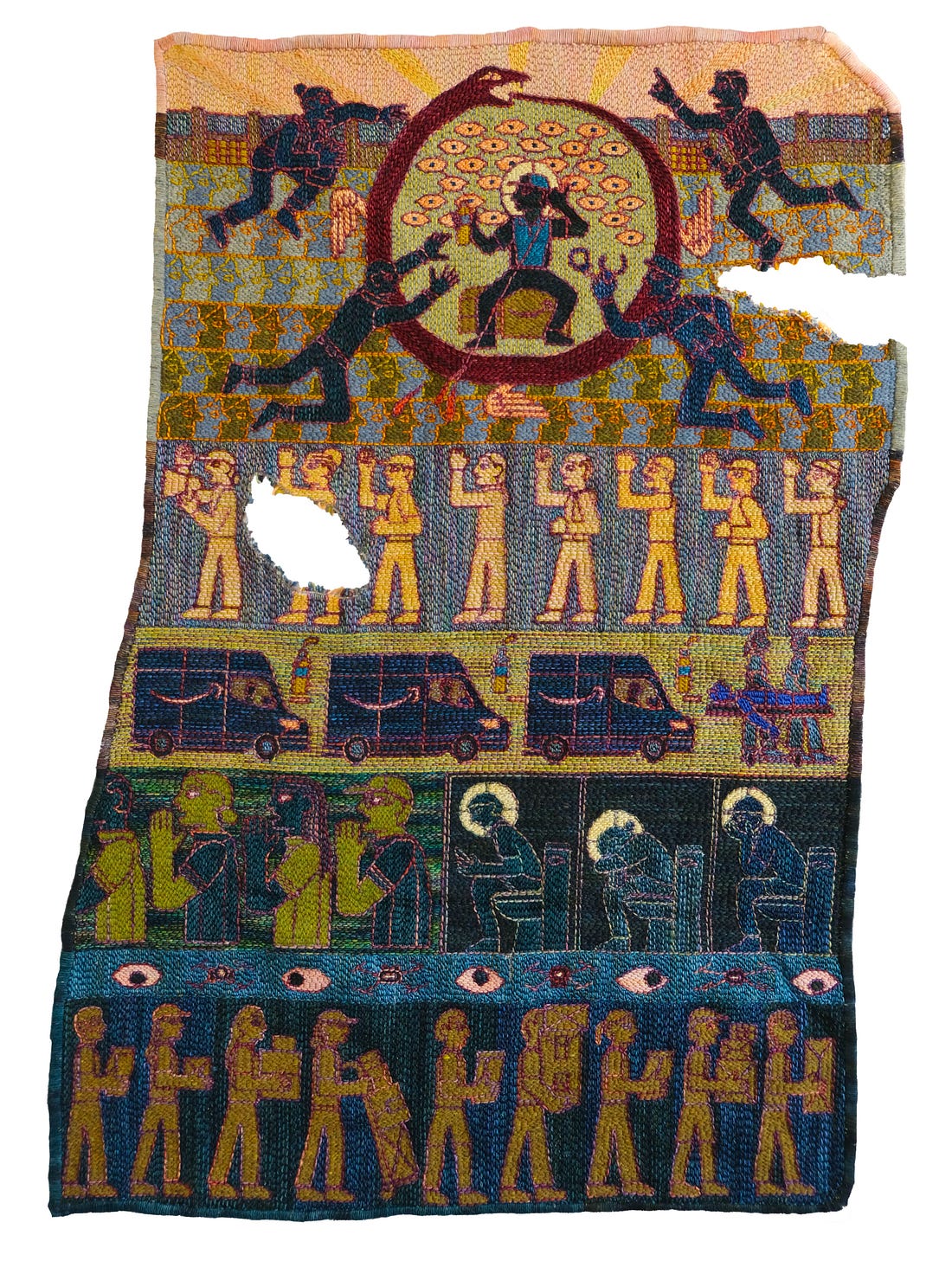
The other most moving part of the exhibition was tapestry focused on a recent labor fight at a Volkswagen plant in Chattanooga. Arnold was supposed to reveal the tapestry at a rally of about 200 Volkswagen workers and their family members before a much-anticipated vote on whether or not to form a union. “I didn’t know what the workers would think about it, and I was kind of scared that they might think I was hijacking their really important moment,” she told me later.
It was a “really important moment” in part because two previous attempts to unionize the Tennessee plant had failed – and the stakes for workers were high. According to Caleb Michalski, an employee at the plant, employees were pushed to keep to strict timelines, even to the detriment of their health, safety and dignity. He’d seen coworkers literally pee on themselves on the line because supervisors wouldn’t let them take a bathroom break.