|
 |
On Friday, I sent a special message to our free subscribers. It highlighted how Popular Information’s work shines a light on stories that powerful people would rather keep in the shadows, and impacts the national political debate.
For example, in January, Popular Information uncovered that the military ouster of Venezuelan President Nicolás Maduro created a financial windfall for a prominent Trump-supporting billionaire, investor Paul Singer. In February, we exposed how major corporations — including General Motors, State Farm, and Microsoft — were bankrolling a political ad that featured a white supremacist slogan.
We are planning even more ambitious reporting like this, but it is time-consuming and expensive.
Although Popular Information has 538,000 readers, only a small percentage support our work as paid subscribers. We could put up a paywall to encourage more people to pay, but we believe access to crucial information shouldn’t be limited by income.
To keep Popular Information available to everyone, we set a goal of 150 new paid subscribers, and we’re close.
To help get us over the top, we’re offering 20% off subscriptions for one more day.
If you value this work and can afford $4.80 per month or $40 per year, please help Popular Information continue to fight for the truth.


 |
In private calls over the last several weeks, Saudi Crown Prince Mohammed bin Salman (MBS) reportedly urged President Trump to attack Iran. Iran is a top regional rival of Saudi Arabia, and MBS had become concerned about Iran’s growing military capabilities.
The lobbying campaign achieved success on Saturday, when Trump announced he had begun “major combat operations in Iran.” Trump launched a war even though U.S. intelligence assessed that Iran posed no imminent threat to the United States. In June 2025, Trump publicly declared that more limited strikes “completely obliterated Iran’s nuclear capability.”
MBS’s influence with Trump has grown as the Saudi government has invested billions in projects that personally enrich Trump and his son-in-law, Jared Kushner.
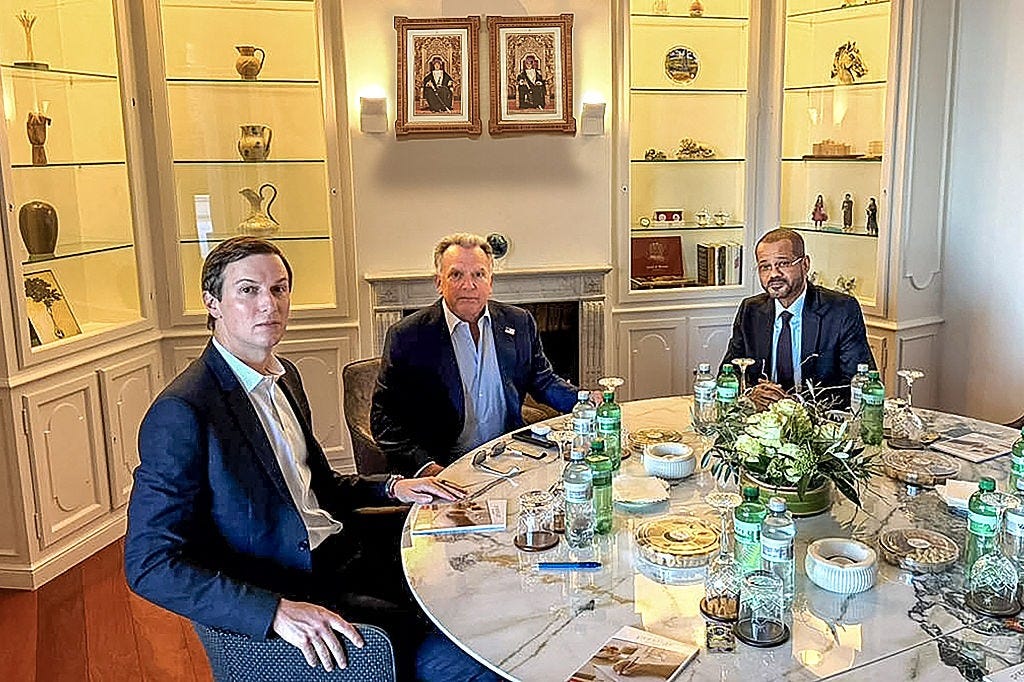
Despite the glaring conflicts-of-interest, Trump installed Kushner as a top negotiator with Iranian officials. Kushner and Middle East envoy Steve Witkoff participated in a mediation session with their Iranian counterparts in Geneva on Thursday, billed as a last-ditch effort to avoid war.
The Saudi Arabian Public Investment Fund (PIF) is the largest investor in Jared Kushner’s private equity fund, Affinity Partners. PIF invested $2 billion in Affinity Partners in 2021, even though the PIF committee that screens investments recommended rejecting Kushner’s proposal, citing “inexperience” and “excessive” fees. The committee’s recommendation was overruled by MBS, who heads PIF’s Board of Directors.
PIF pays Kushner 1.25% of its investment, or $25 million, annually. The Senate Finance Committee estimates that Kushner will be paid $137 million in management fees from PIF by August 2026. Further, in September 2025, PIF, Affinity Partners, and others jointly acquired Electronic Arts, the publisher of iconic video games like The Sims and Madden NFL, for $55 billion. The deal, which is the largest leveraged buyout in history, will likely be very lucrative for Kushner.
After raising billions for the Saudis and other foreign governments, Kushner dismissed concerns about conflicts of interest, pledging he would not be involved in Trump’s second term. In February 2024, Axios’ Dan Primack asked Kushner whether his business relationship with foreign governments would make it “very difficult… to do any sort of foreign policy work” moving forward. “I’m an investor now,” Kushner replied. “I served in government, and I think my track record is pretty impeccable. Now I’m a private investor.”
Yet, after Trump took office, Kushner resumed his central role in shaping U.S. foreign policy. In an October 2025 interview on 60 Minutes, Kushner argued that financial conflicts made him and Witkoff more effective. “What people call conflicts of interests, Steve and I call experience and trusted relationships that we have throughout the world,” Kushner said.
CNN reported that both Saudi Arabia and the UAE lobbied Trump to strike Iran. Like Saudi Arabia, the UAE has significant financial ties to Kushner and Trump.
The UAE is another major backer of Affinity Partners, directly investing about $200 million with Kushner’s firm. Additional money came via Lunate, a supposedly private Abu Dhabi investment firm that is financed by government money and tied to the UAE’s sovereign wealth funds.
Witkoff is the co-founder of the crypto firm World Liberty Financial (WLF) and retains an 8-figure stake in the company. Trump and his family also own significant pieces of the company. Sheikh Tahnoon bin Zayed Al Nahyan, the UAE’s national security advisor and head of the country’s largest sovereign wealth fund, purchased 49% of WLF days before Trump’s inauguration. Of the $250 million paid up front by the UAE, $187 million was directed to Trump family entities and $31 million to the Witkoff family. In May 2025, MGX, a company controlled by Tahnoon, purchased $2 billion of crypto tokens from WLF.
Following the conclusion of the mediation on Thursday, Kushner and Witkoff “ominously issued no statement,” and the pair was reportedly “disappointed“ by the Iranian negotiating position. After presumably being debriefed by Kushner, Trump said, “we’re not thrilled with the way they’re negotiating.” According to Trump, it would be “wonderful” if the Iranians “negotiated in … good faith and conscience but they are