What matters in U.S. and global markets today

Global news you can trust.

Download the Reuters App.


Morning Bid U.S.

Morning Bid U.S.

A Reuters Open Interest newsletter

What matters in U.S. and global markets today


By Mike Dolan, Editor-at-Large for Finance and Markets

Crude oil prices spiked as much as 10% overnight following the outbreak of war in the Middle East. Joint U.S.-Israeli strikes on Iran on Saturday have elicited a significant response from Tehran that has brought traffic through the critical Strait of Hormuz to a virtual standstill. Prices have cooled slightly but remain elevated.

Meantime, financial markets are getting their first chance to react to the escalating conflict, which has seen the killing of Iranian Supreme Leader Ali Khamenei and an ongoing wave of retaliation across the region.

I’ll get into that and more below.

But first, listen to the latest episode of the Morning Bid daily podcast - a special edition featuring a conversation with ROI Energy Columnist Ron Bousso on the conflict's implications for energy markets.


Data refreshes every time you open this email. For more U.S. market news, click here. Please send any feedback to morningbid@thomsonreuters.com.


Today's Market Minute

  • Oil prices surged on Monday and shares slid as conflict in the Middle East looked set to last weeks, threatening to upend a global economic recovery and perhaps reignite inflation.
  • Conflict in the Middle East has become a top worry for investors unsettled by the prospect of a power struggle in Iran and a protracted regional war, with ramifications for everything from global trade to inflation.
  • Amazon's cloud unit, AWS, said on Sunday that power to its data center in the United Arab Emirates was shut down temporarily after objects struck the facility, triggering sparks and a fire.
  • Global energy markets face one of their gravest shocks in decades, writes ROI Energy Columnist Ron Bousso.
  • The OPEC+ decision to lift crude oil output by 206,000 bpd from April is little more than a symbolic gesture amid the widening Middle East conflict, argues ROI Asia Commodities and Energy Columnist Clyde Russell.
 

Middle East maelstrom

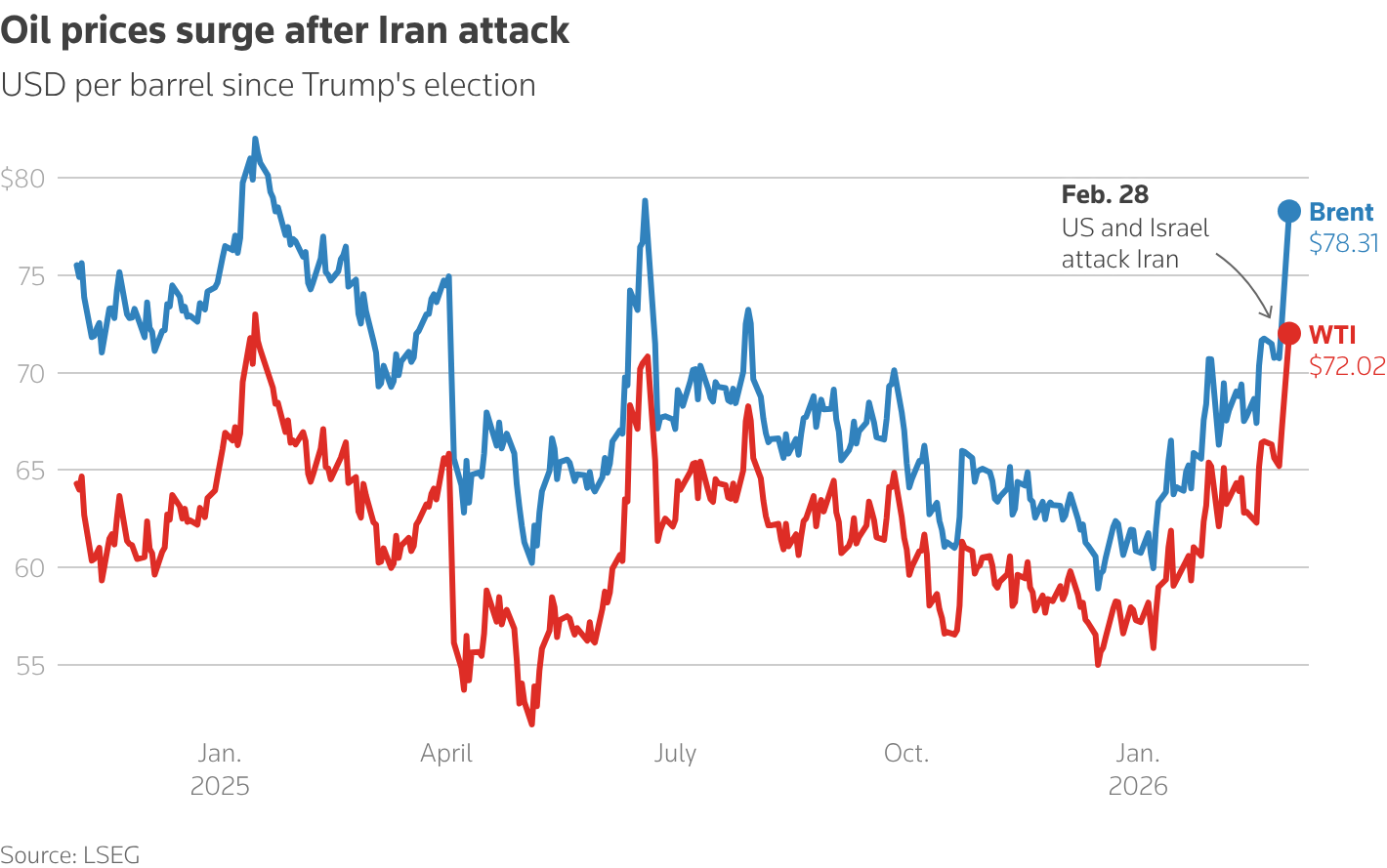
Global Brent crude prices initially topped $80 per barrel this morning to hit their highest level since January 2025, but have since fallen back to about $79 - still well shy of the $100 levels now routinely touted by many in the oil market as a possible destination if the conflict lasts several weeks.

U.S. President Trump has indicated the campaign could last four weeks - potentially long enough to ensure that the effective closure of the Strait of Hormuz waterway causes significant stress to world supplies.

A modest OPEC+ output boost in April will likely do little to ease supply issues, not least because producers in the region will struggle to export while navigation in the Gulf is disrupted.

Significantly for inflation watchers and interest rate markets, crude prices are now significantly positive year-on-year for the first time in more than a year.

On top of another hot January inflation readout on Friday, the prospect of creeping energy prices further clouds the Federal Reserve's horizon, with markets no longer fully pricing in another rate cut until September.

Meantime, the picture for U.S. Treasuries is extremely complicated.

They had rallied significantly late last week on a mix of rumbling credit concerns, AI-related stock market hits and a safety bid on the risk of an Iran conflict. But the inflation risks associated with the crude spike have seen 2-year yields bounce back from three-year lows - reversing all of Friday's drop.

The dollar is a big winner, as energy price concerns and worries about a wider regional conflict jolt the currencies of big energy importers Japan, China and Europe.

Stocks have fallen further, but not excessively - with U.S index futures, as well as Asia and Europe's benchmarks, all down between 1% and 2%. 


Today's key chart  


Graphics are produced by Reuters.

Oil's 9% surge on Monday was more restrained than many had feared over the weekend, but the duration of what's now a widening regional conflict will be critical to how energy and wider financial markets react from here.

At least 150 tankers have dropped anchor in Gulf waters, shipping data showed on Sunday, while three were damaged amid escalating Iranian retaliation to U.S.-Israeli strikes.


Today's events to watch

  • U.S. S&P Global and ISM February manufacturing PMIs (9:45-10:00 AM EST)
 

Want more smart, engaging financial analysis in your inbox? Subscribe to Trading Day by Jamie McGeever, a daily newsletter delivered just after the market close. And check out