| | In today’s edition: Bari Weiss and CBS News’ Iran coverage.͏ ͏ ͏ ͏ ͏ ͏ |
| |  Washington Washington | New York | Dallas |
 | Media |  |
| |
|
 - Bari Weiss’ war
- Mixed Signals
- WaPo’s future
- Crockett vs. The Atlantic
- Merger metrics
|
|
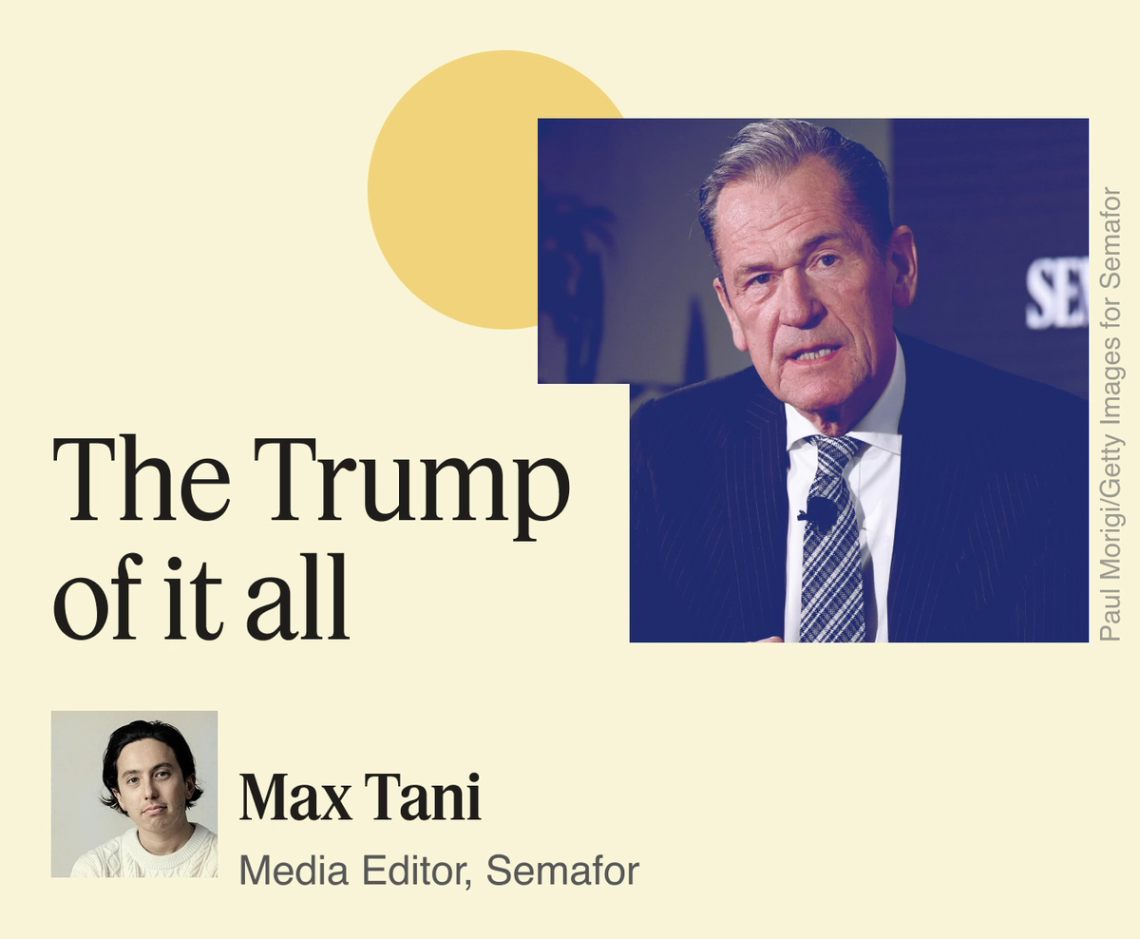 Before we took the stage last week at Semafor’s Trust in Media summit, Axel Springer CEO Mathias Döpfner told me the extremely straightforward reason he had agreed to the event: He believed the topic was important, and wanted to talk about what he was doing to restore trust. I did my best to ask him about it, but it was hard not to get distracted by all the Washington politics Döpfner seemed caught up in. He had just met with White House chief of staff Susie Wiles. And as he was preparing for the interview, Döpfner, a Netflix board member, was also checking his phone to get up to speed on Netflix’s ultimately unsuccessful attempt to buy Warner Bros. Discovery, after President Donald Trump went after fellow board member Susan Rice for comments criticizing companies that bent to his will. The German mogul wasn’t our only guest who evaded our questions about getting sucked into Washington politics: Onstage with Ben Smith, former BBC News head Deborah Turness recounted how she resigned last year after a documentary edit became the focal point of a massive lawsuit from Trump against the British broadcaster. It’s the recurring theme of the Trump age. As much as corporate leaders want to avoid politics and make money, it’s nearly impossible to strike deals without navigating an administration aggressively using leverage to extract lopsided concessions. Corporate media owners who loved Trump the first time around for his ratings, web traffic, and subscription juice are instead feeling the squeeze as he directly meddles in their businesses. Many media organizations are already on the back foot. They’re even more vulnerable to pressure, partially because of declining audience trust and the allure of sensationalized content from social media — which we’ve seen on full display over the weekend, as misleading, fake, and contextless short-form video content of the fallout from the US and Israeli strikes on Iran floods social media platforms. Most of the ideas shared on Wednesday couldn’t answer how to keep audiences from being misled by bogus social media content. Instead, Döpfner suggested greater transparency about the values of media institutions. So did FCC Chairman Brendan Carr, in somewhat unexpected praise for Zeteo founder Mehdi Hasan. Turness suggested news outlets think more creatively about formats and better cover the right. There’s no true playbook for how to navigate this moment. But finding a way to improve trust with audiences may be what helps them survive the vortex that is Trump’s Washington. Also today: Bari Weiss’ CBS leadership in wartime. |
|
 Last week, we announced in the newsletter that we were moving to Saturday mornings. And yet, today is Sunday. Let me explain why we decided to stay put for now. Since Ben and I launched the newsletter at the end of 2022, the media and news landscape has changed. The media news cycle is moving faster, the daily micro-scoops and advances are getting more incremental, and all of our inboxes are getting pretty crowded. There’s even a media newsletter trying to charge readers to recap all the other media newsletters. (We do this for free!) So we’ve increasingly sought to pull back a bit from the scrum and drive the conversation with our reporting on everything from Trump’s demand for a new Rush Hour film, to slow-motion changes at The Economist. And so we were considering shifting the newsletter to Saturday mornings, to deliver a combination of agenda-setting big reads and a comprehensive sense of the media agenda as you head into the weekend. But our sophisticated media readers have a lot of opinions about media, and we underestimated how much people enjoy Sunday evening’s traditional greet-the-week timeslot, which we inherited from Ben’s New York Times column. We received some polite messages — well, light cyberbullying — from readers and, uh, Semafor colleagues unhappy about the change. If there’s one thing I’ve learned about this media era, it’s to give the people what they want. So for now, we’ll be keeping the normal Sunday send — full of scoops, insight, and intel, as ever. |
|
 Leigh Vogel/Getty Images for Uber, X and The Free Press and Shannon Stapleton/Reuters Leigh Vogel/Getty Images for Uber, X and The Free Press and Shannon Stapleton/ReutersBari Weiss has long held a strong point of view on US policy toward Iran. Now she’s testing to what extent that perspective should dictate the television broadcast network she runs. The joint Israeli and American attacks on Iran were the first major test of the new CBS News’ right-leaning and pro-Israel editorial leadership. Three CBS staffers told Semafor that Weiss has been more engaged in covering the Iran protests and US military buildup in recent weeks than almost anything else in her time at the helm of CBS News. Two people familiar with the meetings said that Weiss has taken a greater interest in this topic than others during the network’s 9 am calls. Weiss has used her rolodex to book guests related to the topic. After Saturday’s strikes, CBS News President Tom Cibrowski and Weiss decided to quickly program and book a CBS Evening News special 10 pm Saturday broadcast. It featured an intro by CBS News anchor Tony Dokoupil trumpeting the demise of Iranian leader Ayatollah Ali Khamenei and interviews with several guests lauding the attack, including Free Press and CBS contributor Elliot Ackerman and Rep. Rick Crawford, R-Ark. The zeal for the story also led to some unforced errors. Weiss on Saturday reposted a tweet from Iranian-born former Trump administration official Ellie Cohanim, who incorrectly claimed that Saudi Arabia was joining the US and Israeli operation against Iran. (Cohanim later deleted the post.) |
|
Ex-BBC boss on network’s challenges |
 On this week’s episode of Mixed Signals, former BBC News boss Deborah Turness joins Ben Smith for her first public interview since resigning amid a controversy over an editorial mishap involving a Donald Trump speech. She talks about whether the BBC is truly impartial, how she handled newsroom blind spots around rising populist movements like the UK’s Reform party, and why she believes public media can survive a polarized age. The interview was recorded at Semafor’s Trust In Media summit.
|
|
WaPo editor Murray looks to paper’s future |
 Paul Morigi/Getty Images for Semafor Paul Morigi/Getty Images for SemaforIn the wake of mass layoffs, Washington Post executive editor Matt Murray told me he was on track to getting the paper back in the black. He sidestepped my attempt to get him to pin down a timeline, but said he was confident in where the Post was heading. The paper still “punches above [its] weight,” he told me when asked about whether competitors like The New York Times and The Wall Street Journal have eclipsed it. Batting back a theory that owner Jeff Bezos, whose changes to the paper’s opinion section triggered a collapse in subscriptions, was intentionally trying to dismantle the Post, Murray said Bezos was “committed to a long-term future” for the company. “Great journalism is central, but the journalism alone isn’t enough,” Murray said. |
|
Crockett’s war on the press |
 Kaylee Greenlee/Reuters Kaylee Greenlee/ReutersTexas Rep. Jasmine Crockett ejected Atlantic reporter Elaine Godfrey from one of her Senate Democratic primary campaign events on Monday, Max scooped, apparently frustrated by Godfrey’s prior critical coverage of her. Crockett’s campaign first repeatedly denied to Semafor the incident had occurred, joking, “Is Elaine with us in the room now?” The denials pushed Godfrey to publish her own account of the incident and a contemporaneous recording. It wasn’t the first time Crockett had tried to move against a journalist. Crockett’s campaign called the Capitol Police on CNN reporter Edward-Isaac Dovere earlier this month, alleging that he was trespassing, people familiar with the situation said. How Crockett treats the media is important given her momentum against opponent James Talarico; on Friday, former Vice President Kamala Harris gave the Dallas congresswoman a last-minute boost. |
|
Mergers and consolidations |
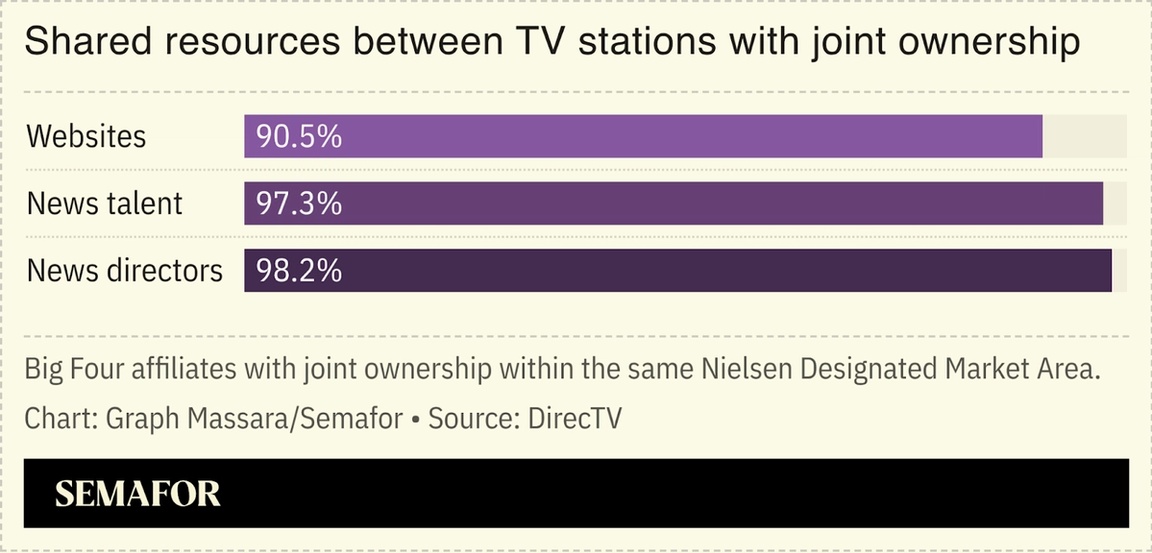 Mergers between big broadcasters, like the deal currently pending between Nexstar and Tegna, lead to less local news, DirecTV argued in a filing to the FCC last week. A survey backed by the satellite TV provider — which is fighting a Nexstar-Tegna merger to create a conglomerate that would reach 80% of households — found that when the same owner buys up multiple affiliate stations within the same media market, they almost always wind up consolidating into one operation. In Indianapolis, for example, where Nexstar owns both Fox affiliate WXIN and CBS affiliate WTTV, both channels share a website and employ the same news director and talent. But Carr gave the Nexstar-Tegna merger his blessing earlier this month; he said at Wednesday’s summit that the future for smaller-market broadcasters, if the FCC doesn’t act, is “trailers with broadcast antennas just pumping in content from New York and Hollywood.” — Graph Massara |
|
 With Pix, deciding what to watch, read, or listen to next has never been easier. Sign up for free Pix newsletters to get the latest on trending shows, movies, books, and more — delivered straight to your inbox. Fun, easy to read, and filled with trusted picks worth your time. |
|
Bloomberg: After Netflix tapped out of the Warner Bros. deal, Ted Sarandos told Lucas Shaw that “once it was clear that we weren’t in the CNN business, it was a lot less interesting [to Trump]. He didn’t care that much more about our deal.” Sarandos also reacted to Rice’s controversial comments with a shrug: “I don’t want or expect our board members to be out talking about politics ever, let alone in the middle of a deal, but they do have the right to speak, and she wasn’t speaking for Netflix.” FT: Condé Nast CEO Roger Lynch told Anna Nicolaou that Google’s AI Overview feature is a “death blow” to SEO traffic. Breaker: Lachlan and Rupert Murdoch are moving to seal court records related to the Murdoch family trust battle of Succession fame, Lachlan Cartwright scoops. |
|
 - The New York Times is going after critics of its reporting on social media, responding to conservative accounts like Libs of TikTok and End Wokeness, which criticized the paper’s framing of its obituary for Iranian leader Ayatollah Ali Khamenei.
- All roads lead to emergency pods: Earlier this month on Mixed Signals, we interviewed former national security advisers Jake Sullivan and Jon Finer about their recent transition from running much of US foreign policy to chatting on a podcast once a week about the stuff they used to work on. The change has been a bit surreal to watch — no more so than when I saw the duo on Substack live
|
|
|


