|
Evaluation of Performance Years 6 and 7 (Oct. 2021–Dec. 2023)
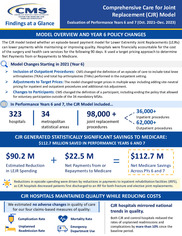
The CJR model tested whether an episode-based payment model for Lower Extremity Joint Replacements (LEJRs) can lower payments while maintaining or improving quality. Hospitals were financially accountable for the cost of the surgery and health care services for the following 90 days. It used a target pricing approach to determine net payments from or repayments to Medicare.
In Performance Years 6 and 7, CJR hospitals continued to achieve value by reducing spending, optimizing post-acute care use, and maintaining quality.
- The CJR Model generated $112.7 million in net Medicare savings across performance years 6 and 7.
- CJR hospitals primarily reduced episode payments for LEJRs by reducing post-acute care payments.
- CJR hospitals maintained quality of care for LEJR patients.
- Hospitals varied in their ability to meet the target price. Safety-net hospitals (SNHs) performed worse than non-SNHs.
|
The Two Page Overview:
The Report (includes an Executive Summary):
Additional Supporting Materials:
|
|
 |
Final Evaluation Report, 2021 - 2023
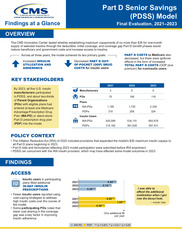
The CMS Innovation Center tested whether establishing maximum copayments of no more than $35 for one-month supply of selected insulins through the deductible, initial coverage, and coverage gap Part D benefit phases would reduce beneficiary and government costs and increase access to insulins. By 2023, all five U.S. insulin manufacturers participated in PDSS, and about two-thirds of Parent Organizations (POs) with eligible plans had entered at least one Medicare Advantage Prescription Drug Plan (MA-PD) or stand-alone Part D prescription drug plan (PDP) into the model.
The final evaluation report covers the three years of the PDSS Model (2021-2023). Key findings from the report include:
- PDSS was popular among key stakeholders, indicated by its increasing participation over time.
- The model achieved its two primary goals of lowering out-of-pocket drug costs for insulin users and increasing insulin utilization and adherence. However, Part D premiums tempered the cost decline for insulin users in PDPs.
- The model shifted costs from beneficiaries to manufacturers, as evidenced by increased coverage gap discount payments and drug rebates.
- The model also lowered Part D costs to CMS for both participating plan types.
- PDSS resulted in some spillover effects on noninsulin users in participating plans, who paid more for their total Part D costs.
- The IRA insulin provision affected some 2023 outcomes, particularly by reducing estimated model impacts on beneficiary costs and utilization.
|
The Two Page Overview:
The Report:
Additional Supporting Materials:
|
|
 |
Final Evaluation Report: CCA Extension (2016–2021)
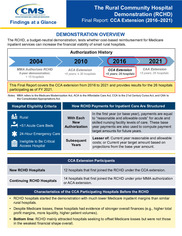
The RCHD, a budget-neutral demonstration, tests whether cost-based reimbursement for Medicare inpatient services can increase the financial viability of small rural hospitals. RCHD was initially authorized by the Medicare Modernization Act in 2004 and subsequently extended in 2010 (Affordable Care Act), 2016 (21st Century Cures Act (CCA)), and 2021 (Consolidated Appropriations Act (CAA)).
Features of the demonstration include:
- Eligible hospitals are rural hospitals with less than 51 acute care beds, 24-hour emergency care, and who were ineligible to be critical access hospitals.
- With each new authorization, in the first year (or base year), payments are equal to “reasonable and allowable costs” for acute and skilled nursing facility levels of care. These base year payments are also used to compute payment target amounts for future years.
- In subsequent years, payments are equal to the lesser of current year reasonable and allowable costs or current year target amount based on projections from the base year amount.
This Final Report covers the CCA extension from 2016 to 2021 and provides results for the 26 hospitals participating as of FY 2021. Key findings from the report include:
- As designed, the RCHD did impact and improve Medicare inpatient margins.
- Combined Medicare inpatient and outpatient margins still did not reach a breakeven point for all participants, especially for newly joined hospitals during the COVID-19 period.
- Hospital leaders consistently reported that RCHD participation was crucial for maintaining financial viability, especially in hospitals operating with negative margins.
|
The Two Page Overview:
The Report:
Additional Supporting Materials:
|
|
 |
|

