A 'March Against The Machines' event takes place this weekend.

Audio Articles now available!

Download the Reuters App.


Sustainable Switch

Sustainable Switch

Climate Focus

By Sharon Kimathi, Energy and ESG Editor, Reuters Digital

Hello!

A green wave is taking over Britain’s politics as the Green Party won a much-anticipated by‑election, as activists take to the streets to protest over the environmental cost of new data centres.

The Green Party's Hannah Spencer won the contest for the vacant parliamentary seat of Gorton and Denton, with Nigel Farage's populist Reform UK party coming second, and Labour pushed into third place.

The Green Party, whose policies focus on protecting the Green Belt and ensuring easy access to green spaces for everyone, won 40.7% of the vote on Friday in an election triggered by the resignation of a member of parliament for health reasons. The Reform Party got 28.7% of the vote, and Labour 25.4%.

Meanwhile, activists are set to take to the streets of Britain on Friday for two days of protests against the expansion of data centres and their impact on communities and the environment.

The protests, coordinated by environmental charity Global Action Plan, are part of a growing international backlash against the power- and water-hungry sites needed to meet surging demand for AI computing power.

The biggest protests will be the 'March Against The Machines' event, which will start outside the offices of OpenAI on Saturday at midday.

OpenAI said in January it would create a community plan for all sites in its Stargate operation, a $500 billion initiative to build AI data centres for training and inference.

Tech companies are investing directly in power infrastructure as energy access becomes a critical constraint on AI expansion, with the push for more and larger data centres driving electricity demand higher.

The Energy and Net Zero Secretary today launched a new inquiry on the environmental impacts of data centres in the UK, as Energy Secretary Ed Miliband says future energy demand from data centres “remains inherently uncertain”.

The Environmental Audit Committee’s new inquiry will examine how much energy and water data centres are likely to use, and how this could impact the Government’s net zero carbon goals.

I want to hear from you.  Do you think data centers will have a negative impact on energy, water, and the environment? Let me know on LinkedIn or send an email to Sharon.kimathi@thomsonreuters.com. 


Climate Buzz

1. Warmer winters leave Pakistan festival on thin ice

Across Pakistan’s northern mountains, winters are arriving later and behaving unpredictably. In the wider Hindu Kush–Himalayan region, scientists report fewer extreme cold events and shorter snow seasons; what locals call a “snow drought,” when snowfall fails to settle. Click here for the full Reuters wider-image feature.

And neighboring India is likely to record one of its warmest Marches on record, with above-average temperatures forecast in key wheat and rapeseed-growing states, potentially cutting yields, two weather bureau sources said.


The Karakoram WinterLude Season 8 ice hockey match on a man‑made rink, in Sost village in the Gojal area of Upper Hunza Valley, Gilgit‑Baltistan, Pakistan. REUTERS/Akhtar Soomro 

2. Congo lakes are releasing ancient carbon, raising climate concerns, study says

Sticking with unpredictable weather patterns, two large lakes in the Democratic Republic of Congo are releasing carbon that has been locked away for thousands of years in surrounding peatlands, scientists said, which could threaten climate stability. Click here to learn more.

3. CEO of World Economic Forum quits after Epstein ties come to light

No sector has been untouched by the recent revelations of the Epstein files, including the environmental space, as the president and CEO of the World Economic Forum, Borge Brende, will be stepping down a few weeks after the forum launched an independent investigation into his relationship with late U.S. sex offender Jeffrey Epstein. Brende said he did not want the issue to be a distraction for the forum, which organizes the annual Davos summit.

4. How did the Ivory Coast and Ghana's cocoa sales crisis come about?

The producers of half the world's cocoa in the Ivory Coast and Ghana have struggled to sell beans and pay farmers this year. Reasons for this range from favourable weather that led to a record surplus, lower cocoa prices, and falling demand from chocolate makers. Click here for the full Reuters explainer.

5. Norway's wealth fund using AI to screen for ESG risks

Norway's $2.2 trillion sovereign wealth fund, which is the world's largest, is using AI to screen companies for risks such as potential links to forced labour and corruption to avoid potential financial losses, it said. It has often set the pace on environmental, social, and governance issues.


What to Watch

 
Play 
 

Move over Moo Deng, there’s a new adorable standout pygmy hippo taking social media by storm. The Wildlife World Zoo, Aquarium & Safari Park in Litchfield Park, Arizona, recently welcomed a new baby pygmy hippo named Jellybean. Click here to enjoy a bit of Jellybean.


Climate Commentary

  • Clean energy policies from South Africa to Egypt are set to drive widespread uptake of solar and battery systems, setting the stage for Africa to become a prominent growth arena for solar systems, according to a comment by Reuters Global Energy Transition Columnist Gavin Maguire.
  • Click here for an Ethical Corp Magazine comment by Wen-Yu Weng, a member of the Executive Leadership team at the Ellen MacArthur Foundation, who shares her thoughts on the looming critical minerals shortage as rare earths have become a strategic focus for businesses and governments. 
 

Climate Lens


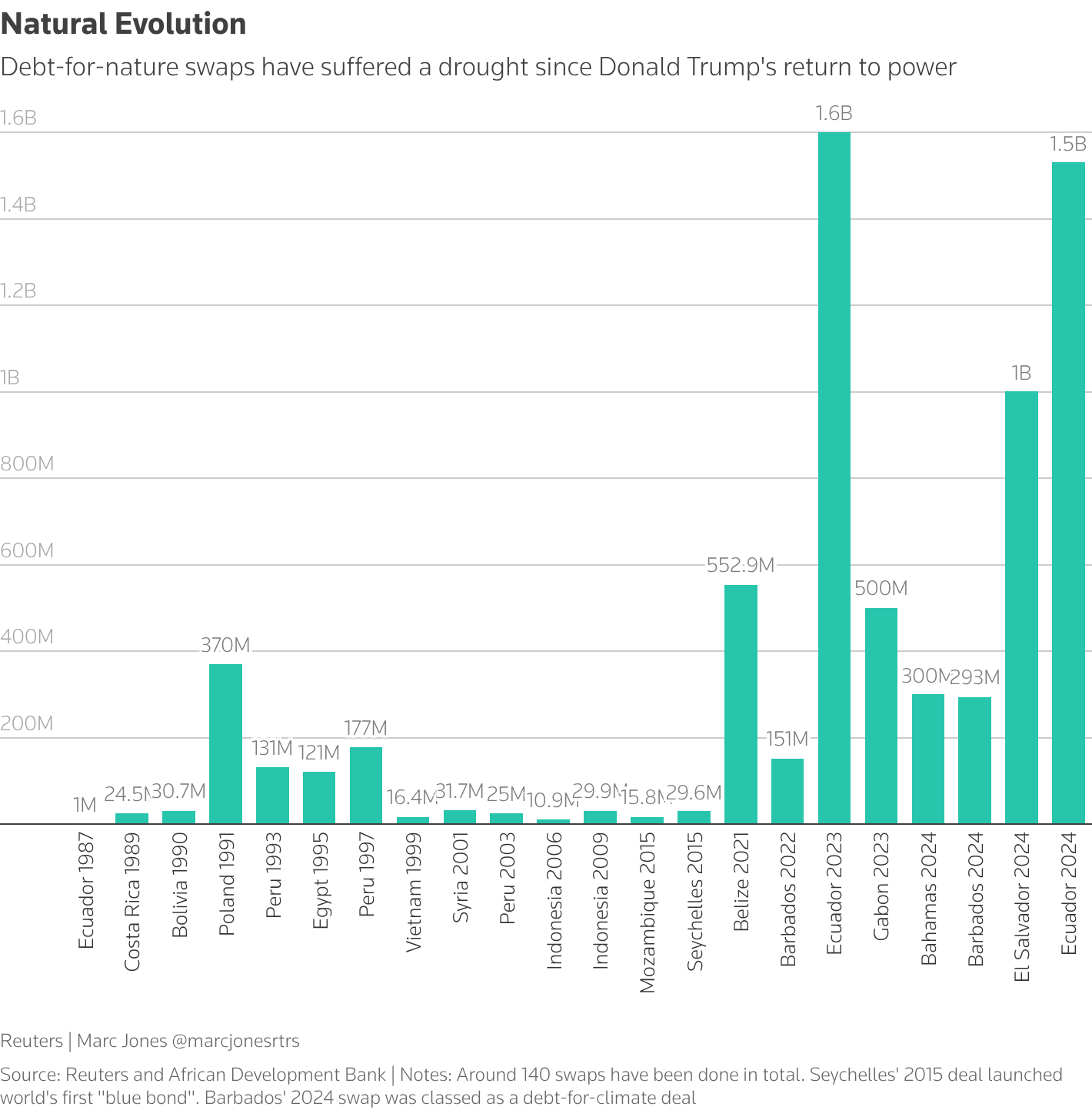
Sticking with today’s focus on Britain, the nation’s biggest asset manager, Legal & General, has committed up to $1 billion over the next five years to become a cornerstone investor in a major new wave of "debt-for-nature" swaps in countries such as Ecuador, Belize, Gabon, and El Salvador. Click here to learn more.


Number of the Week

$2.3 trillion

That’s the amount of revenue growth that extreme weather will take away from the sports economy, according to a recent report by Oliver Wyman.