While there was no obvious trigger for the renewed AI angst, the smoldering anxiety in those sectors all month was fed by another viral research note, from little-known research house Citrini, sketching out worse-case scenarios in the labor market and wider economy from a rapid AI rollout.
The note - which reads a bit like the research equivalent of a disaster movie set in the future - had been circulating all weekend. But its impact says more about AI nervousness in the wider market than anything else.
And stock futures seemed to have calmed down ahead of today's bell as tomorrow's results from chip giant Nvidia now loom large.
Meantime, the U.S. tariff confusion took another twist on Tuesday as new duties came into effect at 10% rather than the 15% announced by President Trump on Saturday. This will no doubt add to calls from around the world for more clarity on U.S. trade policy.
Many countries are wondering if existing bilateral trade deals are now defunct, alongside countervailing pledges of investment in the U.S. The EU has again delayed ratification of the pact it agreed with Washington last year, while the UK held out the possibility of retaliatory action if its own deal is not honored.
All this makes an uncomfortable backdrop for President Trump's State of the Union speech later on Tuesday - and may well prompt him to dwell more on geopolitical issues, such as the standoff with Iran, than his signature economic policies.
On that score, global crude oil prices continued to climb on Tuesday ahead of a third round of U.S.-Iran nuclear talks on Thursday.
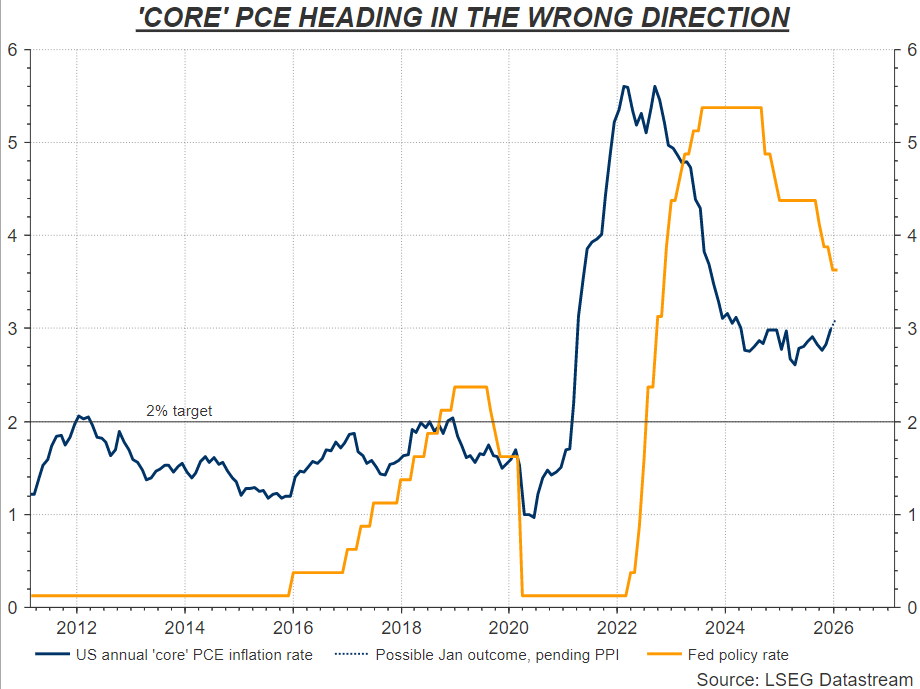
Perhaps significantly for inflation-worriers, the year-on-year Brent crude price turned positive on Tuesday for the first time in more than a year.
U.S. Treasuries were steady ahead of the week's big auctions.
Elsewhere, mainland Chinese markets returned from the New Year holidays, and stocks rose 1%, while the yuan continued its 2026 surge against the dollar to its strongest levels in almost three years.
Japan's yen, on the other hand, weakened again. Traders cited two stories. The first was a report that Japanese Prime Minister Sanae Takaichi has voiced concerns about the Bank of Japan raising interest rates further, and the second was China's decision to prohibit the export of dual-use items to 20 Japanese entities that it says supply Japan's military.
However, both Japan and South Korea's main stock indexes rose on Tuesday.