Plus US LNG exports & the cost-of-living debate

Global news you can trust.

Download the Reuters App.


Power Up

Power Up


A Reuters Open Interest newsletter

By Gavin Maguire, ROI Energy Transition Columnist


Data refreshes every time you open this email. For more energy news, click here. Please send any feedback to powerup@thomsonreuters.com.

Hello Power Up readers,

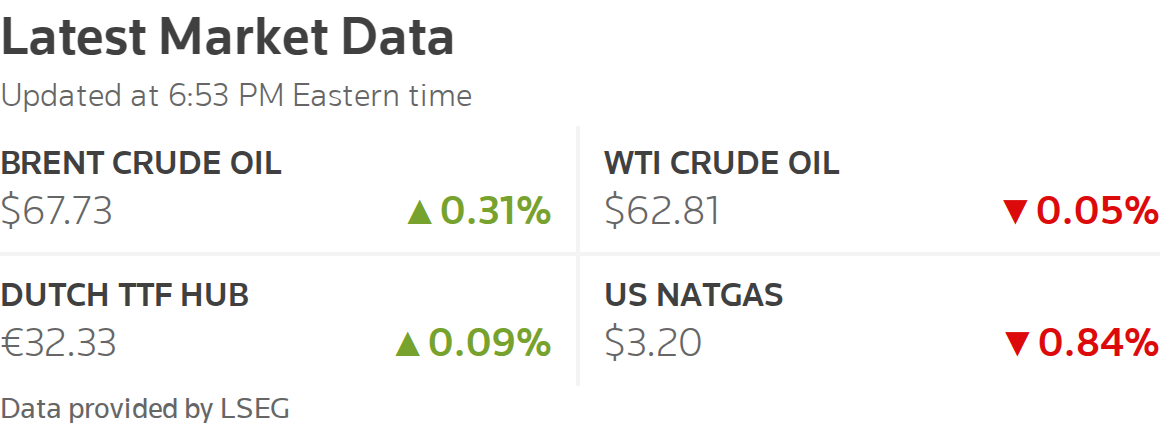
Ron's off for a few days so I'm back on deck with the latest major energy news & analysis. First up, oil prices are at 6-month highs on jitters about potential military conflict between the U.S. and Iran. Reuters has got rolling coverage of that linked under the top energy headlines below.

Elsewhere, participants across the U.S. energy sector - from investors and plant workers to utility planners and coal miners - are still getting to grips with what the repeal of the so-called Endangerment Finding means. We'll dig into that below. 

And while booming exports of U.S. LNG are central to the U.S. energy dominance narrative, the rapid rise in natural gas demand from LNG exporters may drag the sector into the ongoing cost-of-living debate, with tighter gas supplies and higher gas prices feeding through to record high electricity bills. See below for more.

Here are a few more major energy stories & columns:

  • Crude's current Iran premium assumes no supply disruption ROI columnist Clyde Russell looks at crude oil's current Iran premium - or more precisely the lack thereof - and the underlying assumption that there will be no supply disruption any time soon. 
  • Asia gobbles up crude oil, but geopolitics shifts supplier mix Separately, Clyde also digs into how Asia's crude oil import cocktail is changing in response to geopolitical dynamics. 
  • China isn’t importing any US LNG, but it's still in the game China this month marks a year since it last imported liquefied natural gas from the U.S. amid a tense trade war between the world's two largest economies. ROI columnist Ron Bousso reveals how China is still impacting global LNG flows nonetheless.
  • Vitol backs proposed $3 billion LNG plan in S. Africa        EXCLUSIVE: Global commodity trader Vitol is backing a consortium planning to build a $3 billion gas-fired power station and liquefied natural gas import facility at South Africa's east coast Durban port. 
  • US refiners seek to buy crude directly from Venezuela EXCLUSIVE: U.S. refiners Phillips 66 and Citgo Petroleum are seeking to buy heavy crude directly from Venezuelan state oil company PDVSA starting in April to maximize profits, rather than purchasing through trading houses and U.S. oil major Chevron.
  • Guyana's oil growth potential rises as Venezuela tensions ease The tiny oil-producing nation of Guyana, already one of the world's fastest-growing economies, has a window of opportunity for more expansion amid ongoing U.S. activity in neighboring Venezuela.
  • Libya brings in Western traders in blow to Russian fuel flows EXCLUSIVE: Global oil firms and traders including Vitol, Trafigura and TotalEnergies have won tenders to supply Libya with gasoline and diesel as the country grants large Western players wider access and reduces imports of Russian fuel.

As always, don’t hesitate to contact me at gavin.maguire@thomsonreuters.com or follow me on LinkedIn with any questions or thoughts.


The repeal of the Endangerment Finding impacts a slew of industries from car makers to power generators to chemicals producers. REUTERS/Carlos Barria


Top energy headlines

  • Oil prices rise 2% to six-month high on concern over potential US-Iran conflict
  • Oil companies jostle for projects to boost Venezuelan output quickly; a real grind awaits
  • US to West's energy watchdog: scrap net zero focus or we'll quit
  • Gunvor management buyout values trading group at around $5 billion, sources say
  • Canada's Cenovus beats fourth-quarter profit estimates on higher production


Fallout from US climate policy repeal

The scrapping of U.S. federal climate regulations has upended energy investor narratives that have prevailed so far this decade, and is sparking a re-think on which sectors might now win and lose in the U.S. energy space.

The repeal of the so-called Endangerment Finding removes the legal basis for federal regulations of greenhouse gas emissions and a swath of other rules governing pollution standards and driving uptake of clean energy technologies.

Imminent court challenges look likely to muddy the waters on what the repeal means for various sectors over the near term, with regulators, utilities, companies and communities all working out how to cope with any ensuing regulatory vacuum.

That said, some rough outlines can be drawn on which sectors may benefit and which may suffer setbacks now that the previous federal rules on pollution standards are at least watered down for the foreseeable future. Read today's column for more...

Read the full column

US LNG exports vs the cost-of-living

U.S. exporters of LNG consumed more natural gas than both households and commercial businesses last year, tightening U.S. gas supplies and putting the LNG export boom squarely in the frame of discussions surrounding rising U.S. energy costs.

Liquefied natural gas exporters gobbled up a record 5,000 billion cubic feet (141.6 billion cubic meters) of natural gas during January to November of 2025, the latest data from the U.S. Energy Information Administration (EIA) shows.

That total sharply exceeds the roughly 4,000 BCF of gas consumed by residences and the 3,000 BCF consumed by commercial sites during that period, and means LNG exporters are now the third-largest U.S. gas consumer behind industry and power firms.

The U.S. LNG export tally was 25% higher than in the same period of 2024, and accompanied a 61% rise in the benchmark U.S. natural gas price - the Henry Hub spot price - last year.

As natural gas power plants account for around 40% of U.S. electricity supplies - the most of any power source - that run-up in natural gas costs in turn fed into electricity bills for consumers, which hit all-time highs last year.

With U.S. households already grappling with record costs for insurance, housing, food and medical care, pushback against further increases in power bills is likely to be a major issue among voters in the run up to this year's midterm elections.

That in turn means that LNG exporters who compete with households and power firms for gas could come under fire, even as additional LNG export capacity is due to come online and lift potential U.S. LNG export volumes even higher. Check out the full column for more.


Get full access to Reuters.com for just $1/week. Subscribe now.


Sponsors are not involved in the creation of newsletters or other Reuters news content. Advertise in this newsletter or on Reuters' website

LiveIntent Logo