|
|
|
|
Good morning. The women’s hockey teams from Canada and the United States are facing off today for the ultimate Olympic prize: a gold medal. But silver is nothing to sneeze at, and copper, viewed through the right lens, might be even more interesting. What we can learn from their price rises since the Paris Olympics is in focus today – plus, why Ottawa is aiming to attract more foreign students. |
|
|
|
|
|
|
|
|
|
|
|
|
|
|
|
|
Fraud: The two men found guilty of fraud in the multimillion-dollar redevelopment of Toronto’s St. Michael’s Hospital have been sentenced to several years in prison. |
|
|
|
|
|
|
|
|
|
|
Mining: Rio Tinto takes control of Montreal’s Nemaska Lithium amid a critical minerals push. |
|
|
|
|
|
|
|
|
|
|
|
|
|
|
|
Speed skater Steven Dubois holds his gold medal yesterday in Milan. An Olympic gold medal containing 523 grams of silver plated with six grams of gold has a raw material value of about $2,300 to $2,500 U.S. dollars. Stephanie Scarbrough/The Associated Press
|
|
|
|
|
|
|
|
|
|
|
The measure of Olympic medals |
|
|
|
|
The last time we melted down the medals to determine their true value – leaving out bothersome, sentimental intangibles such as ambition, pride and human excellence – world markets were in flux. |
|
|
|
|
As nations united at the Paris Summer Games in 2024, investors were worried about a fracturing U.S. economy, rethinking their heavy bets on big tech companies and their expensive AI ambitions, and bracing for how a potential Trump administration might disrupt global supply chains. Prices of gold, silver, and copper (the main component of bronze medals) were swept up in a broad selloff, but swiftly regained their stride as investors sought security against the unknown. |
|
|
|
|
|
|
|
|
That sounds familiar! Yes, we’re cherry‑picking themes a little here – Japan’s surprise rate hike that August sent its own shockwaves through global markets – but these were the economic forces that largely defined 2024 and continue to shape the world today. |
|
|
|
|
In the weeks leading up to the Milan Cortina Winter Olympics, metal prices luged through swings of volatility and stretches of sober second thought. In other words, they moved with the twists and turns playing out across the world, and continue to offer a glimpse at what’s in store. |
|
|
|
|
What the shiny metals show |
|
|
|
|
Gold and silver, which are considered havens when investors worry about how stocks will perform, have surged since Donald Trump’s election a few months after the Paris Olympics. Ongoing geopolitical uncertainty – including Russia’s strike on Ukraine and the renewed conflict in the Middle East – together with the U.S. trade war have pushed investors toward the safety of precious metals. |
|
|
|
|
Stretching back through a quarter-century of global surprises, in fact, gold has continued to set world records: |
|
|
|
|
|
|
|
|
|
|
|
|
|
|
|
Value of a gold medal, U.S. dollars per ounce. The Globe and Mail
|
|
|
|
|
Investors hit reset on the metals a couple of weeks ago, buying back into the U.S. dollar and equities on news of Trump’s nominee for the next chair of the U.S. Federal Reserve. But market watchers expect gold and silver to continue climbing over a longer horizon. Even if the Trump administration shows signs of walking back its larger threats, the possibility of new bombshells in a capricious White House is ever present. |
|
|
|
|
That’s one reason gold is still reaching new heights. And silver, the “poor man’s gold,” recently surpassed percentage jumps in bullion prices as investors sought safety. But its price is less useful as a pure measure of market sentiment because of its heavy industrial use in things like electronics and solar panels. |
|
|
|
|
Doctor Copper will see you now |
|
|
|
|
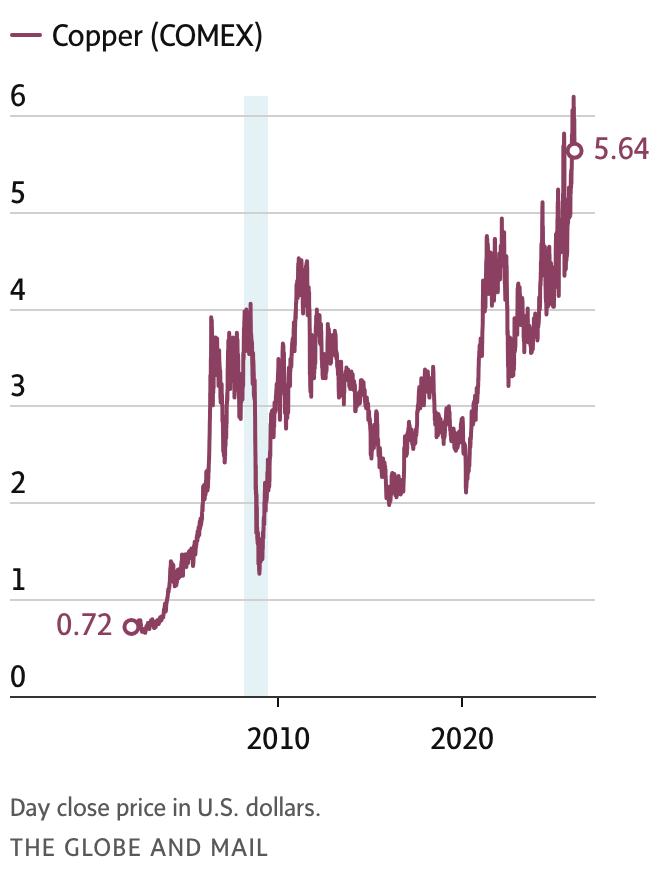
The rise of copper prices since Paris hasn’t been quite as steep as its shinier peers on the periodic table, but its ascent has been no less notable. |
|
|
|
|
Copper is treated as an economic vital sign, owing to its critical role in industrial machinery, power grids, AI, data‑centre expansion, defence, and clean‑energy. When demand for copper is high, “Doctor Copper” as it’s known, often suggests a healthy diagnosis of the wider economy. |
|
|
|
|
But when demand is low, we might hear some doctoral tut-tutting. In this chart, do you see the steep ski hill around the 2008 mark? That’s the Great Recession destroying industrial activity. But since then, demand has been on a slow and steady climb. |
|
|
|
|
|
|
Copper prices have surged more recently after the White House’s proposed tariffs triggered a flood of imports to get ahead of a policy change. That stockpiling distorted global trade flows and created tightness abroad as U.S. inventories ballooned. |
|
|
|
|
With the tariff outlook still uncertain, some analysts say copper’s price is being driven out of fear more than scarcity. But when markets start diagnosing themselves on anxiety alone, it’s no surprise they end up paging Doctor Copper. Even if scarcity isn’t an issue now, industry leaders are warning it could be as soon as late 2026. |
|
|
|
|
|
|
|
|
|
|
|
|
|
|
|
|
When Olympians win gold, they’re winning six grams of gold wrapped around 523 grams of silver. Those scoring second place get al |