|
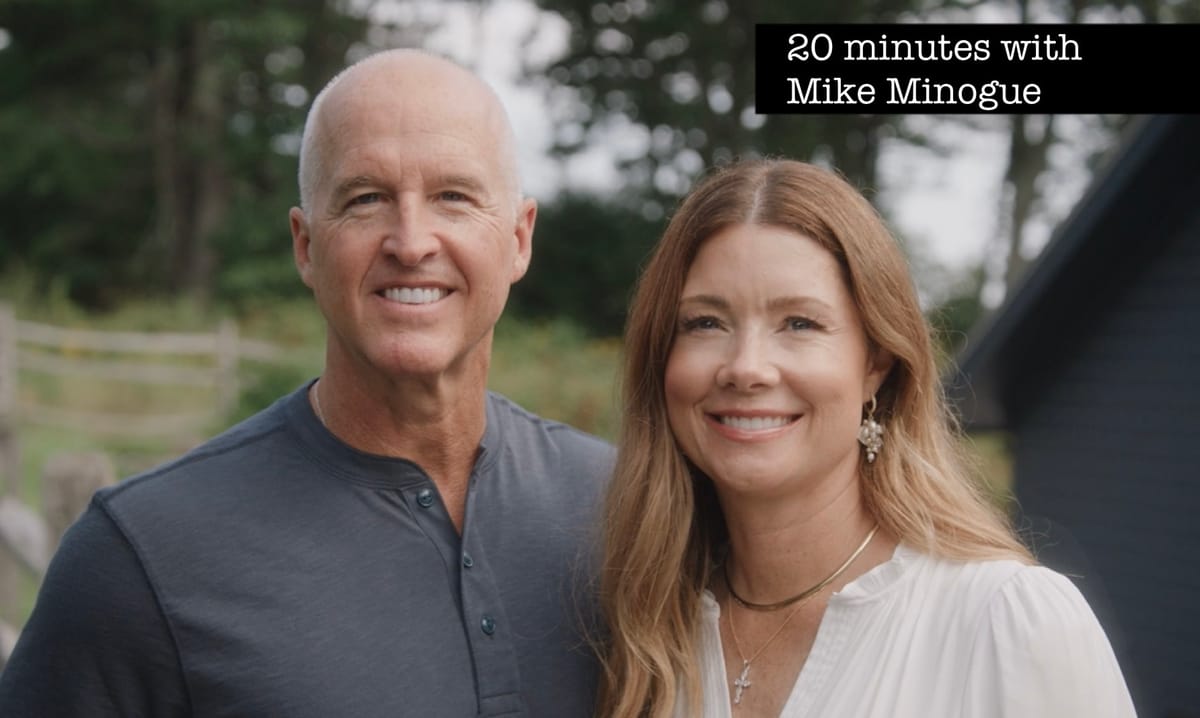
Mike Minogue, a Republican candidate for governor in Massachusetts, is positioning himself as an unconventional contender in the 2026 race, drawing on a background that spans military service, corporate leadership, philanthropy, and family life. As a 1989 graduate of the U.S. Military Academy at West Point and an Army Ranger who served during Operation Desert Storm, the 58-year-old South Hamilton resident often frames his leadership philosophy around service and responsibility. Minogue said that same sense of purpose underpins both his personal life and his political ambitions. “My faith grounds me in humility and true, sincere compassion to help others,” Minogue explained, adding that this belief is “the intent of the Michael and Renee Minogue Foundation,” the philanthropic organization he runs with his wife, Renee. The foundation focuses on veterans, healthcare, and education, areas Minogue describes as essential to breaking cycles of poverty and expanding opportunity. Education, in particular, has become a defining issue for Minogue, both personally and politically. He said that he and his wife did not grow up wealthy. However, they benefited from strong teachers and institutions. “One of the areas that is very special to us is education. We think that is the best way to break the cycle of poverty,” he said. Through their foundation, the Minogues have supported faith-based schools, scholarship programs, and policy initiatives, such as the federal scholarship tax credit. Created under the One Big Beautiful Bill Act, the federal scholarship tax credit allows states to opt in and lets individual taxpayers claim a nonrefundable credit of up to $1,700 for cash donations to state-approved scholarship-granting organizations that provide K–12 scholarships. Minogue argues that the program could be transformative if Massachusetts opts in. “If we keep the money in the state through scholarship-granting organizations, it could mean over a billion dollars in grants,” he said, adding that such funding could help children “trapped in failing schools” because of their zip code. While acknowledging that Massachusetts has many strong schools, Minogue contends that inequality remains persistent. “We also have some poor ones in the wrong zip codes, and that’s where I think what a blessing and what a gift it is to give a good education to children,” he said. “That’s what the American dream is all about.” Minogue’s emphasis on education is deeply tied to his family life. A father of five, he and his wife homeschooled their children for a period while he was leading Abiomed, the Danvers-based medical device company, where he served as chairman, president, and CEO from 2004 to 2023. “We homeschooled for a while early on when I was incredibly busy with Abiomed, and we traveled all over the world,” he said. Homeschooling allowed the family to remain together while exposing their children to global perspectives, Minogue said. “The kids have been all over the world… Germany, Italy, Japan, all over America,” he said. That experience, Minogue believes, shaped his children’s worldview and reinforced the importance of curiosity and adaptability. Despite his high-powered career, Minogue describes family life as highly structured and values-driven. “We’re obsessed with academics,” he said, crediting his wife, advocating for early homeschooling, and instilling strong discipline as well as extended levels of love and effort into their children. At the same time, physical fitness plays a central role. “We’re also very focused on athletics and physical fitness,” Minogue said, noting that all five children play multiple sports and that family workouts, runs, and games are a regular tradition. “We think that the mind, body, spirit is part of the keenest success in life,” he added. Family traditions extend beyond sports. On birthdays, he said the family gathers to tell the person being celebrated what they love most about them. “It’s a once-a-year check-in where you tell your siblings or your children what you love about them,” he explained, describing it as a way to reinforce familial bonds and appreciation. Faith is another constant in the Minogue household. “We have a family mission statement and a code of conduct,” Minogue, a Catholic, said, explaining that it emphasizes serving a purpose greater than oneself and living with humility and compassion. That framework, Minogue believes, keeps him grounded, even as he enters a high-pressure statewide race. “Kids keep you grounded because it forces you to be curious, to get feedback, and to give constructive feedback,” he said. “In raising leaders and in being a good leader, you have to serve something bigger than yourself, but when you do that, it brings you joy.” That same ethos, Minogue says, is driving his decision to run for governor later in life, after decades of professional success. He believes his children understand and support that choice. “They know that their parents are willing to step up and do something to help hundreds of thousands of people,” he said. “I watched all my nieces and nephews try to make it here, and they've moved to places that have lower taxes and lower cost of living. I had the American dream with Abiomed, and we need hundreds of more Abiomeds in the state,” he said, reflecting on his time and how the company’s products saved hundreds of thousands of lives and created thousands of jobs. Minogue argues that Massachusetts needs more stories like that. Minogue has been critical of Governor Maura Healey, particularly following her State of the Commonwealth address. He argues that many of the problems she now seeks to address are the result of her own administration’s policies. “This is the difference between a politician that campaigns on problems and doesn’t fix them versus a leader who solves problems and takes accountability,” he said. Minogue criticized what he described as overspending, overtaxing, and overregulation, arguing that such policies have driven businesses and families out of Massachusetts while increasing costs for those who remain. “Massachusetts needs to go back to being the best place to live, to work, and to raise a family,” he said, adding, “That’s something that I have experienced doing.” When Minogue references his desire to be a “new kind of governor,” he frames it as a direct extension of his professional background. “I have a skill set that a normal candidate doesn’t have,” he said, citing his experience as a combat veteran, a West Point graduate, and a leader of both small and large companies. He also points to his deep familiarity with healthcare, which accounts for the largest share of spending in the state budget. “The job of being a governor is really like being a CEO,” Minogue said. “When I’m governor of Massachusetts, I will solve problems. I’ll look at ideas from anyone. I won’t see people as political enemies. I’ll see them as neighbors, and that's what Massachusetts needs.” On immigration, Minogue has taken a firm stance. He said that under his administration, Massachusetts would not be a sanctuary state. “I will prioritize the illegal immigrants that are gang members, drug dealers, that are violent and criminal and pose a threat to our citizens,” he said, emphasizing cooperation with federal law enforcement. While acknowledging the need for compassion, he argued that Massachusetts cannot function as “the welfare state for the nation” while residents struggle with rising costs. Economic growth, energy policy, and healthcare reform are central to Minogue’s agenda. He has proposed third-party audits of the state budget to eliminate waste and fraud rather than raising taxes. Minogue has also called for expanding energy infrastructure, including gas pipelines and nuclear power, to reduce costs and attract businesses. “We are not going to be able to build buildings, hospitals, and manufacture here unless we have safe and cheaper energy,” Minogue said, arguing that long-term energy planning is essential to competitiveness. If elected, Minogue says his first 100 days would focus on accountability, affordability, and economic outreach. “The first thing I would do is the audit of the entire $62 billion budget. The second thing I would do is identify and eliminate millions of dollars in waste and fraud to bring down the budget,” he said. Minogue also said he would move quickly to eliminate energy-related taxes and begin recruiting entrepreneurs and companies to stay and grow in Massachusetts. “That’s my experience, that’s my network, that’s my skill set,” he said, pledging transparency and broad-based governance. “I will be the governor for all people… so again, Massachusetts is the best place to live, to work, and to raise a family.” Minogue is one of three Republicans hoping to earn his party’s nomination against incumbent Democratic Gov. Maura Healey. The others are Brian Shortsleeve, former MBTA Chief Administrator, and Mike Kennealy, the Secretary of Housing and Economic Development under former Gov. Charlie Baker. In a race that will test whether Massachusetts voters are open to a business-minded, faith-driven outsider, Minogue is betting that his blend of service, leadership, and accountability offers a compelling alternative. As he often frames it, the decision to run is less about personal ambition than obligation. Those interested in learning more about Minogue’s campaign can visit his website at www.minogueforma.com.
|