Hello! Today’s newsletter takes stock of where we are 10 years after the Paris Agreement took effect.
Newly released climate datasets show that the world is warming at an accelerating pace, with 2025 ranking among the three hottest years ever recorded, and ocean heat and sea levels crossing new thresholds.
Data from some of the world's leading scientific agencies shows that global warming has sped up markedly since the mid‑2010s. But how did we get here and is there a way to really make a sustainable switch? Before we answer that question, let’s look at some of the tech, social and governance stories that have been on my mind: |
|
|
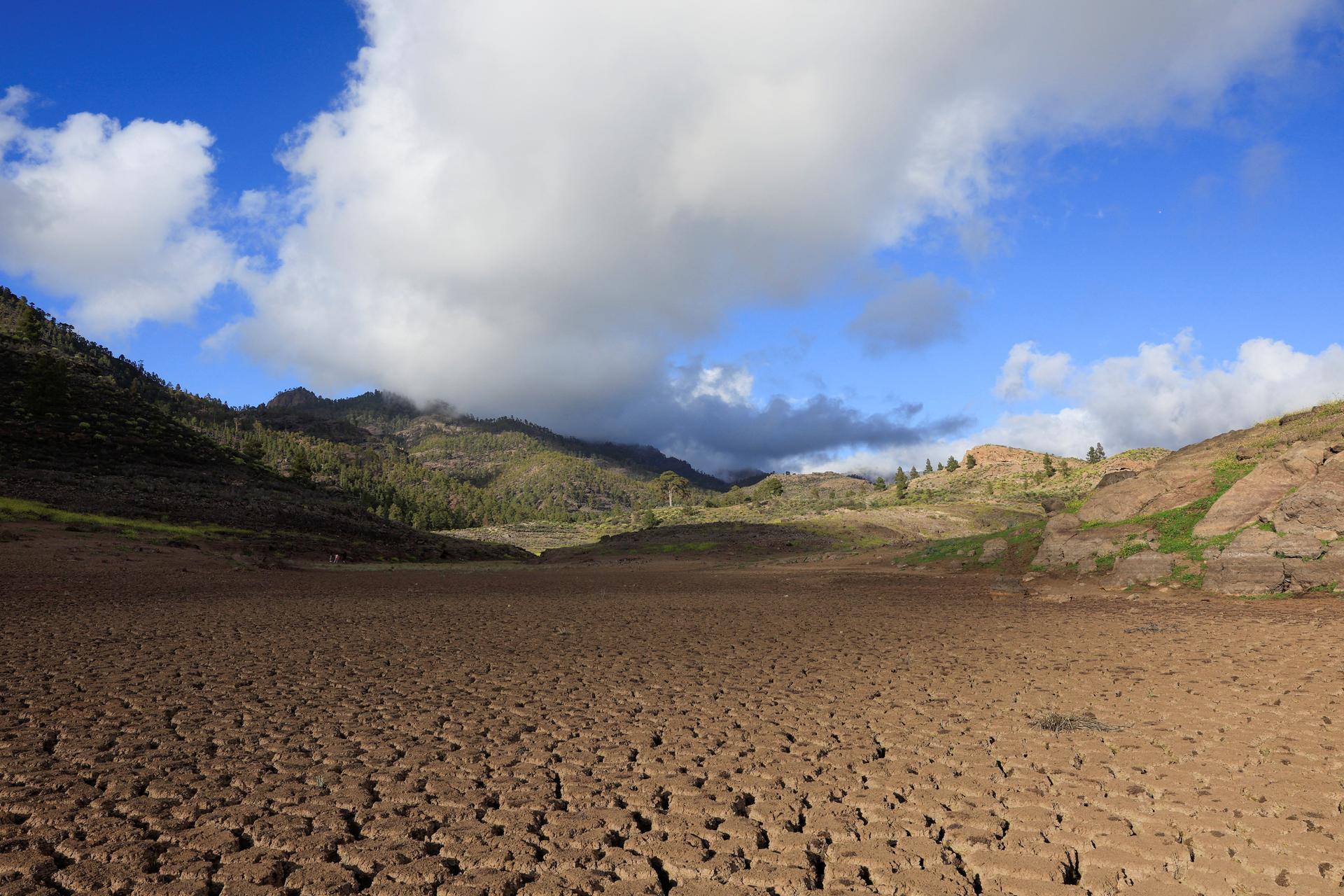
A general view of parched land at Cueva de Las Ninas reservoir while strong drought continues in the island of Gran Canaria, Spain. REUTERS/Borja Suarez |
U.S. President Donald Trump – and vocal climate-change skeptic – has rolled back a series of environmental policies over the past year, which has contributed to the environmental agenda being challenged across the globe.
Just last week, Trump’s administration repealed the "endangerment finding", the foundation for federal climate regulations. Click here for a Reuters story on what that means for businesses as they struggle to navigate an uncertain future of multiple national, state and regional rules.
The latest climate rollback – a boon for automakers that will be freed of costly tailpipe emissions standards – also comes as the World Meteorological Organization's (WMO) Global Atmosphere Watch network showed concentrations of carbon dioxide, methane and nitrous oxide climbing to record highs, fueling the temperature spike observed from 2023 to 2025, scientists say.
Last year, Trump addressed the U.S. Department of Energy in a post on his social media platform Truth Social encouraging it to "drill, baby, drill", a message he is pushing in Venezuela following the U.S. capture and transfer of the country’s President Nicolas Maduro.
Trump has enacted policies that he says would unleash American energy and lower prices at the pump.
Additionally, U.S. power consumption hit its second straight record high in 2025, and will rise further this year and in 2027, according to the Energy Information Administration. But what does this mean for global carbon dioxide emissions?
Well, global fossil fuel CO2 emissions are projected to climb to a record 38.1 billion metric tons in 2025, driven by rising coal, oil and gas use despite rapid growth in renewable energy, according to the latest Global Carbon Budget report. |
|
|
Keeping with the rapid growth of renewables, while America is on track to boost its fossil fuel use, Europe and China have doubled down on clean energy.
Last month, nine European governments committed to accelerating the expansion of offshore wind power through large-scale, cross-border projects, to hit their overall target of 300 gigawatts (GW) of offshore wind capacity by 2050, according to a draft summit declaration, seen by Reuters.
In fact, wind and solar power produced more electricity than fossil fuels in the EU for the first time last year, according to data from energy think-tank Ember.
The same can be said for China which drew 51% of its energy from clean sources last year, data from Global Energy Monitor shows. So, what’s the conclusion? These major countries are making a sustainable switch, so what gives?
Well, researchers warn there is only room for about 170 billion more tons of CO2 — equivalent to roughly four years of emissions at current rates – if the world wants to cap global warming at 1.5 degrees Celsius (34.7 degrees Fahrenheit) above the pre-industrial average.
While the EU has ambitious targets to cut greenhouse gases – the main cause of climate change – its efforts have fallen short on adapting to the extreme weather climate change is already fueling, according to the EU's adviser, the European Scientific Advisory Board on Climate Change.
Click here to read more about what EU independent advisers are requesting to combat climate change effects. |
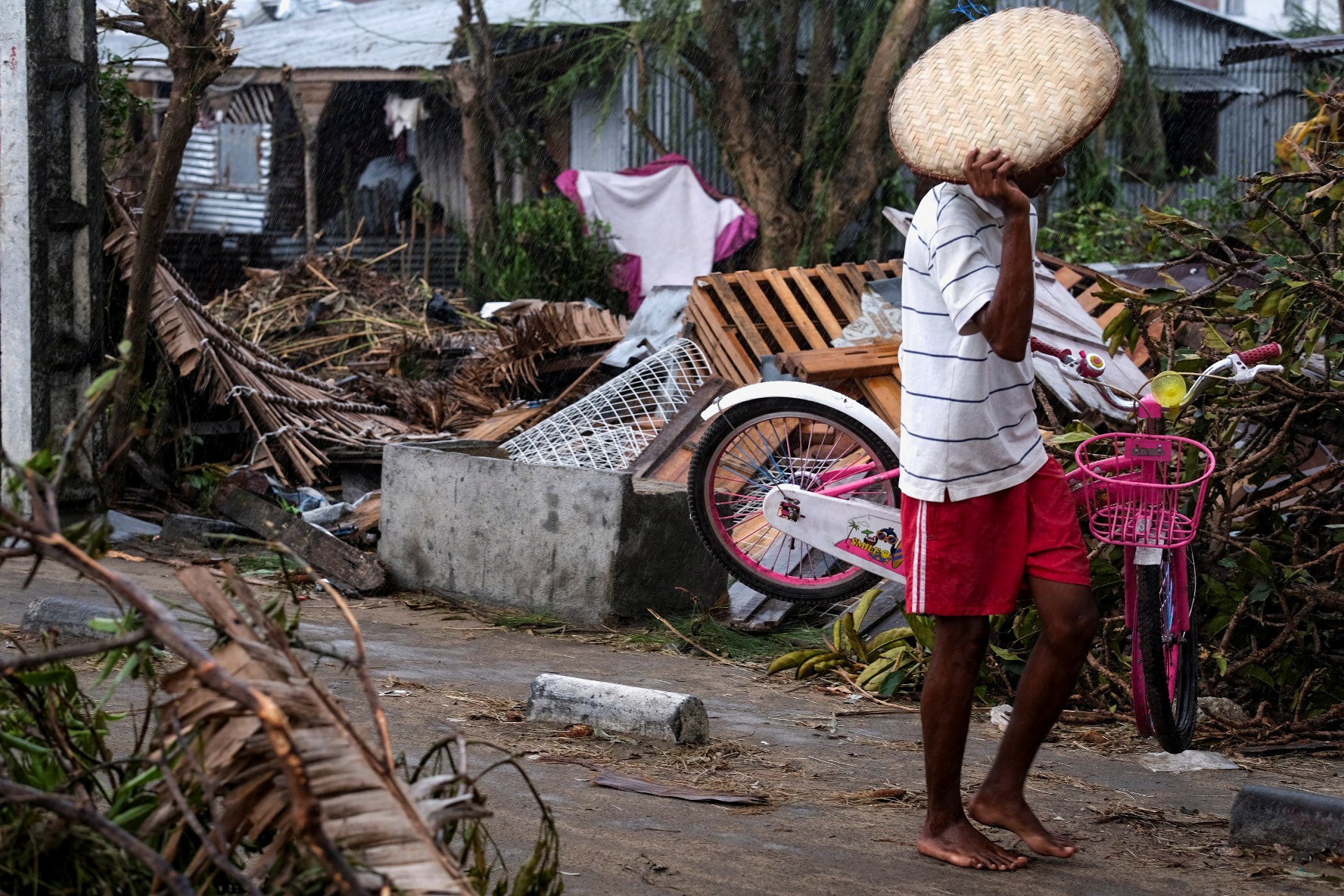
A man walks with his belongings after Cyclone Gezani tore through the port city of Toamasina, on the island of Madagascar, leaving a trail of destruction. REUTERS/Stringer |
-
Cyclone Gezani: East Africa’s island nation of Madagascar has been battling with a fierce cyclone over the weekend, which has left at least 59 people dead, the disaster management office said on Monday. The cyclone displaced 16,428, while 15 people remain missing, 804 were injured and 423,986 were classified as affected by the disaster, the National Bureau for Risk and Disaster Management (BNGRC) said. Click here for more.
-
Morocco's rain: Over in North Africa, most residents of Morocco’s city of Ksar El Kebir are now allowed to return home after major floods caused overflowing river waters that swept across 110,000 hectares in the northwest last week, the interior ministry said. The exceptional rainfall ended a seven-year drought that had pushed the country to ramp up investments in desalination.
-
Iberian storm: Deadly downpours, thunder, snow and strong gales have repeatedly battered Spain and Portugal, damaging infrastructure and crops and forcing authorities to evacuate thousands of people. One woman died in Barcelona on Friday after she was hit by a piece of warehouse roof blown down by the eighth storm to sweep across the Iberian Peninsula this year, officials said.
-
New Zealand storm: Heavy rainfall and fierce winds disrupted flights, trains and ferries, forcing the closure of roads across large parts of New Zealand's North Island on Monday. Tens of thousands lost power as the storm swept through, leaving behind flooded semi‑rural neighbourhoods, inundated homes, fallen trees and collapsed roads once the waters receded.
- Snowfall and the Olympics: Heavy snow scrambled the Winter Olympics schedule in the Italian town of Livigno on Tuesday as organizers cancelled the women's snowboard slopestyle medal event and delayed the start of the qualifying round in freestyle skiing aerials. Temperatures hovered at a chilly minus 6 Celsius.
|
|
|
Reverend Jesse Jackson walks with assistance during a protest in the wake of Kyle Rittenhouse's "not guilty" verdict in Chicago, Illinois, U.S. REUTERS/Cheney Orr |
Today’s ESG spotlight commemorates the life of the charismatic U.S. civil rights leader Jesse Jackson, who has died at the age of 84.
Jackson was an eloquent Baptist minister raised in the segregated South who became a close associate of Martin Luther King Jr and twice ran for the Democratic presidential nomination.
"Our father was a servant leader – not only to our family, but to the oppressed, the voiceless, and the overlooked around the world," the Jackson family said in a statement. Click here for the full obituary. |
|
|
Sustainable Switch was edited by Emelia Sithole-Matarise. |
|
|
|