| | In today’s edition: Apple News and the regulators. ͏ ͏ ͏ ͏ ͏ ͏ |
| |  Cupertino Cupertino | Washington | London |
 | Media |  |
| |
|
 - Apple in Washington
- Warner wiggles
- Mixed Signals
- Epstein and Nautilus
- Crypto takedowns?
- Guardian’s new pod
- Data disconnect
|
|
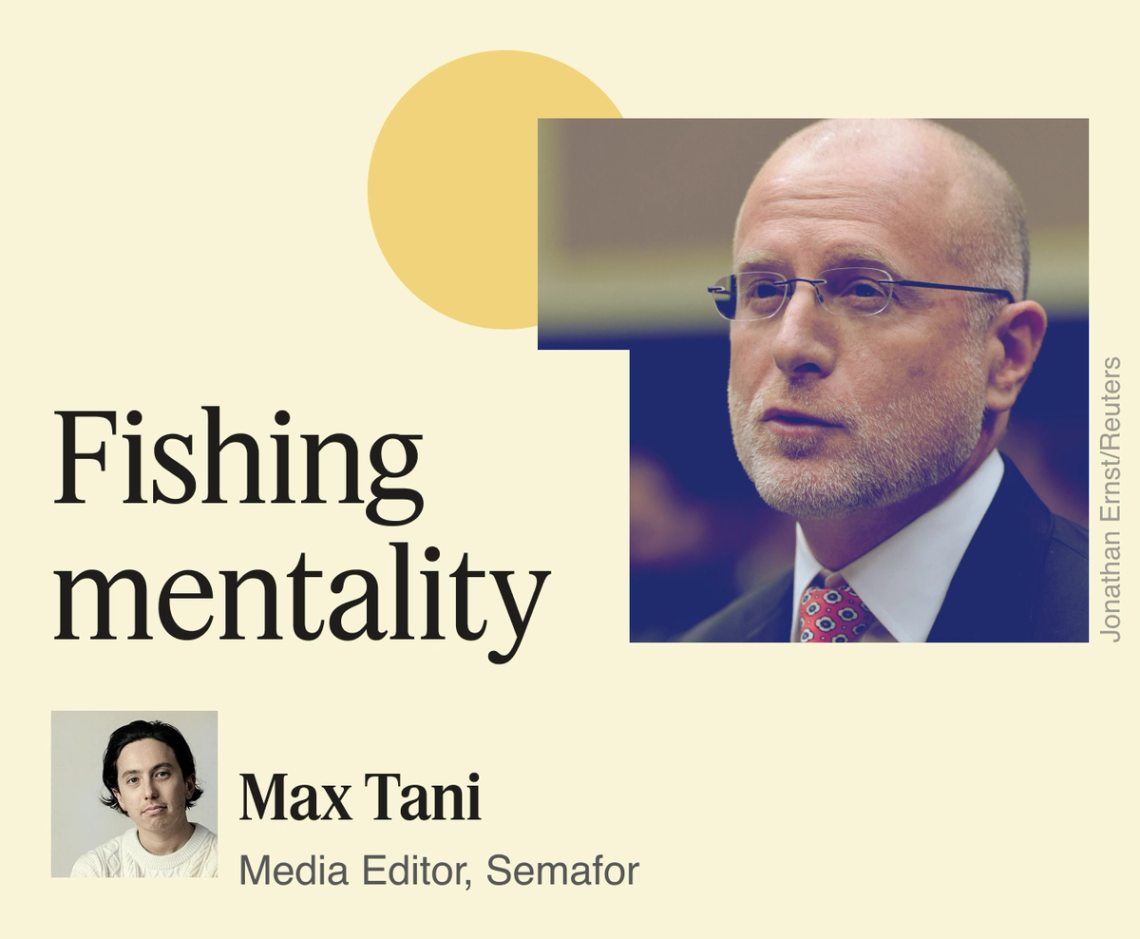 President Donald Trump’s regulators have spooked the media. But are they actually as powerful as they make themselves out to be? Last week, the Federal Trade Commission sent a warning to Apple that the company may have violated its own terms of service by refusing to include conservative content in its Apple News mix. FCC Chairman Brendan Carr, Trump’s most aggressive media regulator, quickly applauded it. Carr’s team also spent part of last week looking for ways to capitalize on some of the conservative outrage over Bad Bunny’s halftime performance by seeing if the singer had violated any regulations around “indecent material.” Both moves got a lot of attention, but seem unlikely to go very far. Apple seems pretty insulated from the FTC, despite the regulator’s creative complaint. And according to the New York Post’s Charles Gasparino, the FCC’s probe into Bad Bunny’s half time performance was seemingly over before it began. In the first year of Trump’s second term, his regulators cast a major shadow over the media business, regularly compelling big media companies to acquiesce to their needs. But with a less aggressive antitrust posture in general, some stalled regulatory moves, and the potential for a Democratic Congress in 2027 waiting to go after companies that have bowed to the administration, it will be interesting to see whether major media companies decide that tangling with the regulators isn’t as scary as it seemed a year ago. We’ll be sure to ask Carr about it when he returns to our media summit later this month in Washington (more on that below). Also today: A science magazine founder’s emails to Jeffrey Epstein and some unusual behavior by cryptocurrency news sites. |
|
Apple News’ political honeymoon is over |
 Photo: Evelyn Hockstein/Reuters; Illustration: Joey Pfeifer/Semafor Photo: Evelyn Hockstein/Reuters; Illustration: Joey Pfeifer/SemaforThe FTC’s letter to Apple over Apple News last week represents an escalation in pressure from the Trump administration and its allies on the right against one of the most important remaining platforms for news. “We’ve got a ‘fish where the fish are’ mentality,” David Bozell told Semafor. Bozell’s group, the Media Research Center, is ramping up the pressure on news aggregators, and was behind a series of informal studies of the political valence of Apple News content that grabbed the attention of regulators and the White House. And while Apple has largely stayed silent so far in response, Max writes about a recent little-noticed example in which Apple caved when faced with potential regulatory scrutiny of its news product in the UK. |
|
WBD leans toward Paramount |
 Mike Blake/Reuters Mike Blake/ReutersAfter weeks of back-and-forth, the battle for control of Warner Bros. Discovery may be tilting toward Paramount. Warner Bros. directors are leaning towards opening negotiations with the Ellison-backed company, according to people familiar with the matter. That would open the door for Paramount to further improve its bid, should Warner’s board meet and formally designate Paramount’s bid “potentially superior” to the rival Netflix offer. Shareholders have been putting significant pressure on Warner to open talks — prompted in part by a public display of dissatisfaction from Pentwater Capital, a big owner. Warner Bros. also finds itself in a tricky position: Netflix previously threatened to pull out of bidding if it wasn’t promised exclusivity, a threat which galvanized Warner’s board enough to sign a deal. The company has a fiduciary obligation to maximize value for shareholders, but it also cannot risk Netflix walking away. Regulatory concerns for Netflix also loom large. The European Commission is skeptical of consolidation. And Trump’s US antitrust enforcers have already signaled they will be giving the current Netflix-Warner Bros. tie-up intense scrutiny, according to people familiar with the matter. — Rohan Goswami |
|
Rolling Stone scion on ‘Track Star’ and algorithms |
 Gus Wenner, chairman of Rolling Stone and son of the magazine’s legendary founder, has spent years balancing the brand’s print heritage with its digital transformation. On this week’s Mixed Signals, Ben and Max talk with Wenner about his new holding company, Wenner Media Ventures, and why he thinks algorithms disrespect audiences. They also discuss the venture’s investment in the hit video series Track Star, his defense of Rolling Stone’s most provocative journalism, and his media investments coming later this year. |
|
Science magazine founder courted Epstein |
 Justice Department/Handout via Reuters Justice Department/Handout via ReutersNew emails reviewed by Semafor show that the founder and publisher of the prestige science magazine Nautilus assiduously courted Jeffrey Epstein, then a convicted sex offender, in pursuit of funding for the chronically insolvent publication. John Steele lunched with the disgraced financier at Epstein’s Manhattan townhouse in 2017, after getting an introduction from backer Larry Summers. Afterward, he tried comparing his own recent public labor fight with freelancers to Epstein’s sex crime conviction: “Jeffrey, As someone who is no stranger to controversy… I thought you might appreciate how I spent my day yesterday,” he wrote. Steele eventually wrangled $25,000 from Epstein, as first reported by NBC News in 2019. Steele later said he’d donate it to charity, but Fragment Media, which now owns Nautilus, could not confirm the donation ever happened. — Brendan Ruberry |
|
Crypto news sites take down posts |
 Dado Ruvic/Reuters Dado Ruvic/ReutersEarlier this month, the crypto public relations and communications firm Chainstory released a study the company conducted saying that many crypto press release “wires” have been paid to promote risky products. The study was covered fairly widely within the crypto space, garnering links in Coinbase, Cointelegraph, and other outlets. But some sites later deleted their writeups of the study. Investing.com, one of the biggest business-focused digital news and investing sites, ran a piece titled, Crypto press releases dominated by high risk projects, chainstory study finds. But within a few days, it had been taken down without explanation. Crypto Potato, a niche news site popular among crypto enthusiasts, also wrote up the study, only to delete it later. Neither site shared with Semafor why they removed the articles. But one person familiar with the decisions told Semafor that at least one executive from a company described by the survey had reached out to multiple outlets asking for the pieces to be taken down, arguing that the survey data was faulty and biased. |
|
The Guardian debuts new flagship podcast |
 The Guardian’s podcast page in Apple Podcasts. The Guardian’s podcast page in Apple Podcasts.The Guardian’s growing US outpost is launching a daily video podcast later this year, Semafor has learned, to compete with the likes of The New York Times and NPR. The show will be co-hosted by WNYC host Kai Wright and The Guardian’s Carter Sherman, and will have a staff of 10 employees. A spokesperson for The Guardian emphasized that unlike other daily podcasts, it would be launching in a video format, with a YouTube-native feel that could be easily clipped for Instagram and other platforms. The new show is “a chance to show more Americans the Guardian’s unique brand of journalism: global, independent, and free,” Guardian US editor Betsy Reed told Semafor. The left-leaning UK news brand doubled its US presence last year, and now has more than 200 staffers based stateside. |
|
Nice work if you can get it |
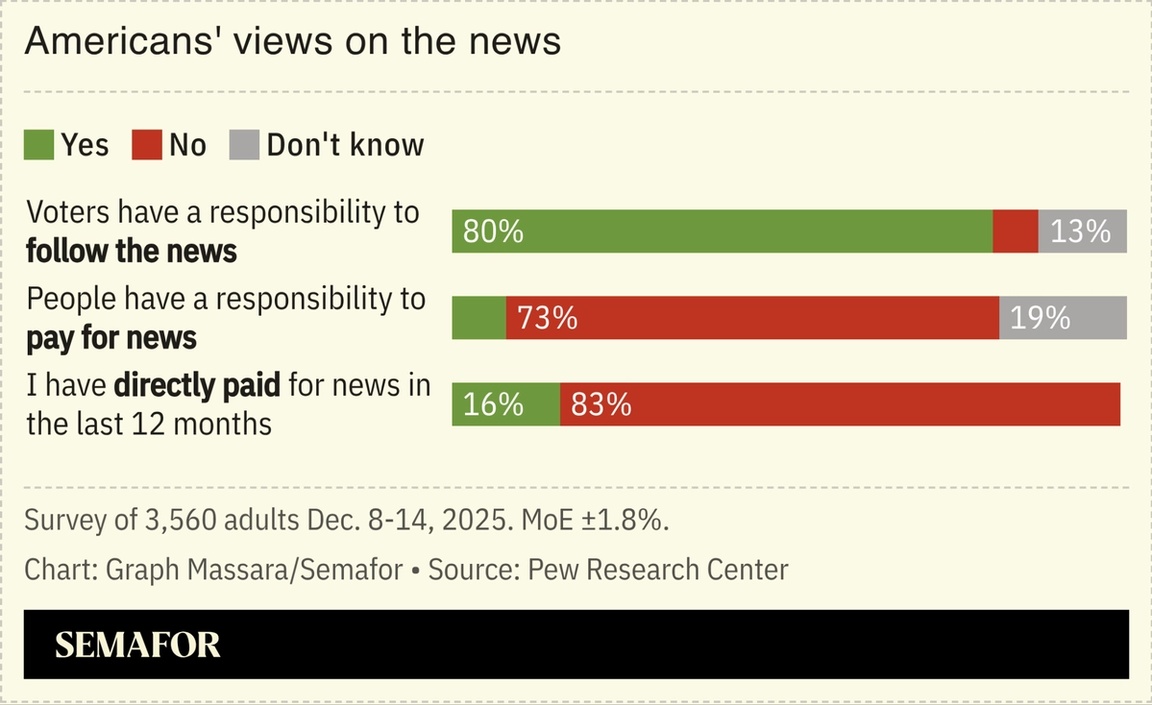 Good news: Seventy-one percent of news organizations are doing well financially. At least, that’s what the Americans Pew polled about their news habits late last year believe. Pew recorded those answers before The Washington Post’s very public bloodletting this month, but other data points buried in this broad survey show similar disconnects: Eighty percent of Americans said voters have a responsibility to keep up with the news, but just 8% said they had a responsibility to pay for it. Asked how news outlets should make money, a strong plurality said they should sell ads and sponsorships in lieu of a paywall — a tough business these days, given AI’s cannibalization of web traffic. (The second-most popular choice was “not sure,” which will ring true to the cash-strapped 29% of news organizations.) — Graph Massara |
|
 Semafor will host its annual Trust in Media Summit in Washington, DC on February 25, convening the industry’s most influential leaders for timely conversations on media credibility and the shifting dynamics of media power. Semafor editors and reporters will be joined by leading voices in media, including: Brendan Carr, Chairman, FCC; Matt Murray, Executive Editor, Washington Post; Kristen Welker, Moderator, Meet the Press and Anchor, Meet the Press NOW; Mathias Döpfner, CEO, Axel Springer; Jacqui Heinrich, Senior White House Correspondent and Anchor of The Sunday Briefing on FOX News Channel; Maribel Pérez Wadsworth, President & CEO, Knight Foundation; Deborah Turness, Former CEO, BBC News; and Hamish McKenzie, Co-Founder & Chief Writing Officer, Substack. Request an invitation to join the conversation as it happens live. Feb. 25, 2025 | Washington, DC | Request Invite |
|
|


