|
MAIN FEATURE
HOW TO ENGINEER PERPETUAL CASHFLOW
Let's say you want $140,000 in tax-free spending money. You don't borrow $140,000. You borrow $150,000.
Here's where it goes:
-
$10,000 → goes into an Interest Reserve Account (makes your monthly payments for 12 months)
-
$140,000 → goes to you as tax-free liquidity
The lender holds the $10,000 in a separate account. Every month, they automatically deduct your payment from that reserve. You never touch it. You never think about it. It just handles itself.
For 12 months, you have zero payment obligations. The debt services itself.
Now, this isn't some exotic strategy. This is standard practice in hard money lending, real estate financing, and commercial credit. When I was doing creative financing and purchase order financing in California, every hard money lender required this.
If I wanted $1 million to build a property, they'd charge 10% interest. $100,000 per year. So they'd loan me $1.1 million, hold $100,000 in an interest reserve, and make the payments for me automatically.
It removes the entire mental burden of "how do I make the payment?"
Because you don't. The structure makes it for you.
The Rolling Debt Strategy: Infinite Runway
Okay, but what happens after 12 months when the interest reserve runs out?
This is where it gets really interesting.
You don't pay off the debt. You roll it forward.
Here's how it works over time:
Year 1: You borrow $150,000.
Year 2: Bitcoin appreciates. Your collateral is now worth more. You borrow $300,000.
Year 3: Bitcoin appreciates again. You borrow $450,000.
Year 4: You borrow $600,000. Pay off $450K. Keep $150K.
Do you see the pattern?
Your debt is growing, but your collateral is growing faster. As long as Bitcoin appreciates faster than your debt accumulates, you have infinite runway.
You never make a payment out of pocket. You never sell Bitcoin. You never trigger capital gains.
The asset funds the lifestyle. Forever.
When to NEVER Pay Off Debt
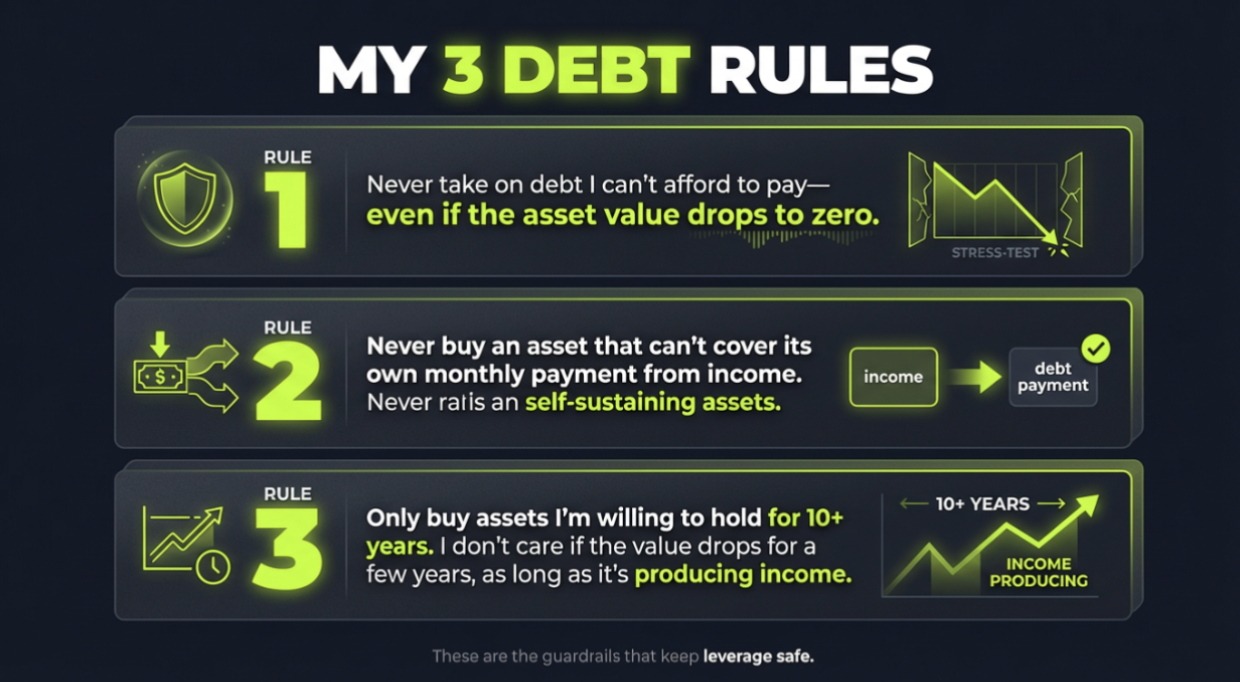
Here's the rule: As long as asset appreciation exceeds debt cost, never pay off the debt.
If Bitcoin grows 30% per year and your borrowing cost is 5%, you're capturing a 25% spread. Why would you ever pay that off?
You wouldn't.
You'd keep rolling it forward, compounding the asset, and living off the liquidity.
This is what Michael Saylor does at Strategy. This is what treasury operations are built on. This is what generational wealth looks like.
Your grandkids don't inherit $300 million that they're tempted to sell. They inherit $300 million in Bitcoin with $30 million in manageable debt (10:1 ratio), and they continue the cycle.
They borrow. They never sell. They pass it down again.
That's how wealth compounds across generations.
Why This Removes the Biggest Mental Block
Most people don't use leverage because they're afraid of the payment.
But the payment isn't the problem. The payment is a design variable.
You design where it comes from:
-
Interest reserve account (pre-funded)
-
Asset cash flow (real estate, miners, dividends)
-
Rolling refinance (borrow more, pay off old debt)
-
Layer Two liquidity (cash equivalents, lines of credit)
Once you understand this, leverage isn't scary. It's a tool.
It's like jumping in a pool. If you don't know how to swim, it's terrifying. But if you know how to swim, it's not scary at all.
I was scared of leverage in 2007 because I didn't structure it properly. By 2016, I understood the rules. And once I did, it wasn't scary anymore.
|