| | In this edition, why Wall Street still doesn’t get AI capex spending, and OpenAI considers a ChatGPT͏ ͏ ͏ ͏ ͏ ͏ |
| |  | Technology |  |
| |
|
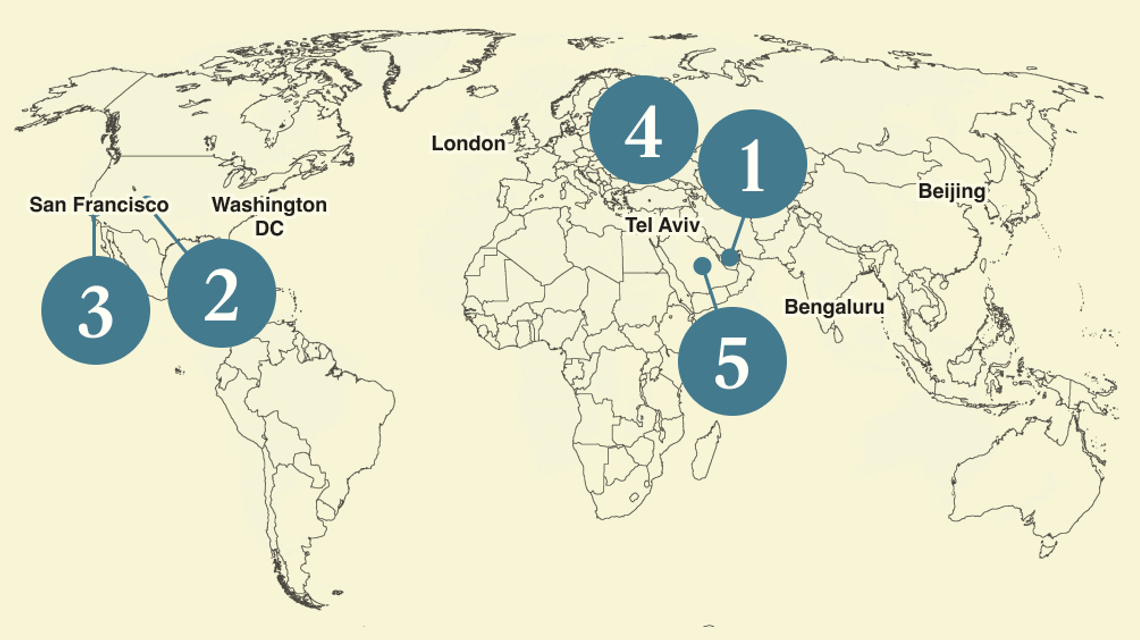 - GPT for UAE
- Crusoe enters the cloud
- AI pulse check
- Starlink becomes target
- Saudi ups defense tech
 Why market panic about Anthropic’s new plugins was likely misplaced, and a startup uses underwater robots to learn more about sea currents. |
|
 Earlier this week, Anthropic released new plugins for specific industries, from legal to finance to biotech research, sending shivers down the spine of Wall Street. Anthropic was making it clear: We are coming for your jobs. Software stocks plummeted. Obituaries for big law firms were written. Goodbye consultants. Amazon, which built the world’s largest computer for Anthropic’s AI models, said Thursday that it plans $200 billion in capital expenditures this year, mostly for more data centers. Its shares promptly fell because, well, Wall Street doubts if this AI stuff is really useful enough to warrant such a big investment. 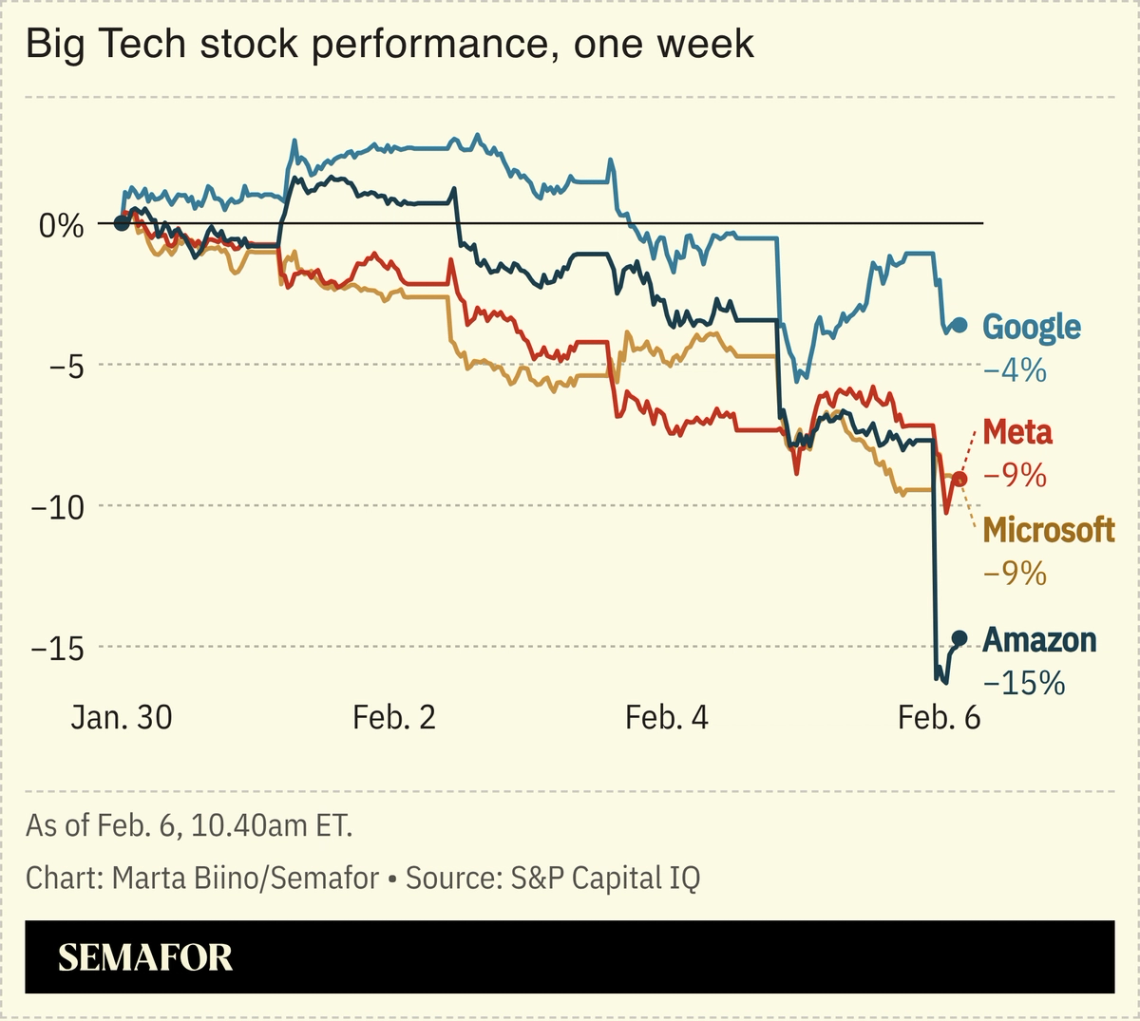 If you’re confused by the mixed message, you should be. The way the market views AI is completely irrational, driven more by viral “it’s so over” X posts than logic or fundamentals. A year ago, DeepSeek released an AI model that was so efficient that it tanked Nvidia’s stock. The rationale: AI is getting cheaper, so nobody is going to need powerful computers to run it. But the fear was misguided: In this market, efficiency only increases demand for more compute. This week was Anthropic’s “DeepSeek moment.” The best way to think about AI is like the next wave in the computer revolution that began in the 1950s. The more monumental the invention, the longer adoption takes. There are probably people born in 1945 — the year the first general-purpose electronic computer went into operation — who retired before learning to type. Things move faster these days, but there are still huge companies that rely on database software built in the 1970s. They can’t snap their fingers and become AI native, even if they want to. Almost every company I have talked to that is trying to build AI applications for businesses is embedding some form of “forward deployed engineer” just to get the implementations to work. Making the AI revolution happen is going to take a herculean effort. It requires a generation of entrepreneurs to step in and build the necessary connective tissue. You can’t just release a “lawyer plugin” and expect big law firms to pack their bags and go home. And, let’s be honest, investors in frontier model providers like Anthropic wouldn’t like that outcome. AI companies need businesses that buy their products and employees that use them. AI is going to make people a lot of money and there will certainly be disruption. Software companies and tech consultancies that can’t find ways to become indispensable will disappear. But it won’t happen overnight and it won’t happen to all of them. This is a big deal, but it’s so not over. |
|
OpenAI, G42 in talks to create UAE version of ChatGPT |
 Ken Cedeno/Reuters Ken Cedeno/ReutersOpenAI is working with Abu Dhabi-based G42 to build a new version of ChatGPT tuned for the UAE to accommodate local language, political outlook, and speech restrictions, according to people familiar with the matter. The fine-tuned version is being designed for use by the country’s government, OpenAI officials told Semafor. When complete, it will be one of the first examples of a local implementation of the popular chatbot, offering a glimpse into how American tech companies will handle a global AI expansion that may require regional versions of the technology. The UAE, which has been ahead of the curve on AI adoption, has for years sought to develop its own AI models that are proficient in Arabic and reflect the country’s culture and values. At the same time, the cutting-edge frontier models like the ones that power ChatGPT are out of reach for all but the world’s two AI superpowers, the US and China. Details are still being worked out, but the final result is expected to be a fine-tuned version of ChatGPT that is fluent in the local Arabic dialect and may come with content restrictions. One person who worked on the project said the UAE hopes the chatbot will project a political line consistent with the monarchy’s. G42 is the AI conglomerate chaired by Sheikh Tahnoon bin Zayed Al Nahyan, an Abu Dhabi royal and brother of the UAE president who also serves as the government’s national security adviser, and leads the country’s biggest sovereign wealth fund. |
|
Crusoe jumps into cloud services |
 The Abilene, Texas data center site in September 2025. Shelby Tauber/Pool/Reuters. The Abilene, Texas data center site in September 2025. Shelby Tauber/Pool/Reuters.Crusoe, the startup developing OpenAI’s massive Stargate data center in Texas, is launching a new cloud computing product, putting it in direct competition with hyperscalers, and possibly even OpenAI. The move is part of a trend among neocloud companies to offer higher-margin services on top of the data centers they’re building. Erwan Menard, senior vice president of Crusoe Cloud, told Semafor that his pitch to customers is that they can get better performance and lower costs with Crusoe than with major cloud providers, because it can offer more “technical intimacy” than a hyperscaler — which is typically more focused on the biggest AI models. Eventually, Menard said, Crusoe envisions having lots of smaller data centers, focused on inference, that will be spread around the country, putting them closer to end users and improving latency. |
|
The team behind Fitbit is back with an AI health app |
 Courtesy of Luffu Courtesy of LuffuThe team behind Fitbit is launching a new consumer health company, betting on AI to help people wade through the morass of family health care. Called Luffu, the app tracks a person’s diet, fitness, daily activity, and lab results, and paints a comprehensive picture of a person’s health over time. It shares information with family members and flags changes to caretakers, such as an adult child of an aging parent. Beyond the promise of fixing one of the world’s most vexing stresses, Luffu points to the burgeoning market for AI startups focused on serving average consumers rather than big businesses. Much of the AI hype comes from the B2B market, while average consumers haven’t yet committed to spending their own dough on the products they use. If Luffu hooks the market, it might be the first to do so. Free chatbots aside, it’s too early to point to any successful direct-to-consumer AI company, Luffu cofounder James Park told Semafor. Luffu is still working on pricing, but Park compared the app to emergency response systems like Life Alert, which cost between $30 and $50 a month. Using bots to better track health information sounds great in theory, but in reality, the inputs still rely on inherently lazy, distracted, or busy human beings. For example, Luffu can alert a user that they haven’t taken their medication, but only if the user is diligently recording when they take their medicine. Luffu says it’s working on integrations with medical providers and devices to streamline some of the data entry, and is easing the manual workload by making inputs easier through voice prompts and photo submissions. But before its bots can revolutionize family health care, Luffu must first solve the human problem. |
|
 When now-President Donald Trump decided to put on an apron and serve customers at a McDonald’s drive-thru on the 2024 campaign trail, it put Tariq Hassan, then McDonald’s chief marketer, in a tight spot. On this week’s Mixed Signals, Ben and Max sit down with the former Golden Arches CMO to discuss the Trump episode, why he thinks admakers should still engage with journalists, and what goes into a good celebrity Super Bowl ad. Listen to the latest Mixed Signals now. |
|
Starlink falls target to geopolitical conflicts |
 Inna Varenytsia/Reuters Inna Varenytsia/ReutersElon Musk’s Starlink satellite internet venture is increasingly being seen as critical infrastructure that can be targeted or exploited in geopolitical conflicts. French authorities on Thursday accused two Chinese nationals of trying to intercept sensitive military data using Starlink from an Airbnb rental. And Russia, which is not allowed to use Starlink, has been illegally mounting Starlink systems on its attack drones, according to researchers. However, Ukraine said the same day that Moscow’s terminals had been “cut off,” in a blow to Russia’s military communications. Global disasters have paved the way for Starlink’s expansion and for the possibility of a borderless internet, making it more difficult for nations to restrict or censor access. Such was the case when activists in Iran used Starlink after Tehran imposed internet blackouts last month. Governments have been able to “jam” signals, or slow the connections down, and while SpaceX has thwarted some attacks, it isn’t yet immune to them. |
|
Saudi, US bolster defense tech investments |
 MASNA Ventures co-founder Lucien Zeigler. Courtesy of MASNA Ventures. MASNA Ventures co-founder Lucien Zeigler. Courtesy of MASNA Ventures.MASNA Ventures, a firm cofounded by American entrepreneur Lucien Zeigler, is launching Saudi Arabia’s first defense-focused venture capital fund to back technology companies in the US and other allied countries, Semafor’s Matthew Martin scooped. It is aiming to raise at least $100 million from US and Saudi investors and will help companies establish manufacturing operations in the kingdom. MASNA’s fund plans to do about 10 deals, initially targeting drone and counter-drone systems, precision-guided munitions, and AI-enabled defense systems. The initiative highlights the growing, tech-centric relationship between the US and Saudi Arabia. The crown prince’s visit to the White House late last year to sign a strategic partnership spurred a wave of investments and deals between the two nations. Among them were the US approving advanced chip exports to the Gulf and data-center deals between US tech companies and HUMAIN, Saudi’s sovereign wealth fund-backed AI company. |
|
 You could never read all of Medium. But every week, the Medium Newsletter collects the most thought-provoking and timely writing from our community of experts and enthusiasts. You’ll get advice from academics, firsthand accounts of history unfolding, and wisdom to get you through hard days. Subscribe now. |
|
|


