What matters in U.S. and global markets today

Global news you can trust.

Download the Reuters App.


Morning Bid U.S.

Morning Bid U.S.

A Reuters Open Interest newsletter

What matters in U.S. and global markets today


By Mike Dolan, Editor-at-Large for Finance and Markets

The AI wave clearly doesn't float all boats. Tuesday's withering shakeout in the shares of software, data analytics and professional services operations shows how new AI development can cut both ways. Other tech firms also suffered, with Microsoft hit again and AMD down sharply out of hours despite a forecast-beating headline earnings beat.

Against that backdrop, Walmart - an early adopter of AI in its processes - became the first retailer ever to top $1 trillion in market valuation on Tuesday. This caps off a year-long rally which has seen its shares soar nearly 26%, vaulting it into the ranks of the tech heavyweights.

I’ll get into that and more below.

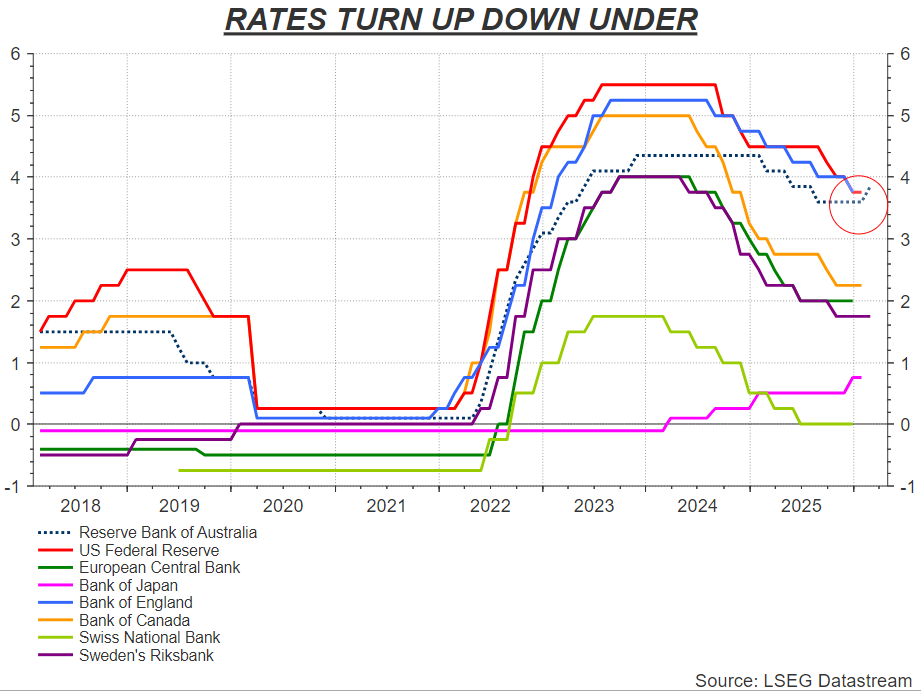
But first, check out my latest column on why Australia's recent rate hike may be a wakeup call for global central banks

And listen to the latest episode of the Morning Bid daily podcast. Subscribe to hear Reuters journalists discuss the biggest news in markets and finance seven days a week.


Data refreshes every time you open this email. For more U.S. market news, click here. Please send any feedback to morningbid@thomsonreuters.com.


Today's Market Minute

  • A significant selloff among data analytics, professional services and software companies deepened on Tuesday, with some investors pointing to a recently updated AI chatbot by Anthropic as the main culprit.
  • The U.S. military on Tuesday shot down an Iranian drone that "aggressively" approached the Abraham Lincoln aircraft carrier in the Arabian Sea, the U.S. military said.
  • Walmart became the first retailer ever to hit $1 trillion in market valuation on Tuesday, placing it among the ranks of Big Tech heavyweights.
  • Amid internal and external challenges, Europe needs clarity of purpose and a bold plan to achieve it, argues Eurizon SLJ's Stephen Jen.
  • President Trump’s focus seems to be shifting to long-term borrowing costs, but Fed Chair nominee Kevin Warsh will struggle to deliver on that front, writes ROI Markets Columnist Jamie McGeever.
 

AI scatters the tech herd

The trigger for the ongoing selloff in global software stocks was actually news from last Friday that AI firm Anthropic had launched a new AI “agent” for automating work tasks. The fact that it took almost two full trading days to land shows how much it blindsided investors, even though recent months have seen markets discriminate much more ruthlessly between winners and losers from AI in the digital and tech space.

Alphabet's results after Wednesday's bell will test the mood further. After major Wall Street indexes lost about 1% or so on Tuesday, Nasdaq futures remained in the red early today. Around the world the tech herd was similarly scattered, with hardware and chip firms in Asia continuing to do well but software firms in India also getting caught in the downdraft.

Elsewhere, European pharma giant Novo Nordisk slumped almost 20% after the Wegovy maker warned about this year's profit outlook amid fierce competition in the weight-loss drugs world.

Back in macro markets, investors are trying to parse signs of an acceleration in economic activity flagged by the sharp jump in ISM's manufacturing index, brisk business loan growth in the Fed's quarterly loan officers survey and even the slightly jarring sight of Australia raising interest rates this week.

ISM's service sector report for last month is due later, with ADP's private sector jobs report also due. Even though the House of Representatives voted on Tuesday to end this week's partial government shutdown - at least for another 10 days - it's too late to ensure a full January employment report this week.

Overseas, service sector surveys were slightly below forecast in Europe, but they picked up steam in Japan and China.

With one eye on tomorrow's European Central Bank and Bank of England policy meetings, currencies were a bit calmer. But the yen fell again ahead of weekend elections in Japan, and China's yuan briefly strengthened to its best levels in almost three years as the Lunar New Year holiday nears.

Gold continued its recovery and oil spiked amid a fresh flare-up in U.S.-Iran tensions that saw the U.S. military down an Iranian drone on Tuesday. Bitcoin struggled to stabilize after hitting its lowest level since before the U.S. election in 2024.


Warning from 'Down Under' may unsettle the Fed

The world's central banks - and many bond investors - may look at Australia's decision on Tuesday with some discomfort. The Reserve Bank of Australia delivered its first interest-rate rise in more than two years, a move that could herald a broader shift in global credit policy as the world economy heats up again.

Japan's peculiar circumstances apart, the RBA is the first major central bank since 2023 to hike rates — and just six months after its last cut.

Although expected by markets, the RBA also leaned hawkish about further hikes. It was coy about whether a new tightening cycle was now underway. But officials were clearly disturbed at their inability to get inflation back to target and doubtful that previous settings were doing the trick.

The debate also circles the thorny concept of where a so-called neutral interest rate may be. It's a question at the heart of the Federal Reserve's conundrum, despite political noise and pressure for it to floor rates even further.


Graphics are produced by Reuters.

Read the full column