| | The US and India reach a trade deal, more overseas Chinese graduates are returning home, and geopoli͏ ͏ ͏ ͏ ͏ ͏ |
| |  BOGOTÁ BOGOTÁ |  RAWALPINDI RAWALPINDI |  SHENZHEN SHENZHEN |
 | Flagship |  |
| |
|
The World Today | 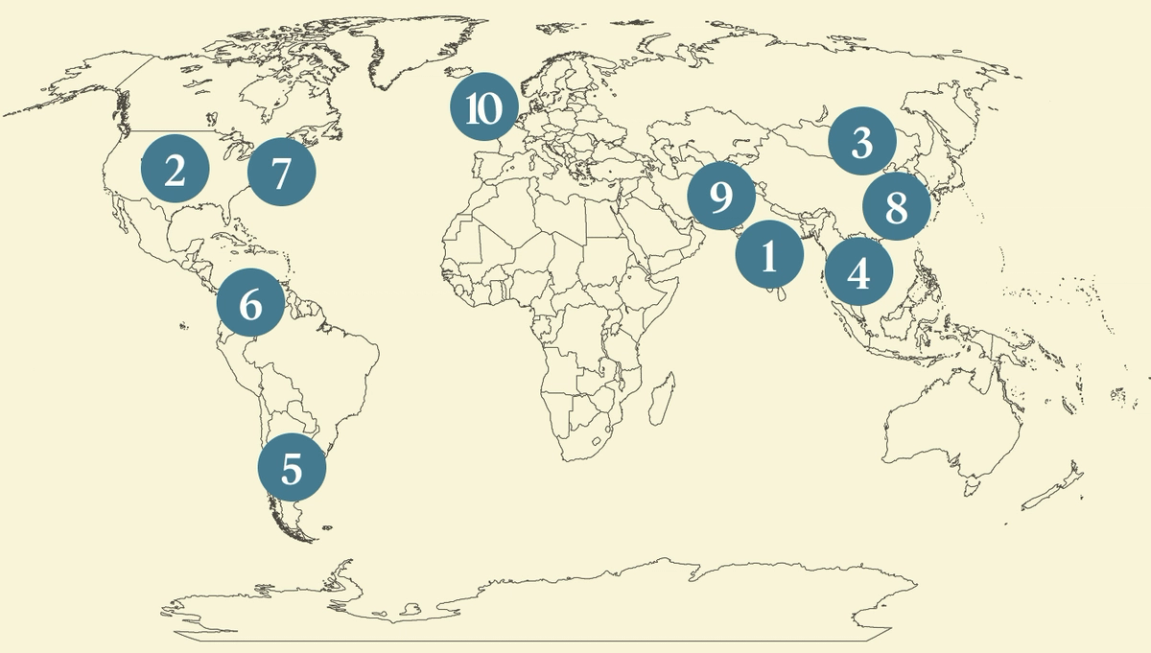 - India, US reach trade deal
- Trump’s rare earth stockpile
- China sees uneven growth
- Trade surpluses persist
- Foreign goods flood Argentina
- Petro heads to Washington
- US clean energy surge
- Chinese grads return home
- The geopolitics of cricket
- BBC says don’t preach
 One of Catherine O’Hara’s finest roles. |
|
US, India strike trade deal |
 Modi and Trump last year. Kevin Lamarque/Reuters Modi and Trump last year. Kevin Lamarque/ReutersThe US and India struck a trade deal to lower American duties on Indian goods, stabilizing the countries’ relationship after months of strain. US President Donald Trump, who had hit New Delhi with steep tariffs over its economic ties to Moscow, said Monday that India would stop buying Russian oil in exchange for the tariff reduction, and would replace it with US and Venezuelan oil. India’s leader said he was “delighted” by the deal, though his government has previously resisted Trump’s threats over purchases of Russian crude: India still imports 1.5 million barrels daily. The agreement comes days after India signed a massive free trade deal with the EU; it has also pursued closer economic ties with smaller countries like Oman. |
|
US to launch critical minerals stockpile |
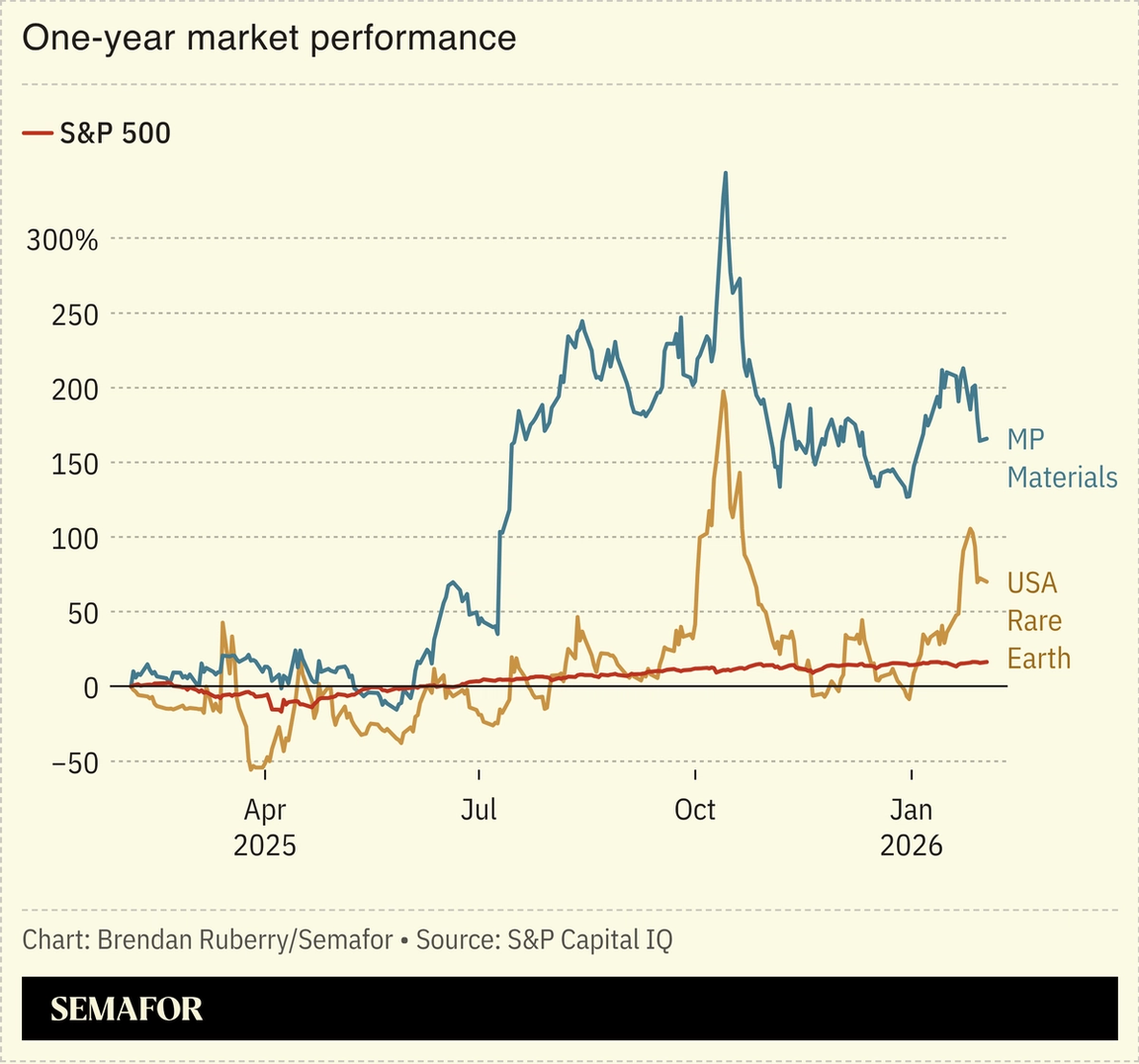 The US government is developing a $12 billion critical minerals stockpile in its quest to bolster its domestic supply chain and reduce dependence on China. Stocks in US rare earth firms jumped Monday on bets of more government financing for the sector; the Trump administration has taken stakes in several mining companies. This effort — dubbed “Project Vault” — is similar to the US’ existing emergency stockpile of oil, launched in the 1970s to guard against supply disruptions. China has shown a willingness to weaponize its dominance in rare-earth processing through export controls: The US is set to press dozens of nations at a summit on Wednesday to de-risk from China by pursuing a strategic alliance over critical minerals. |
|
China manufacturing ticks up |
 Bobby Yip/Reuters Bobby Yip/ReutersChina’s manufacturing sector picked up speed in January, a private-sector survey showed Monday, though the data still points to structural challenges. The report suggested factories accelerated production ahead of the Lunar New Year holiday while responding to an increase in export orders, particularly from Southeast Asia. The global demand for Chinese goods has offset flagging domestic consumption, helping China’s economy grow 5% last year. But that growth has been uneven. Nearly half of the country’s provinces missed their growth targets in 2025, and only one has raised its goal for 2026. In manufacturing hubs, local leaders have resorted to behaving like influencers, posting on social media to urge the public to spend more, Caixin wrote. |
|
SE Asia trade surplus with US widens |
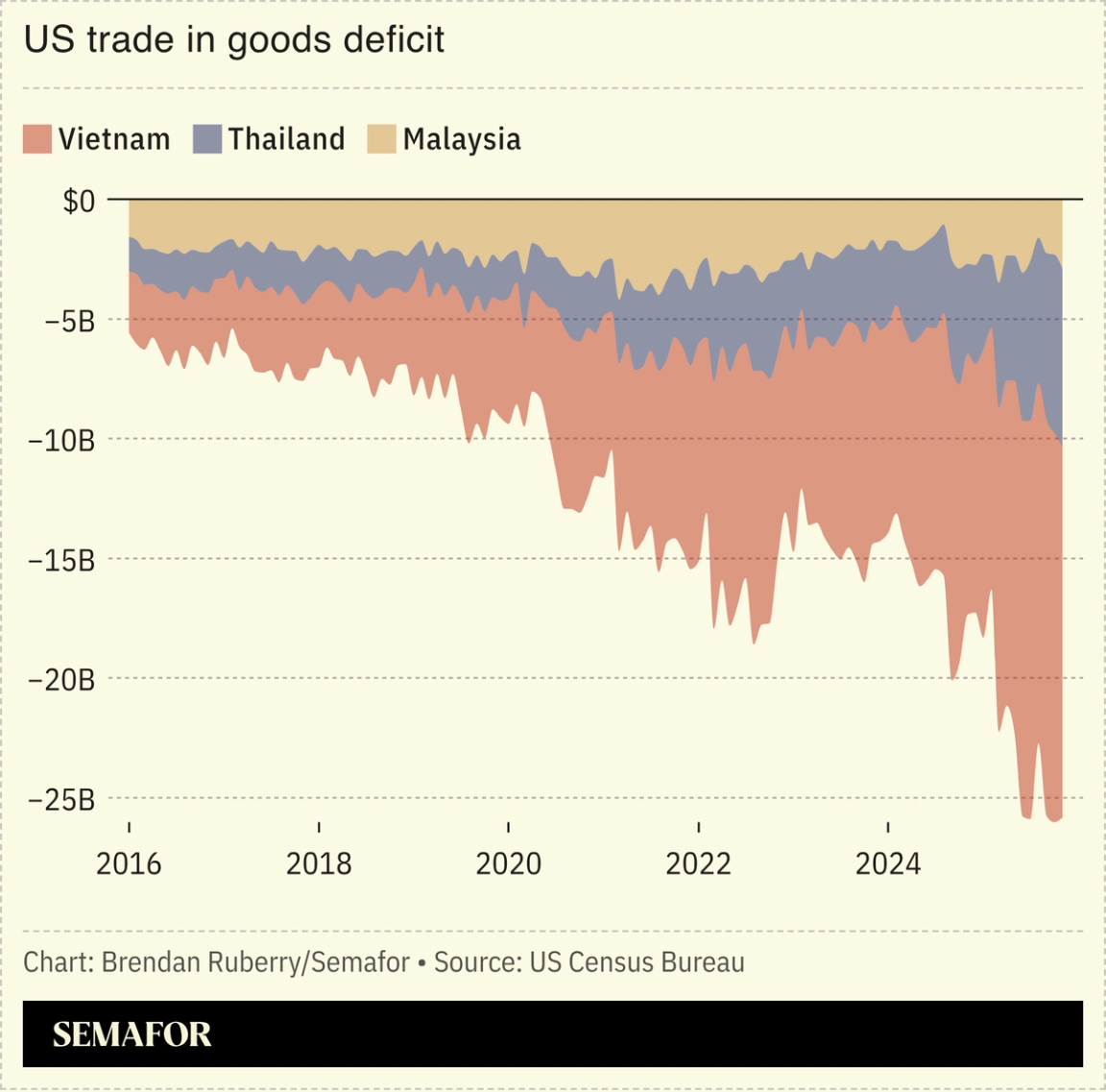 Southeast Asia’s export powerhouses saw their trade surpluses with the US expand last year, despite Washington’s tariffs. The figures from Malaysia, Thailand, and Vietnam — which were all hit with high US duties last April — showed the countries continued to ship more to the US than they purchased, likely because of front-loaded deliveries, Nikkei reported. At the same time, their trade deficits with China widened, reflecting the heft of Beijing’s export engine. Global trade winds have been highly volatile since US President Donald Trump returned to the White House last year. The US’ overall trade deficit has whipsawed, and there’s no expert consensus on how Trump’s policies will impact the trade balance in the long term. |
|
Shein, Temu benefit from Milei reforms |
 Irina Dambrauskas/Reuters Irina Dambrauskas/ReutersConsumer goods imports to Argentina in 2025 were up 55% year-on-year after President Javier Milei cut tariffs and loosened restrictions. Argentines bought three times as much from international e-commerce platforms last year than in 2024 after Milei’s changes in Nov. 2024: Amazon began free deliveries from the US, while Shein and Temu made their first major sales in the country. Foreign goods used to be expensive and rare in Argentina thanks to regulations intended to protect domestic industries, the Financial Times reported. Not everyone is happy with Milei’s reforms — the textile industry, previously insulated from competition by import levies, has seen its workforce shrink 13% since he took office, and has called for legislation against what it calls unfair competition from Chinese e-commerce groups. |
|
High stakes for Petro-Trump meeting |
 Kevin Lamarque/Luisa Gonzalez/Reuters Kevin Lamarque/Luisa Gonzalez/ReutersColombia’s leader is set to meet US President Donald Trump at the White House on Tuesday and attempt to de-escalate tensions. President Gustavo Petro will likely try to convince Trump that Bogotá is cracking down on drug trafficking, even as the country’s cocaine production surges, The Wall Street Journal wrote. The two men struck a friendly tone on a recent phone call, but Petro has since resumed criticizing Trump over his immigration agenda and capture of Venezuela’s Nicolás Maduro. Both leaders’ “willingness to speak their minds no matter the consequences” could derail Tuesday’s meeting, The New York Times wrote, with wide-reaching ramifications for Latin America as Trump takes a more assertive approach to the region. |
|
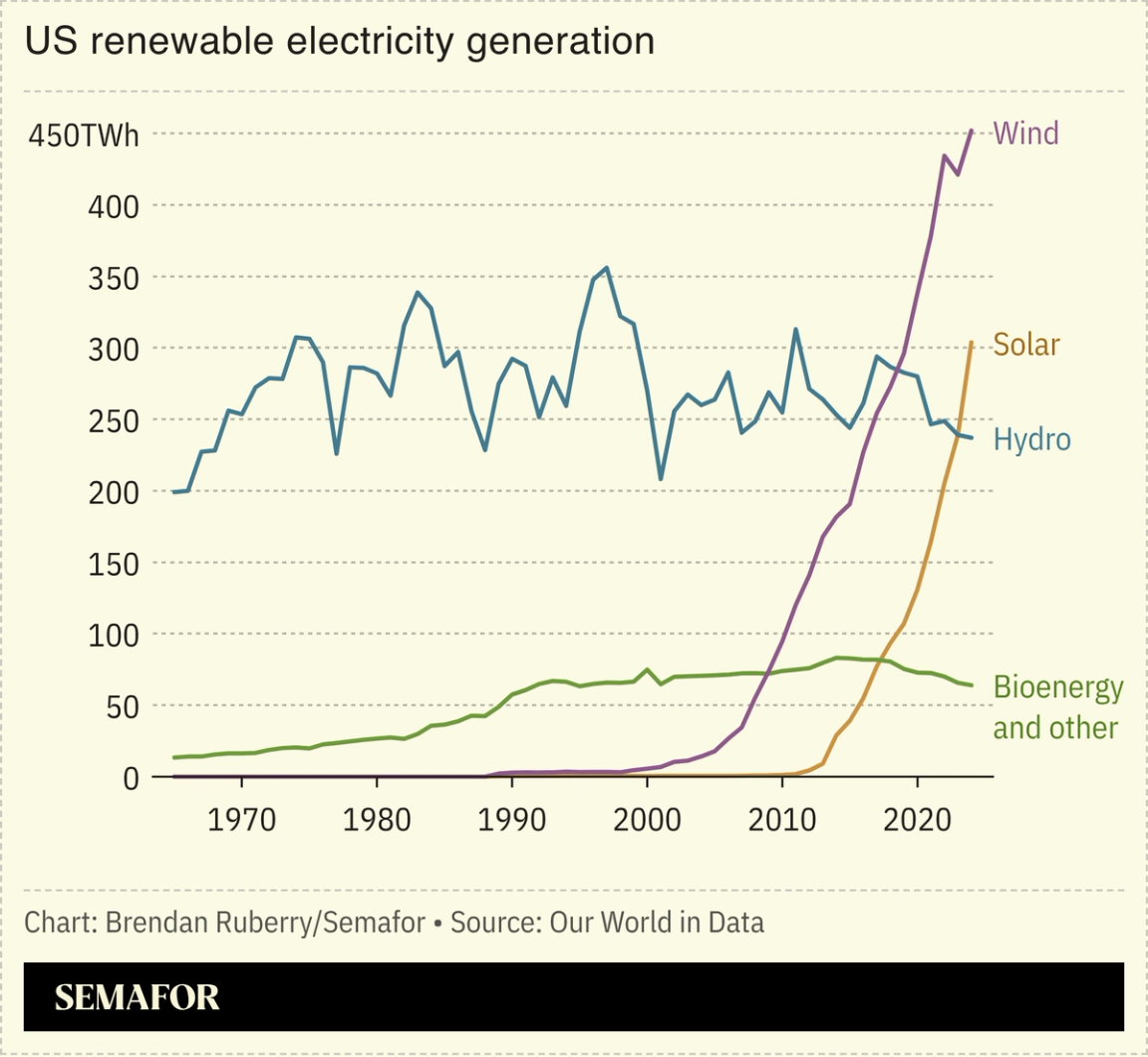 More than 99% of new electrical generation projected to come online this year in the US will be from renewable sources, a report found, despite President Donald Trump’s attacks on the sector. Solar, wind, and battery capacity is already booming: Utility-scale solar generation in the US increased by 22 gigawatts, enough to power about 20 million homes, in the first 11 months of 2025 — up 33.9% since Nov. 2024, while battery storage grew 49% over the same period. Wind power in particular is soaring even as Trump disparages it. His effort to halt new projects was dealt a fifth judicial defeat Monday after a judge ruled that construction could resume on a wind farm off the country’s northeast coast. |
|
More overseas grads return to China |
 Thomas Peter AUNI/Reuters Thomas Peter AUNI/ReutersMore Chinese-born graduates of overseas institutions are returning home to work, data shows, as Beijing looks to shore up its talent base in advanced sectors. Figures from a job recruitment platform showed that job applications from overseas graduates last year surged the most in high-tech and advanced manufacturing fields, South China Morning Post reported. The influx comes as the US-China race for tech dominance heats up, and as Washington makes it harder for highly skilled foreigners to stay in the US. But the graduates returning to China are encountering a harsh reality there, too. Amid an economic slowdown, many young people are struggling to find suitable roles in a crowded job market; vocational schools are becoming increasingly popular. |
|
Geopolitical rifts upend cricket |
 Rupak De Chowdhuri/Reuters Rupak De Chowdhuri/ReutersPakistan’s cricket team said it would boycott its upcoming match against India at the T20 World Cup, as geopolitics continue to upend one of the sport’s marquee events. Islamabad cast the decision as a gesture of solidarity with Bangladesh, previously disqualified after refusing to play in India. The India-Pakistan matchup, which was estimated to generate some $250 million in revenue, is so “commercially powerful” that the International Cricket Council routinely groups them together in tournaments despite their strained relations, The Times of India noted. Players and politicians urged mediation: “Cricket can open doors when politics closes them,” Pakistan’s former captain wrote. But as the sport’s commercial priorities chafe against political reality, “the disintegration of this global tournament continues,” The Guardian wrote. |
|
BBC urged to rethink ‘preachy’ storylines |
 Alessia Pierdomenico/Reuters Alessia Pierdomenico/ReutersAn internal BBC report recommended that the broadcaster avoid “clunky” colorblind casting or “preachy” storylines in drama series. The study, commissioned by the BBC, said audiences were “unforgiving” of feeling lectured — they don’t expect “anti-colonial struggles” in “an Agatha Christie murder mystery” — or ethnically diverse casting that looks “tick box.” It argued that casting nonwhite actors in positions of power in historical Britain could also make it harder to tell stories about past exclusion of minorities. Colorblind casting can change a story, for better or worse: The New York Times noted that Henrik Ibsen’s Hedda Gabler “becomes something quite different” when the heroine is a Black woman born to a white general, rather than a manipulative Norwegian heiress fighting to maintain her privilege. |
|
|


