Hello,
Today’s newsletter is a tough read, but worth it. It has a catalogue of extreme weather events happening around the world in almost every continent, a new deadly virus spreading and the doomsday clock at its closest point to midnight. But as Martin Luther King Jr, once said: "accept finite disappointment, but never lose infinite hope", as he reflected on the power of human resilience.
With that in mind, let’s get to our main focus for today’s newsletter as a report by World Weather Attribution revealed that a "perfect storm" of climate change and cyclical La Niña weather patterns fuelled catastrophic flooding across southern Africa over the past month, killing 200 people and affecting hundreds of thousands of others. The report showed that the intensity of such extreme rainfall events has increased by 40% since preindustrial times – a clear sign that warmer ocean temperatures linked to greenhouse gas emissions are partly to blame – and that current La Niña conditions had worsened things.
Severe flooding since December has wrought havoc across Mozambique, South Africa, Zimbabwe and Eswatini, "with some areas receiving over a year’s rain in just days," the study said.
La Niña involves the temporary cooling of temperatures in the central and eastern Pacific Ocean. The World Meteorological Organization has predicted a weak La Niña in this cycle, but warned that warmer-than-normal sea temperatures linked to climate change are increasing the chance of floods and droughts.
In China, the Meteorological Administration revealed that its annual average temperature hit a record for a second year at 10.9 degrees Celsius (51.6 degrees Fahrenheit), with the most high-temperature days ever recorded.
Meanwhile, in Italy, the Sicilian town of Niscemi has been left teetering on the edge of a cliff after a landslide that was triggered by a storm. The town is gradually collapsing toward the plain below according to its civil protection chief.
Extreme weather events have become more frequent in Italy. Floods have devastated cities across the country, killing dozens of people and amplifying risks of landslides and floods also in historically less exposed areas. |
|
|
1. Indonesia’s deadly landslide and cuts to its disaster agency |
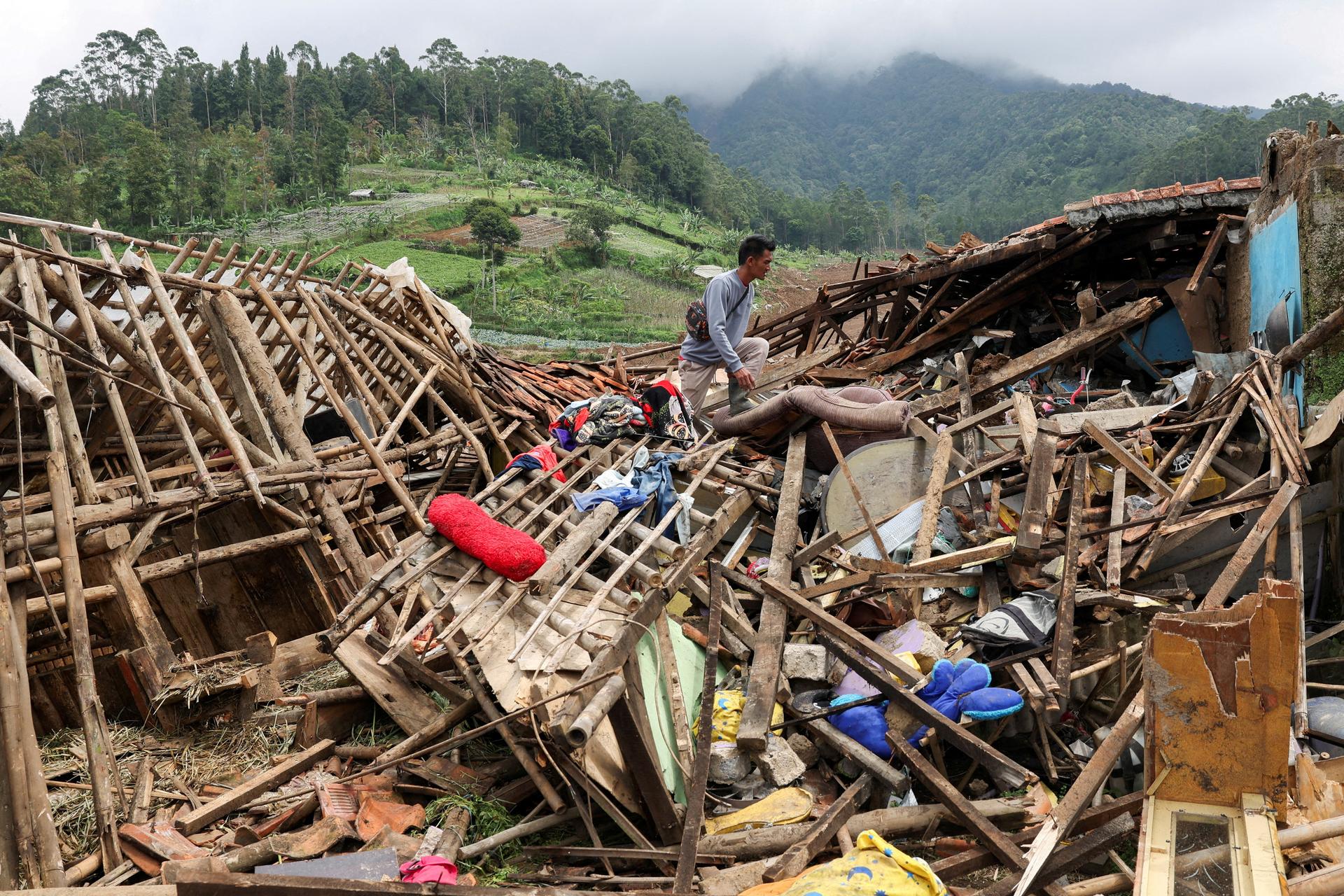
A landslide hit Indonesia's West Java province, triggered by heavy rains that started a day earlier, the disaster mitigation agency said, as it raised the death toll to 34. The rainfall is also hampering the search for 32 people who are still missing. A unit of 23 marine soldiers made up most of the victims that were caught in the landslide during training exercises for Indonesia-Papua New Guinea border patrols, a navy spokesperson said.
Additionally, Indonesia's main rescue agency had its funding cut by a parliamentary panel this week as part of a plan to divert government expenditure to other programmes, such as defence spending, despite concerns over the rise of extreme weather events in the country. Earlier this month, Indonesia experienced flash floods that killed at least 14 people in North Sulawesi.
|
Ahmad Rohimat collects belongings from his damaged house following a landslide in Pasir Langu village, West Java province, Indonesia, REUTERS/Ajeng Dinar Ulfiana |
2. Storm Kristin kills at least three in Portugal, barrels into Spain |
Storm Kristin killed at least three people and left over 800,000 residents of central and northern Portugal without electricity this week, as it toppled trees, damaged homes, and disrupted road and rail traffic before moving inland to Spain. Civil protection authorities reported more than 3,000 weather-related incidents, triggered by wind gusts of up to 150 km/h (93 mph), heavy rain and snowfall in the country of nearly 11 million people.
|
3. Nipah virus fears trigger airport checks across Asia after India confirms two cases |
Two cases of the deadly Nipah virus in India have prompted authorities in Indonesia, Thailand, Singapore, Hong Kong and Malaysia to step up airport screening in an effort to prevent the infection from spreading.
The virus, which is carried by fruit bats and animals such as pigs, can cause fever and brain inflammation and has a fatality rate of between 40% and 75%. Although it can spread from person to person, transmission is not easy and typically requires prolonged contact with an infected individual. Click here for a Reuters explainer on the virus. |
4. Japan braces for more heavy snowstorms as midwinter election nears |
Northern and western parts of Japan face more heavy snowstorms later this week, the Meteorological Agency said, as lawmakers campaign in the first winter election in 36 years, with the risk of lower voter turnout due to the freezing weather. |
5. Temperatures as low as minus 30C in Ukraine next week may damage crops
|
Extremely low temperatures down to minus 30 degrees Celsius (minus 22 degrees Fahrenheit) will hit Ukraine at the beginning of next week, which is dangerous for winter crops, agricultural analysts and the national emergency service said. |
|
|
Click here for a Reuters video with some hopeful news amid all these extreme weather events as a team of Hong Kong scientists have developed an artificial intelligence weather-forecasting system to predict thunderstorms and heavy downpours up to four hours ahead, compared with the range of 20 minutes to two hours now. |
|
|
-
Click here to check out this enlightening piece about the toxic chemicals in our food by Rupert Simons, partner with Systemiq, an environmental consultancy based in Britain, for Ethical Corp Magazine. It was really eye-opening so do give it a read.
- This next one is a little bit off script as it’s not a comment, but an explainer, that's well-worth reading. Click here to read an explainer by Joey Roulette, Reuters’ resident space reporter, about why Elon Musk wants to put artificial intelligence data centers in space.
-
And finally, click here to read about the intersection between women in boardrooms and sustainability and why it matters in a piece by Oliver Balch for Ethical Corp Magazine.
|
|
|
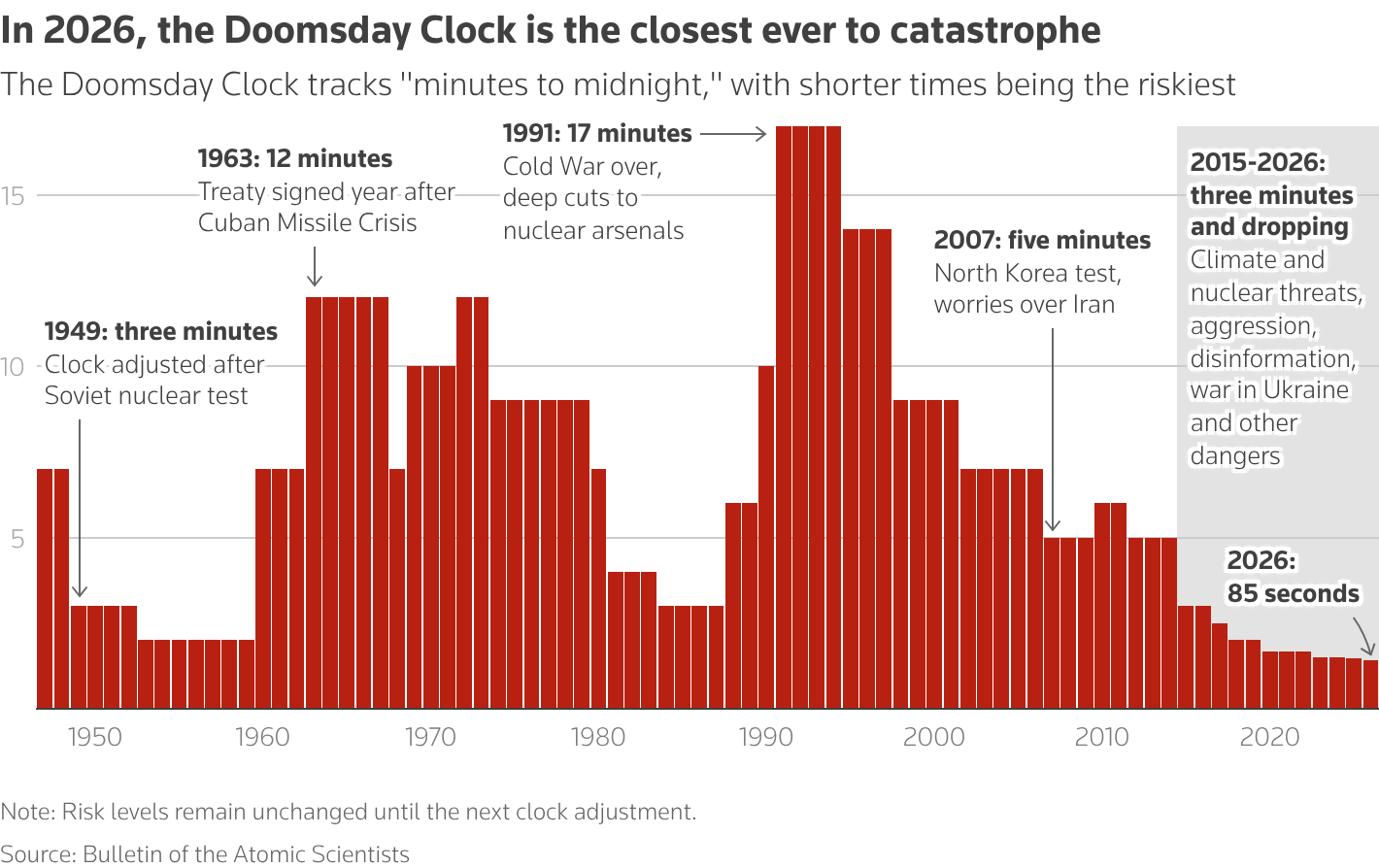
This week, the Bulletin of the Atomic Scientists set their "Doomsday Clock" to 85 seconds before midnight – four seconds closer than it was set last year – citing aggressive behavior by nuclear powers United States, Russia and China, fraying nuclear arms control, conflicts in Ukraine and the Middle East and AI worries among factors driving risks for global disaster. Click here to find out more.
The Doomsday Clock was set up by the Chicago-based nonprofit in 1947 during the Cold War tensions after World War Two to warn the public about how close humankind was to destroying the world. |
|
|
|