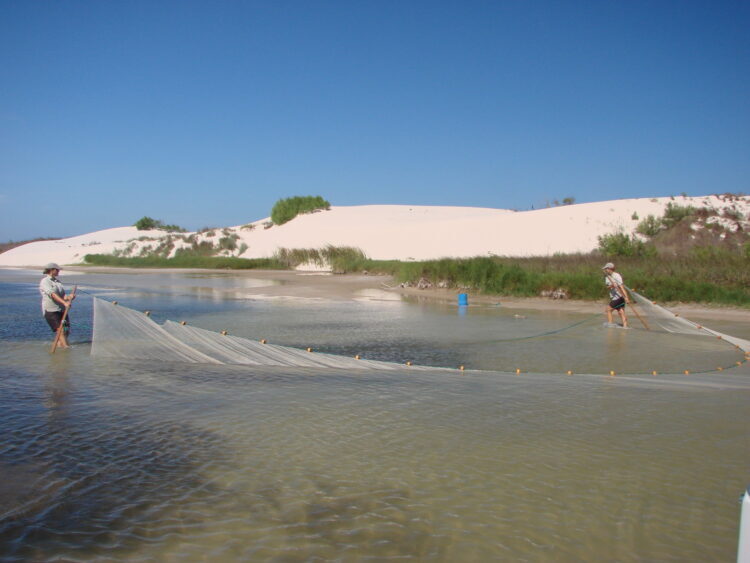
 TPWD staff collect seine samples to track and manage fisheries populations. Photo credit Zachary Olsen
Trapped inside on a cool, sunny day in Santa Barbara, California, a group of scientists are deep in discussion. It’s November 2023, and the group is at the National Center for Ecological Analysis and Synthesis (NCEAS), a synthesis center in the U.S. that has supported hundreds of scientific synthesis working groups like this one.
This working group of Texas scientists has traveled to NCEAS to synthesize long-term data with the goal of understanding how severe weather events impact Texas estuaries.
“The idea is along the Texas coast, we’ve got a lot of biogeochemical and fishery data, but we never have a chance to synthesize it,” said Dr. Zhanfei Liu, professor at the University of Texas Marine Science Institute and co-lead of the working group. Through scientific synthesis, the group will transform several existing, disparate datasets into knowledge that informs environmental policy.
To inform state environmental policy, resource managers share their insights on the long-term data and decision-making with these scientists. Having the Texas Parks and Wildlife Department (TPWD) as members of the working group means the final synthesis products will respond to their fishery management needs.
This working group was in the first cohort of the Gulf Ecosystem Initiative (GEI), a $3.5 million partnership between NCEAS and the NOAA RESTORE Science Program to fund synthesis science and postdoctoral research for the Gulf. The GEI working groups conduct synthesis research that integrates knowledge from different disciplines, is cross-sectoral and tackles pressing scientific and societal challenges through collaboration and innovation.
The current GEI call for proposals is open for working groups and the postdoctoral fellowship! The deadline to apply is February 20, 2026.
|