Trump ‘s awkward embrace

Global news you can trust.

Download the Reuters App.


Power Up

Power Up


A Reuters Open Interest newsletter

By Ron Bousso, ROI Energy Columnist


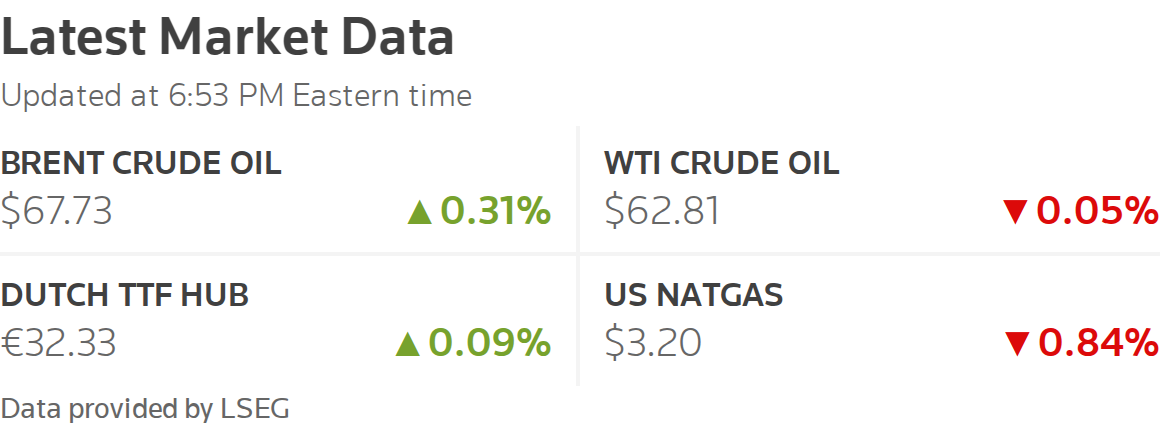
Data refreshes every time you open this email. For more energy news, click here. Please send any feedback to powerup@thomsonreuters.com.

Hello Power Up readers,

Cooler heads have prevailed in the picturesque resort town of Davos this week – at least for now. After a tense day at the World Economic Forum annual meeting on Wednesday, President Donald Trump abruptly ratcheted down tensions. He stepped back from threats to impose tariffs as leverage to seize Greenland, ruled out the use of force and suggested a deal was in sight to end the bitter stand-off with Nato allies over the remote Danish territory. The comments sparked a stock market rally while oil prices rose slightly to $65 a barrel.

It's anyone’s guess how long the de-escalation between the Western allies will last, as Trump did not appear to relinquish his ambition for Greenland. In any event, the stand-off highlighted a key European vulnerability - its heavy dependence on a single supplier for its critical energy needs.

Less than four years ago, Europe’s economy was dealt a harsh blow in the wake of Russia’s full-scale invasion of Ukraine, as nations had to rapidly find alternatives to the abundant Russian natural gas they had relied on for decades. That scramble triggered a severe supply shock and a four-fold increase in European gas prices in the first six months of the conflict.

Europe resolved this problem by trading one dependency for another. As Russia's share of European Union gas imports fell to 12% last year, from 45% before the invasion, Europe rapidly turned to U.S. liquefied natural gas (LNG). Imports of U.S. LNG skyrocketed from 18 million metric tons in 2021 to 65 million tons last year, making up 57% of all LNG imported by the EU and Britain in 2025, according to analytics firm Kpler. Today, the U.S. supplies nearly a quarter of the EU's total gas imports.

Fast forward to this week, and European leaders confronted the uncomfortable reality that their lopsided energy relationship has left the region vulnerable once again, as Trump could seek to use Europe’s energy dependency as a bargaining chip in the escalating economic battle over Greenland.

You can read my full column here.

And, finally, to mark the one-year anniversary of President Trump’s second term in office, I looked back at his relationship with the U.S. oil industry over the past 12 months. It had a promising start but has become increasingly fraught. More on this below.

Here are a few more headlines:

  • Oil prices rose this week after production at the Tengiz oilfield in Kazakhstan, one of the world’s largest, was halted on Sunday due to a fire. The field, operated by a Chevron-led consortium, produced around 900,000 barrels per day in 2025, nearly 1% of global supplies. Reuters reported that the outage could last up to 10 days.
  • Thermal coal exporters are on the lookout for expansion opportunities following their first annual contraction in sales volumes last year since Covid-19 slammed fuel demand in 2020. The problem is, growth markets are hard to find, writes ROI Energy Transition Columnist Gavin Maguire.
  • Wind and solar power in 2025 generated more electricity in the European Union than fossil fuels for the first time ever, driven by a surge in solar output, data from energy think tank Ember showed.

As always, don’t hesitate to contact me at ron.bousso@thomsonreuters.com or follow me on LinkedIn with any questions or thoughts.


Top energy headlines

  • Oil slides 2% as Trump tones down threats against Greenland and Iran
  • US energy secretary calls for doubling global oil output in Davos
  • Trafigura makes first Venezuelan crude sale under supply deal, sources say
  • Davos: China defends wind power strategy after Trump's criticism
  • Venezuela's proposed oil reform to give autonomy to companies to operate, cash sales -documents


Trump’s awkward grip

President Donald Trump has lavished the U.S. oil industry with favourable policies since returning to the White House, but his twin demands for cheap oil and “energy dominance” are increasingly colliding with companies’ bottom lines.

Over the past year, the Republican president has rolled out numerous pro‑fossil fuel measures and offered strong support for U.S. oil firms abroad, a sharp departure from his Democratic predecessor Joe Biden’s focus on combating climate change.

But the industry’s early enthusiasm for Trump’s “drill, baby, drill!” ethos has been tempered by his push for low energy prices and his appeals to the Organization of the Petroleum Exporting Countries to increase output. OPEC+, which includes Russia, sharply raised production targets throughout the year, sending U.S. benchmark crude to a near five‑year low of $55 a barrel in mid‑December.

At the same time, Trump has used America’s oil and gas strength to advance his “energy dominance” agenda and the so‑called Donroe doctrine, his rebranding of a 19th‑century principle asserting U.S. influence over the Americas.

The centrality of oil in Trump's strategy was made crystal clear when U.S. forces captured Venezuelan President Nicolas Maduro in early January on drug trafficking charges, prompting Trump to quickly announce that Washington would indefinitely take control of the oil riches of a country home to the world’s largest proven reserves – some 300 billion barrels.

But it is far from clear if U.S. oil majors are willing to pour billions into the Latin American country at this point. Exxon CEO’s lukewarm comments on Venezuela drew Trump’s ire, who threatened to block the company’s access to Venezuela, underscoring the risks of defying the president.

Read the full column
 

Get full access to Reuters.com for just $1/week. Subscribe now.


Sponsors are not involved in the creation of newsletters or other Reuters news content. Advertise in this newsletter or on Reuters' website

LiveIntent Logo
AdChoices Logo