What matters in U.S. and global markets today

Global news you can trust.

Download the Reuters App.


Morning Bid U.S.

Morning Bid U.S.

A Reuters Open Interest newsletter

What matters in U.S. and global markets today


By Mike Dolan, Editor-at-Large for Finance and Markets 

World stocks bounced back after Trump’s U-turn on Greenland tariffs late Wednesday, leaving markets pondering what the whole four-day drama was for – except as a reminder of how erratic U.S. policymaking has become.

With Trump in Davos all day Thursday, anxiety remains about the potential for further twists and turns, partly explaining why this week’s losses have not yet all been erased despite the apparent détente. But the February 1 tariff threat has been removed for now.

I’ll get into all that and more below.

But first, check out my latest column on just how extreme market positioning was to kick off the year - and the risk of mixing rising geopolitical conflict with an already stretched "hyper bull" market.

And listen to the latest episode of the Morning Bid daily podcast. Subscribe to hear Reuters journalists discuss the biggest news in markets and finance seven days a week.


Data refreshes every time you open this email. For more U.S. market news, click here. Please send any feedback to morningbid@thomsonreuters.com.


Today's Market Minute

  • U.S. President Donald Trump stepped back on Wednesday from threats to impose tariffs as leverage to seize Greenland, ruled out the use of force and suggested a deal was in sight to end the dispute.
  • U.S. Supreme Court justices seemed to embrace the idea that central bank independence must be preserved during Wednesday's arguments over President Trump’s attempted dismissal of Federal Reserve Governor Lisa Cook.
  • Russian President Vladimir Putin will on Thursday discuss a possible peace plan for Ukraine with U.S. envoys Steve Witkoff and Jared Kushner.
  • One surprising market winner from ongoing geopolitical tensions could be Asian defence firms, according to founder and CEO of Emmer Capital Partners Manishi Raychaudhuri.
  • US aluminium buyers are paying a 68% premium for the metal thanks to US tariff hikes and global supply constraints, with consumers in for a shock unless imports pick up soon, writes ROI Metals Columnist Andy Home.
 

Davos détente

The pan-European STOXX index was up more than 1% in early trading on Thursday, following the S&P 500’s 1.16% rise yesterday – its biggest in two months – on news of the Greenland deal. The VIX index, or so-called fear gauge, fell back towards baseline levels after hitting a year-to-date high on Tuesday.

Gold slipped from Wednesday's all-time high of $4,887.82 per ounce as tensions eased and investors sought riskier assets, but it remains elevated above $4,800 amid the still febrile geopolitical situation.

Indeed, details about the deal struck by Trump and NATO secretary-general Mark Rutte remain sparse. While Trump’s sudden shift in tone has defused tensions, European diplomats noted the dispute was not yet resolved and Denmark’s Foreign Minister Lars Lokke Rasmussen reiterated the importance of Danish sovereignty and Greenlandic self-determination.

Whatever was agreed, it will not involve a U.S. takeover of Greenland. Trump noted all parties were “very happy” with the deal, which he said touched on security and minerals and would last "forever". Secretary-General Rutte said on Thursday the deal would focus on guarding against Russian and Chinese influence in the Arctic and that NATO allies would have to step up on security in the region.

Meantime, Treasury yields retreated, helped by a decent 20-year bond auction and signals from the U.S. Supreme Court on Wednesday that justices would not support Trump’s attempt to fire Fed Governor Lisa Cook. Conservative justice Brett Kavanaugh, for instance, noted that a “low bar” for dismissals by the president would “weaken, if not shatter, the independence of the Federal Reserve”.

The Fed is expected to hold rates steady at its January meeting, and investors will get more clues on the policy outlook on Thursday with the release of November’s PCE inflation estimate, the Fed’s preferred inflation gauge.

Attention now switches back to the corporate earnings season. Intel tops today’s calendar, with its stock surging 12% on Wednesday ahead of the report. Its fortunes improved last year due to the AI data center boom and the U.S. government’s decision to take a stake in the company.

Other chipmakers jumped on Wednesday too, with South Korea's stocks racing ahead on Thursday, now easily making the country’s index the best performer of the year with gains near 20%.


Greenland storm barrels into 'hyper bull' market

Global investors began the year drunk on booming growth, record stocks and tech euphoria. Despite Wednesday’s U-turn on the Greenland row, U.S. President Donald Trump's erratic tariff threats should prompt investors to question some of that extreme optimism.

This week's sudden market disturbance hinged on fears of escalating transatlantic trade tensions after Trump threatened more tariffs on Europe unless the U.S. was allowed to take over Danish-controlled Greenland. Europe balked at the move, vowing retaliation for any related tariffs.

With perhaps half an eye on the resulting debt market jolt at home, Trump abruptly stepped back late Wednesday ‌from the tariff threat, just four days after he announced it - claiming NATO assurances on Greenland security.

But the prospect of another year of such brinkmanship and repeated sideswipes at international alliances and trade relations may yet prompt a more careful approach to the overwhelming market consensus that greeted the year.

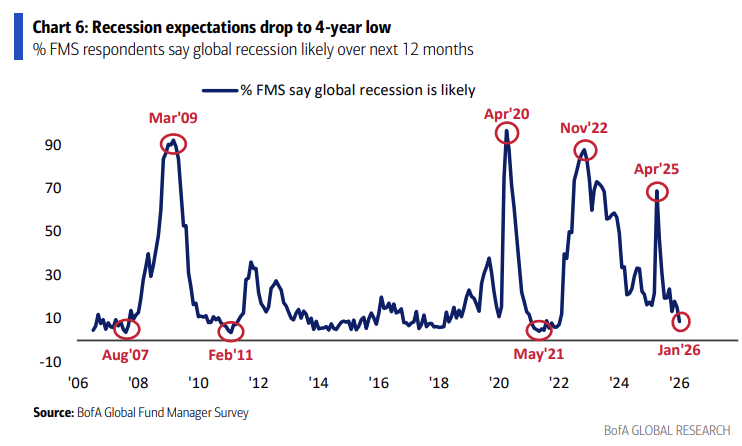
Bank of America conducted its first monthly global funds survey of 2026 just before the Greenland row blew up last weekend. Even so, the results revealed how extreme market positioning and thinking were as the year kicked off.


Graphics are produced by Reuters.

Read the full column