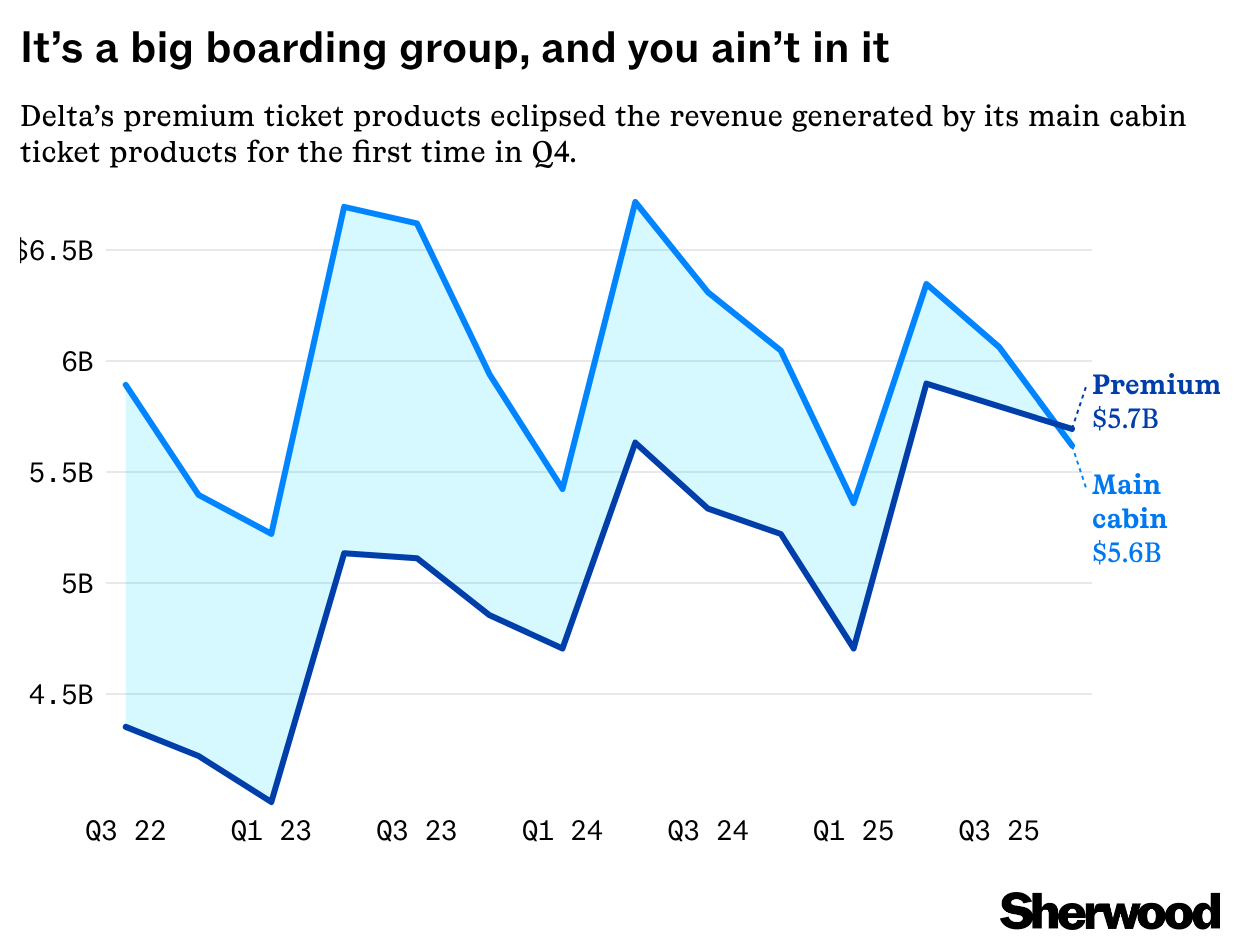
For the first time, Delta Air Lines is making more money from its first-class and Comfort+ passengers than its main cabin passengers. Helping premium to grow comfortably as the main cabin experiences turbulence is Delta’s co-branded American Express credit card, which brought in $8.4 billion last year. |
-
In the fourth quarter, Delta’s premium ticket revenue grew 9% to $5.7 billion, while its main cabin sales fell 7% to $5.62 billion. That happened a few quarters earlier than even Delta expected — back in October, CEO Ed Bastian said it could occur a few times in fiscal 2026.
- “If you look at the economy, if you look, you look at strength of the market and at how... high-end consumers are feeling about their opportunities, they’re quite bullish,” Bastian said on Tuesday’s earnings call.
-
Cardholders receive points on purchases and can board their flights earlier — and benefits increase with higher, i.e. premium, spending. Those cardholders, Bastian says, are “among [Delta’s] most valuable and satisfied customers, traveling more often and spending more on Delta.”
|
While notable, the outcome has been inevitable for a while. Premium ticket growth has outpaced main growth every quarter for at least three years at Delta, as travel has become a core pillar of America’s “K-shaped economy,” in which affluent consumers do well and those on the lower end of the income spectrum cut back. |
|
|
Delta is leaning into the K, relying on wealthier travelers to bolster its profits — and the margin spreads have never been greater. According to Delta President Glen Hauenstein on Tuesday’s earnings call, 2026 will see all of the airline’s new seat growth (it plans to boost capacity by 3%) concentrated in premium cabins. “The bottom end of the industry and the commodity side of the business has been struggling greatly,” Hauenstein said. “That sector has been unable to grow here for the last several years.”
|
|
|
The AI data center boom that’s driving massive growth for hyperscalers’ cloud businesses must “never” cause Americans to pay higher electricity prices, President Trump wrote in a Truth Social post on Monday evening.
The administration said it “is working with major American Technology Companies to secure their commitment to the American People” so US households don’t “pick up the tab” for their data center-driven energy demands, which have helped propel electricity bills higher. |
- Microsoft was first in line to join this presidential push, with its “community-first AI infrastructure plan” unveiled by Vice Chair and President Brad Smith.
-
The most interesting part was the proposal for utilities and public commissions to charge Microsoft enough to cover both data center installation and usage, as well as support two-tier pricing systems that will see “Very Large Customers” like data centers face higher costs.
-
Of the tech giants, the one that could suffer the most is Meta, which unlike Microsoft or Amazon is largely building AI infrastructure for its own products, not for a cloud business that sells that capacity to customers. While Meta has said AI is boosting other revenue streams, it isn’t a stand-alone revenue driver.
|
|
|
Tech giants want energy to realize their AI data center ambitions, but they must walk a fine line to avoid drawing the ire of American households and politicians in the process. Some experts already see a link between higher power prices for consumers and the rise of the AI boom, and we see it too in this chart, though inflation is another driver.
Meanwhile, affordability is a current passion of the president, though George Pollack, senior US policy analyst at Signum Global Advisors, has argued that the Trump administration can realize only two of three objectives, a classic conundrum.
Go Deeper: What happens when AI comes to town |
| |
Meta is laying off more than 1,000 people in its Reality Labs division — the latest in a series of nails in the coffin for the company’s virtual reality and metaverse ambitions as it pivots to AI.
Considering the company changed its name from Facebook to Meta in 2021 to reflect its new goals, we decided to look back at what exactly the company and its CEO were going for way back when… and what’s happened since. |
|
|
|