Quality Payment Program Small Practices Newsletter: January 2026
Quality Payment Program Small Practices Newsletter: January 2026
The Quality Payment Program (QPP) Small Practices Newsletter is a monthly resource that provides small practices (15 or fewer clinicians) with program updates, upcoming QPP milestones, and resources to support their continued participation and success in QPP. We send this newsletter on the second Tuesday of each month.
Please share this newsletter with your fellow clinicians and practice staff and encourage them to sign up to receive this monthly resource.
At-a-Glance: Required and Recommended Activities for Successful Participation in QPP
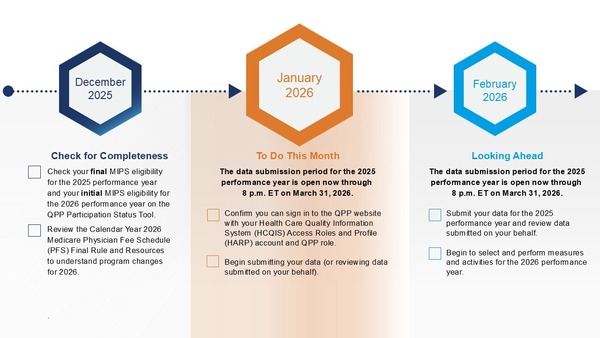
Each month, we share required and recommended activities for small practices to support their successful participation in QPP. The activities follow a rolling quarter approach, letting you see activities for the previous month, the current month, and the following month.
The Centers for Medicare & Medicaid Services (CMS) has opened data submission for the 2025 performance year of the Quality Payment Program (QPP). Data can be submitted and updated until March 31, 2026, 8 p.m. ET.
Submit your data for the 2025 performance year or review the data reported on your behalf by a third party. (You can’t correct errors with your data after the submission period, so it’s important to make sure the data submitted on your behalf is accurate.)
Submission resources have been uploaded to QPP Resource Library.Helpful resources for data submission include:
As noted in the MIPS eligibility announcement sent 12/4/2025, we needed to update the results for the rural special status based on the most recent Federal Office of Rural Health Policy (FORHP) Eligible ZIP code file available. That file wasn’t available when we released updated eligibility on 12/4/2025, but the update was completed 12/11/2025. Updated rural status is available on the QPP Participation Status tool.
In October 2025, we updated performance feedback to identify the MIPS payment adjustment factor(s) associated with their 2024 final score. This information was added to their 2024 MIPS performance feedback, available on the QPP website.
2026 MIPS payment adjustments, based on each MIPS eligible clinician’s 2024 MIPS final score, will be applied to payments made for Part B covered professional services payable under the Physician Fee Schedule from January 1 to December 31, 2026. Payment adjustments are determined by the final score associated with a clinician’s Taxpayer Identification Number (TIN)/National Provider Identifier (NPI) combination.
MIPS eligible clinicians, identified by TIN/NPI combination for the 2024 performance year, will receive a positive, neutral, or negative MIPS payment adjustment in 2026 if they:
Were a clinician type that was included in MIPS;
Enrolled in Medicare prior to January 1, 2024;
Weren’t a Qualifying Alternative Payment Model (APM) Participant (QP);
Were a Partial Qualifying APM Participant (Partial QP) that elected to participate in MIPS as a MIPS eligible clinician; and
Met one of the following criteria:
Individually exceeded the low-volume threshold;
Were in a practice that exceeded the low-volume threshold at the group level and submitted group or APM Entity data; or
As you prepare for the upcoming performance year, we’d like to highlight some recent updates to the QPP website.
We’ve added information for the 2026 performance year
We’ve updated webpages detailing reporting requirements for the various performance categories and reporting options.
We’ve updated the look and feel of the website
We’ve added a “getting started” section for those looking for basic program information.
We’ve expanded the content to provide information beyond reporting requirements, including system access, third party intermediaries, and payment.
We’ve made it easier for you to find related resources and webpages, and we’ve added on-page navigation.
We’ve introduced the Resource Library Assistant, an Artificial Intelligence (AI)-driven tool for quickly finding the answers to your QPP questions in the resources available on the QPP Resource Library.
We want to hear from you
You have the option to indicate on each page whether the content was helpful (using the thumbs up/thumbs down icons).
Once you make your selection, you’ll also have the opportunity to provide more detailed feedback.
The CMS has added calendar year (CY) 2023 QPP performance information in the Provider Data Catalog (PDC) and on clinician and group profile pages on the Medicare.gov compare tool. CMS is required to report the final scores and performances of MIPS-eligible clinicians under each MIPS performance category, and both the names of APMs and of eligible clinicians in Advanced APMs. Performance information for clinicians and groups is displayed using measure-level star ratings, percent performance scores, and check marks.
For details about the 2023 QPP performance information recently added in the PDC and on clinician and group profile pages on the Medicare.gov compare tool, visit the Care Compare: Doctors and Clinicians Initiative webpage.
The following documents, available on the Care Compare: Doctors and Clinicians Initiative webpage and on the QPP Resource Library, include details about the CY 2023 QPP performance information recently added to the PDC and to clinician and group profile pages on the Medicare.gov compare tool:
If you have any questions about public reporting of clinicians and groups in the PDC and on the Medicare.gov compare tool, contact the QPP Service Center by emailing QPP@cms.hhs.gov, submitting a QPP Service Center ticket, or calling 1-866-288-8292 (Monday–Friday, 8 a.m.–8 p.m. ET).
People who are deaf or hard of hearing can call 711 to connect with a Telecommunications Relay Services (TRS) Communications Assistant.
Share your feedback on what you like most about the Small Practices Newsletter, what can be improved, and/or what topics you would like to see addressed. Please include “Small Practices Newsletter” in the email subject line.
Contact the QPP Service Center by email at QPP@cms.hhs.gov, by creating a QPP Service Center ticket, or by phone at 1‑866‑288‑8292 (Monday – Friday, 8 a.m. – 8 p.m. ET).
To receive assistance more quickly, please consider calling during non-peak hours — before 10 a.m. ET and after 2 p.m. ET.
People who are deaf or hard of hearing can dial 711 to be connected to a Telecommunications Relay Services (TRS) Communications Assistant.
This email was sent to NPxrji73qy@niepodam.pl using GovDelivery Communications Cloud 7500 Security Boulevard · Baltimore MD 21244