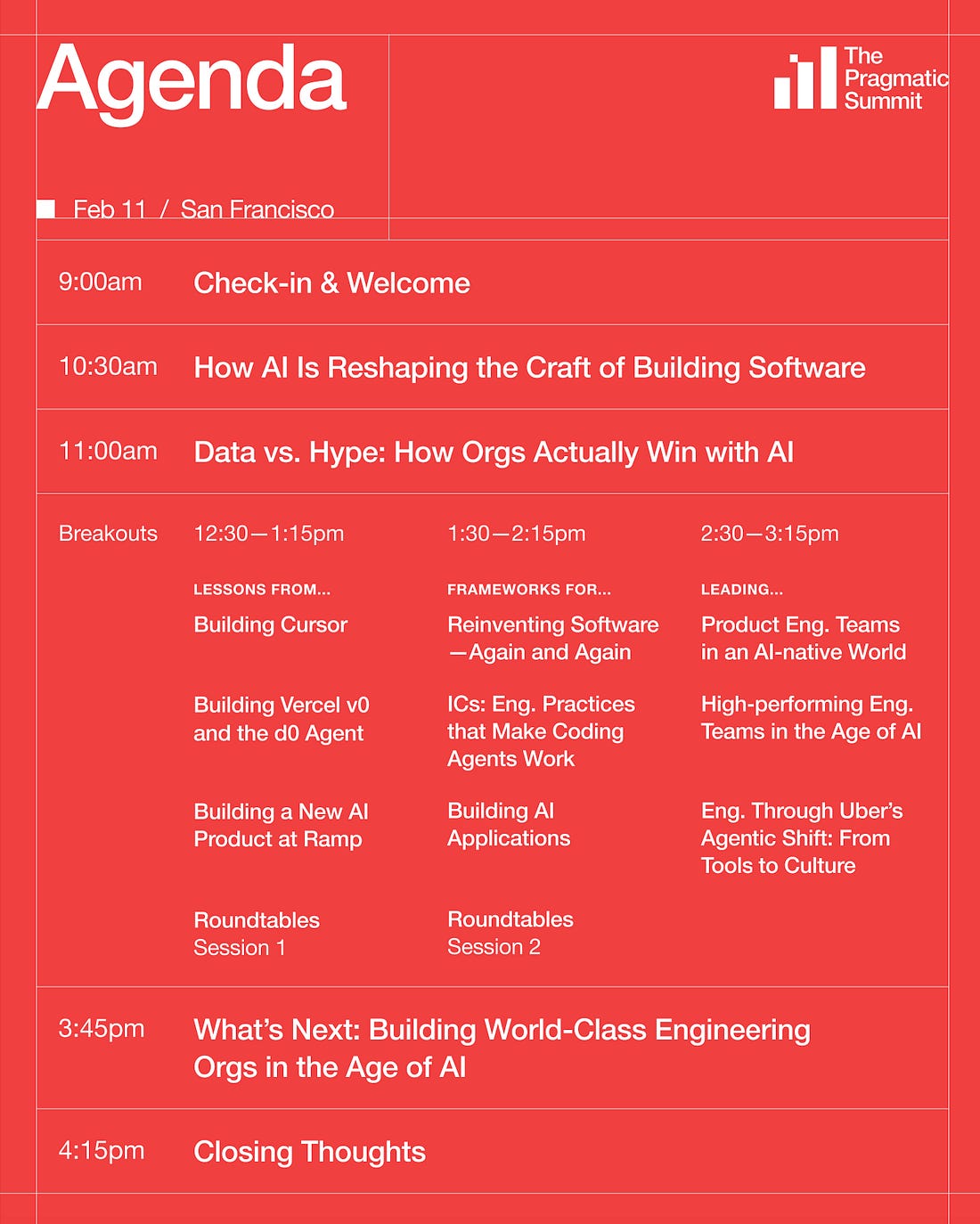
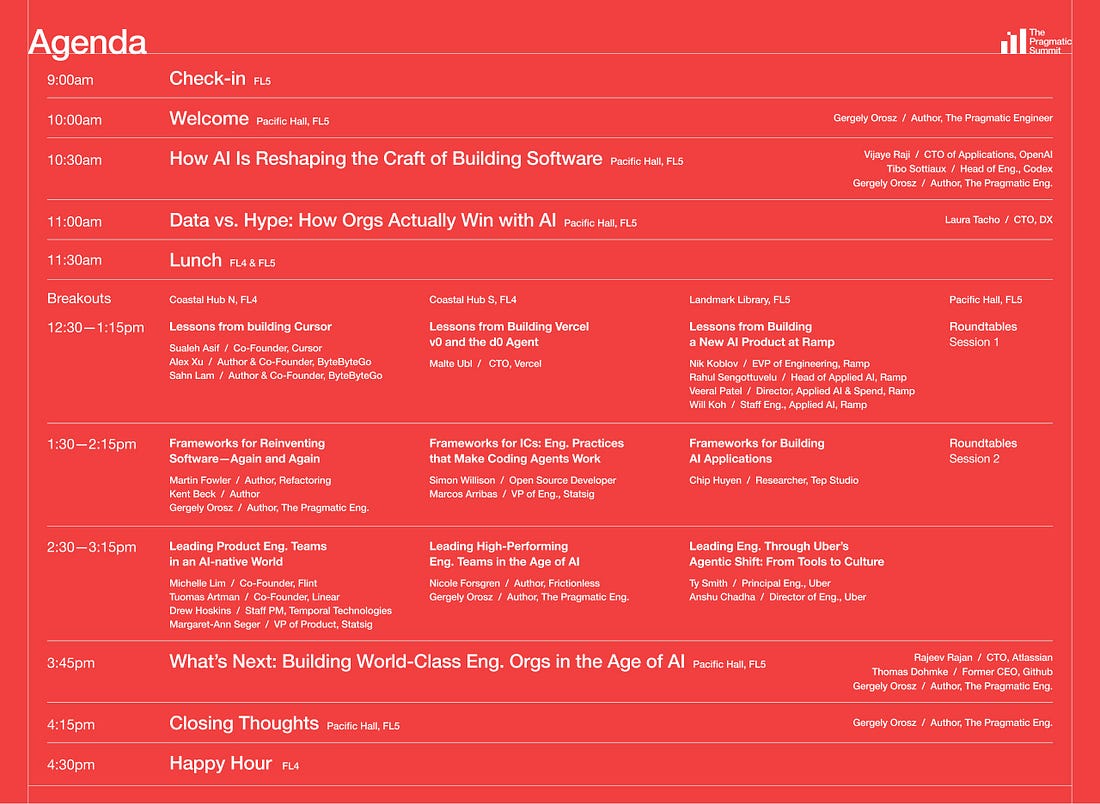
Before we start: the agenda of The Pragmatic Summit is final. Here’s what to expect on 11 February, in San Francisco:
Speakers might be familiar from the podcast — and this is a rare opportunity to meet them in-person. We’ll have Laura Tacho, Simon Willison, Chip Huyen, Kent Beck, Martin Fowler, Nicole Forsgren, Thomas Dohmke and others join. Engineering leaders from the top AI companies and startups will talk about how exactly they build — folks from Cursor, Codex, Linear, Ramp, Vercel and Uber, and more. And in a fun crossover, Alex and Sahn from ByteByteGo will also take the stage.
The exact agenda:
We already have 250 confirmed attendees — experienced engineering leaders and experienced engineers — and just 150 seats left. We also have more delightful surprises planned for the event, and on the day — those who attend will learn of these. If you are thinking of joining, apply now, while there is still space.
If you want to meet in-person, meet folks who have been on the podcast or in the deepdives, and connect with an incredible group at the event: this is the event to do it at.
Talks will be recorded and shared with paid newsletter subscribers in a timely matter — and they will be published in batches for all newsletter subscribers later on as well.
Apply to join the Summit
At some point in the lifespan of a successful product, a member of the team decides it has become too messy, and that what it needs is some kind of system/UX library/UI organization, since what used to be creative, clever UI approaches have become chaotic. At this point, the idea of a reusable components library often starts being seen as a solution.
This usually happens long after the product has found its product-market-fit and while it’s growing in usage, with 10+ designers and frontend engineers working on it. I’ve seen this scenario play out several times: at Skype, Skyscanner, and at Uber, where the outcome was the Base Design System, which was shared externally.