| Forwarded this email? Subscribe for more |


 |
| By The Free Press |
It’s Monday, January 12. This is The Front Page, your daily window into the world of The Free Press—and our take on the world at large. Today: Olivia Reingold, Jed Rubenfeld, Dave Kansas, and Elliot Ackerman on the fallout from the ICE shooting in Minneapolis.
But first: A world on fire.
This year is off to a tumultuous start. Just over a week ago, Donald Trump woke everyone from their holiday slumber with the dramatic raid to capture Venezuelan dictator Nicolás Maduro, who now sits in a cell in New York City.
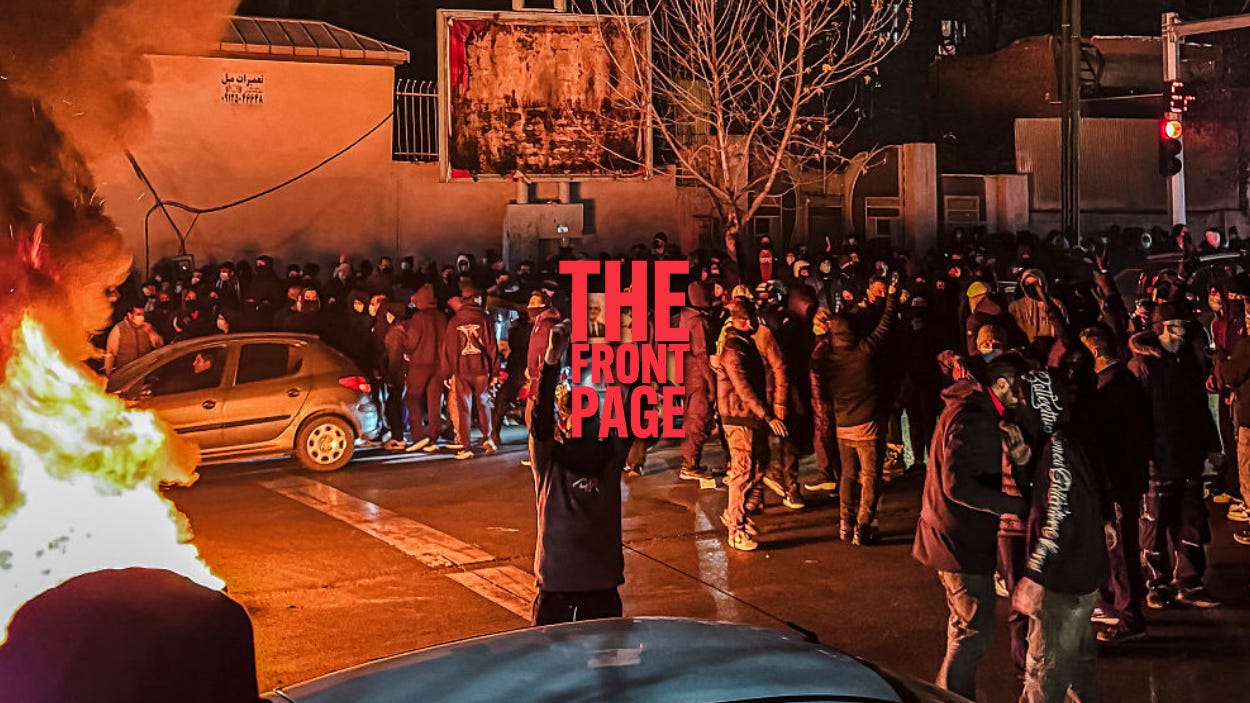
In recent days, protests in Tehran that began two weeks ago have escalated considerably—and been met with a brutal response from the Ayatollah’s regime. Iranian authorities have shut down the internet—and opened fire on their own people. More than 2,000 protesters have reportedly been killed in the last three days.
Meanwhile, Russia has stepped up its strikes on Ukraine, bombarding Kyiv apartment buildings and firing a new hypersonic missile deep into Western Ukraine last week.
What’s not yet clear, though, is how consequential all this will prove to be. Will Maduro’s ouster prove to be the end of that regime—or just a changing of the guard? Could the Ayatollah’s time really be up? And, what, if anything, will end the war in Ukraine?
These are the questions on our minds at the start of this week—and the ones our stories today, in one way or another, seek to address.
We start with Iran. Over the last 72 hours we’ve published must-read analysis of the situation by Roya Hakakian, Michael Doran, and Simon Sebag Montefiore. All of them assess whether these protests are different from the last attempts to oust the regime in Tehran. If you missed their pieces, read them here:
Eli Lake homes in on a more specific question: Will Donald Trump keep his promise to the Iranian people? The U.S. president has pledged that he would attack the regime if it started killing protesters. There is no doubt that is now happening and so, Eli argues, it’s time for Trump to take action. This, says Eli, is a “hinge point in Trump’s presidency.” Read his column:

For the latest news out of Iran, tune in to our livestream at noon ET today. As President Trump weighs his options, Rafaela Siewert will be talking to Michael Doran, Roya Hakakian, and Behnam Ben Taleblu. Tune in here.
From Tehran to Caracas, where, a little over a week after U.S. forces captured Maduro, things are remarkably normal. Writing for The Free Press today, Elliott Abrams, who served as Special Representative for Venezuela from 2019 to 2021, argues that “the regime is functioning internally exactly as it would have had Maduro been removed by a heart attack, and it is making the smallest concessions to Washington that it can.”
If Trump thinks this is the way to put Venezuela on a path to democracy, stability, and prosperity, he is sorely mistaken, says Elliott. And it leaves him wondering: Does the administration have a plan?
Trump’s main focus since the Maduro raid has been on Venezuela’s oil. On Friday, he gathered top oil CEOs at the White House to discuss investing in—and extracting black gold from—Venezuela. Most people are chilly on the immediate prospects for oil production in the country. We asked longtime Venezuela correspondent William Neuman to investigate. Here’s what he found:
Meanwhile, life for ordinary Venezuelans—especially those who dare criticize the regime—is as tough as ever. For a sense of the situation on the ground, read this anonymous account of the crackdown that followed Maduro’s capture:
For more on the Venezuelans resisting the Chavistas in power, tune in to the latest episode of Conversations with Coleman. Coleman talks to Venezuelan human rights leader Thor Halvorssen about the high stakes and uncertain transition now underway in his country. Listen below or wherever you get your podcasts:
Maduro Is Gone. The Mafia State Remains. The Free Press |


The last stop in this tour of the world’s flashpoints is Kyiv. Aidan Stretch reports from the Ukrainian capital, half of which is without heat after the latest Russian barrage. Aidan writes of the damage wrought by the strikes, and describes their grim logic—to break Ukrainian resolve in the middle of the winter, and at a crucial stage in peace talks. Aidan investigates whether that strategy is working: