| | The US trade deficit narrows, Chinese AI companies go public, and global cooperation holds steady de͏ ͏ ͏ ͏ ͏ ͏ |
| |  | Flagship |  |
| |
|
The World Today |  - US trade deficit narrows
- China’s 2026 outlook bleak
- Chinese AI IPO boom
- US lobbyists eye Venezuela
- The next conflict mineral
- Reinventing cooperation
- Elon Musk’s extreme view
- Roblox enacts age check
- US recommends red meat
- Testing older drivers
 A job opening for a treasure hunter, and a love-hate relationship with a passport. |
|
US trade gap at lowest level since 2009 |
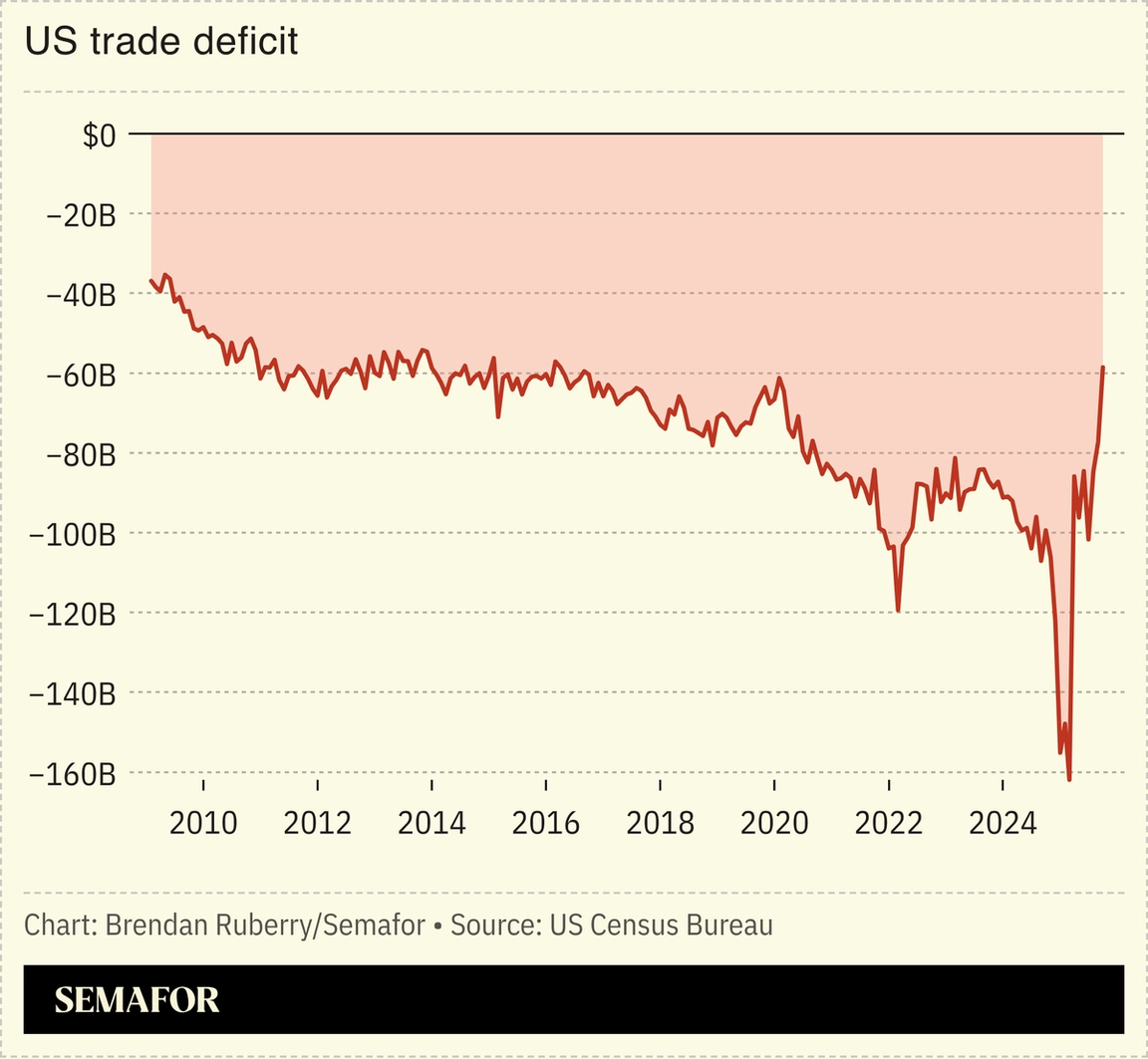 The US trade deficit dropped in October to its lowest level since 2009, new data showed, as imports fell six months after US President Donald Trump’s “Liberation Day” tariffs. Trump made reducing the deficit central to his economic policy, and the US “appears to be winning the trade war,” one analyst said, as tariffs curb imports but other countries keep buying American goods. The drop in imports was largely fueled by pharmaceuticals — many drug companies frontloaded shipments in September after Trump threatened high tariffs, a reflection of the swings in global trade that defined 2025. The sector may face another twist if the US Supreme Court rules Trump’s tariffs were issued illegally, a decision that could come as soon as Friday. |
|
Chinese economists bearish on 2026 |
 Go Nakamura/Reuters Go Nakamura/ReutersChinese experts are broadly downbeat over the trajectory of the country’s economy in 2026. As exports boom, Beijing is trying to shift the drivers of its growth toward consumption. “Don’t count on that happening,” wrote Semafor’s Andy Browne, who spoke to several Chinese economists about their 2026 prognostications. A professor pointed to the deepening real estate crisis as prices crater: “Will the market reach bottom in 2026? Probably not.” One strategic advantage for China stems from AI and its focus on “practical applications” to enhance its vast industrial base, a researcher said: “Let the Americans squander their wealth to chase the elusive artificial general intelligence, the thinking goes.” But productivity-enhancing technology is deflationary, potentially worsening China’s “involution” spiral. |
|
Chinese AI unicorns go public |
 Kane Wu/Reuters Kane Wu/ReutersThe public trading debuts of two Chinese AI unicorns this week reflect the hype surrounding the sector as Beijing looks to rival the US’ leading tech startups. Zhipu became the first of China’s “AI tigers” to go public Thursday, and MiniMax starts trading in Hong Kong Friday. Both run much slimmer operations than their Silicon Valley competitors: Zhipu’s chairman expects US peers to be forced into a price war as Chinese AI companies expand globally at lower price points. The company — seen as a challenger to OpenAI — cares less about profitability than proliferation, Bloomberg wrote. 2026 is expected to be a big year for Hong Kong tech IPOs as Chinese authorities fast-track AI and chip listings. |
|
Venezuela begins releasing prisoners |
 Maxwell Briceno/Reuters Maxwell Briceno/ReutersVenezuela began releasing some political prisoners Thursday, as the country’s new leaders seek to stay in Washington’s good graces while maintaining their grip on power. Domestic and international observers are watching for signs that Venezuela could soften its crackdown on dissent following Nicolás Maduro’s ouster. Democratic reforms should be “the unquestionable measure of success” for the US’ intervention in Venezuela, a Bloomberg columnist argued. The Trump administration is counting on US capital to rebuild Venezuela’s economy, and while American firms, so far, don’t appear to see the troubled country as a home-run market, lobbyists see an opening: “This is not Iraq. This is not Syria,” one told Semafor. |
|
Copper boom likely to surge |
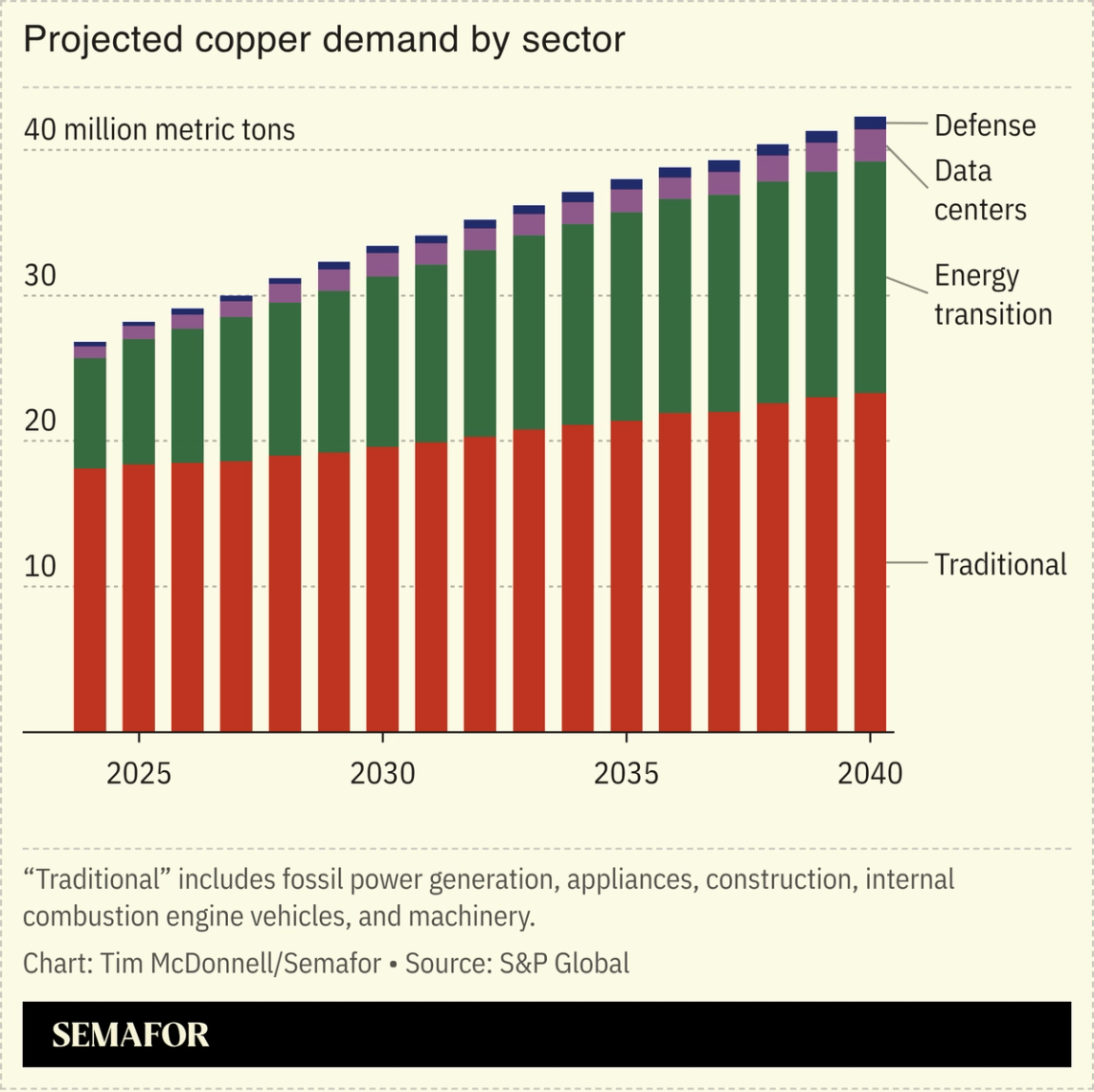 Copper’s meteoric price rise will likely continue thanks to a growing supply deficit that could reach 25% of projected demand by 2040, analysts forecast. Copper is critical for batteries, data centers, and drones, yet new mines are slow and expensive to open, and without policy changes to accelerate mining, copper shortages will constrain the AI revolution and energy transition, S&P Global estimated. One mining billionaire fretted that those expecting copper “to be a $270 billion a year market by tomorrow morning” are “dreaming.” The US has signaled willingness to exercise force in its quest to acquire mineral-rich Greenland, which could escalate protectionism by other powers over critical resources, Semafor’s Tim McDonnell wrote: “Copper is a conflict mineral of the future.” |
|
Global cooperation holds up |
 Kylie Cooper/Reuters Kylie Cooper/ReutersCooperation between nations is holding steady despite myriad threats to multilateralism, a new report found. US President Donald Trump has disrupted global commerce, attacked allies, and withdrawn Washington from dozens of international bodies — ushering in a new global order defined by spheres of influence that breed rivalry and mistrust. But as institution-driven multilateralism falters, “global cooperation is reinventing itself,” a World Economic Forum report said, thanks to a smaller and more flexible coalition of countries coordinating across tech, climate, and natural resource sectors: “Economies are still pursuing global objectives, but focusing on… a viable pathway to advance their respective priorities.” Cooperation on peace and security, though, has cratered, as conventional global actors do little to solve escalating conflicts. |
|
 From geopolitical shocks to climate volatility and disruptive technologies, today’s business environment is increasingly resistant to prediction. As public trust frays, CEOs are being pushed to lead with clarity under pressure. Semafor CEO Signal Editor Andrew Edgecliffe-Johnson will sit down with global leaders, including GE Vernova CEO Scott Strazik, on Wednesday, January 21, in Davos to examine how executives are resetting priorities, reassessing risk, and redefining resilience.
|
|
Musk takes extreme stand on race |
 Nathan Howard/Reuters Nathan Howard/ReutersElon Musk on Thursday endorsed a call for “white solidarity,” an extreme view that offers insight into how the richest man in the world sees his adopted country, the US. Musk has also claimed that a “white genocide” is happening in his home country of South Africa, allegations that experts reject but have been echoed by other US tech leaders in the diaspora, defining the Trump administration’s approach to the country. Musk’s ownership of X has unleashed extreme rhetoric, at times dividing the right, and the social media platform is now facing scrutiny in several countries after its AI chatbot Grok generated sexually inappropriate images of women and what appear to be minors, without their consent. |
|
Roblox chat requires age check |
 Julio Cesar Aguilar/AFP via Getty Images Julio Cesar Aguilar/AFP via Getty ImagesRoblox users can no longer access the chat function without undergoing a mandatory age check, as concerns over children’s safety online proliferate. The gaming platform, which allows users to design and share games, is immensely popular, with roughly 380 million users a month, many of them children. But parents and authorities worry that Roblox exposes young users to inappropriate material, grooming, or exploitation, especially via the chat function; the company faces several lawsuits, including from the US states of Texas and Louisiana. Governments worldwide are increasingly worried about online harms: Australia banned all social media for under-16s, while the UK and several US states require age checks for sites hosting adult material. |
|
US recommends eating red meat |
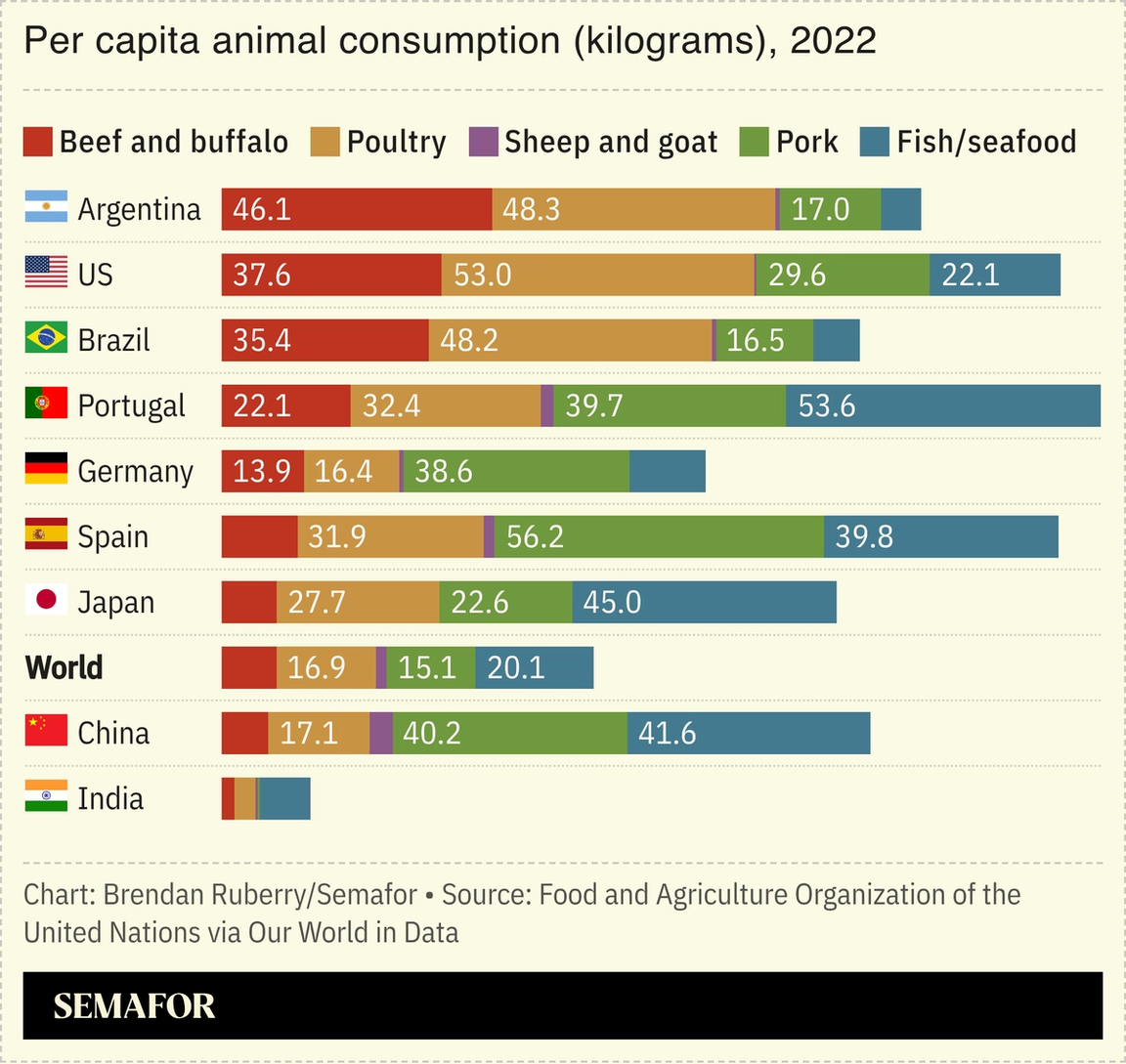 US health authorities changed food guidelines to recommend people eat more meat. The new recommendations say that previous advice has “demonized protein in favor of carbohydrates,” but that common sense and science dictate “prioritizing high-quality, nutrient-dense protein,” including red meat. The advice is unusual — the WHO and most European countries recommend limiting red meat — although nutritional research is notoriously difficult, because it’s hard to tell whether, for instance, people who avoid red meat are healthier because of their diet, or because they are more health-conscious and, perhaps, smoke less or exercise more. A 2019 study suggested that |
|
|


