As 2025 comes to a close, we’re reflecting on the biggest tech stories of the year and how those eve͏‌  ͏‌  ͏‌  ͏‌  ͏‌  ͏‌ 
 
rotating globe
December 24, 2025
Read on the web
semafor

Technology

Technology
Sign up for our free email briefings
 
First Word
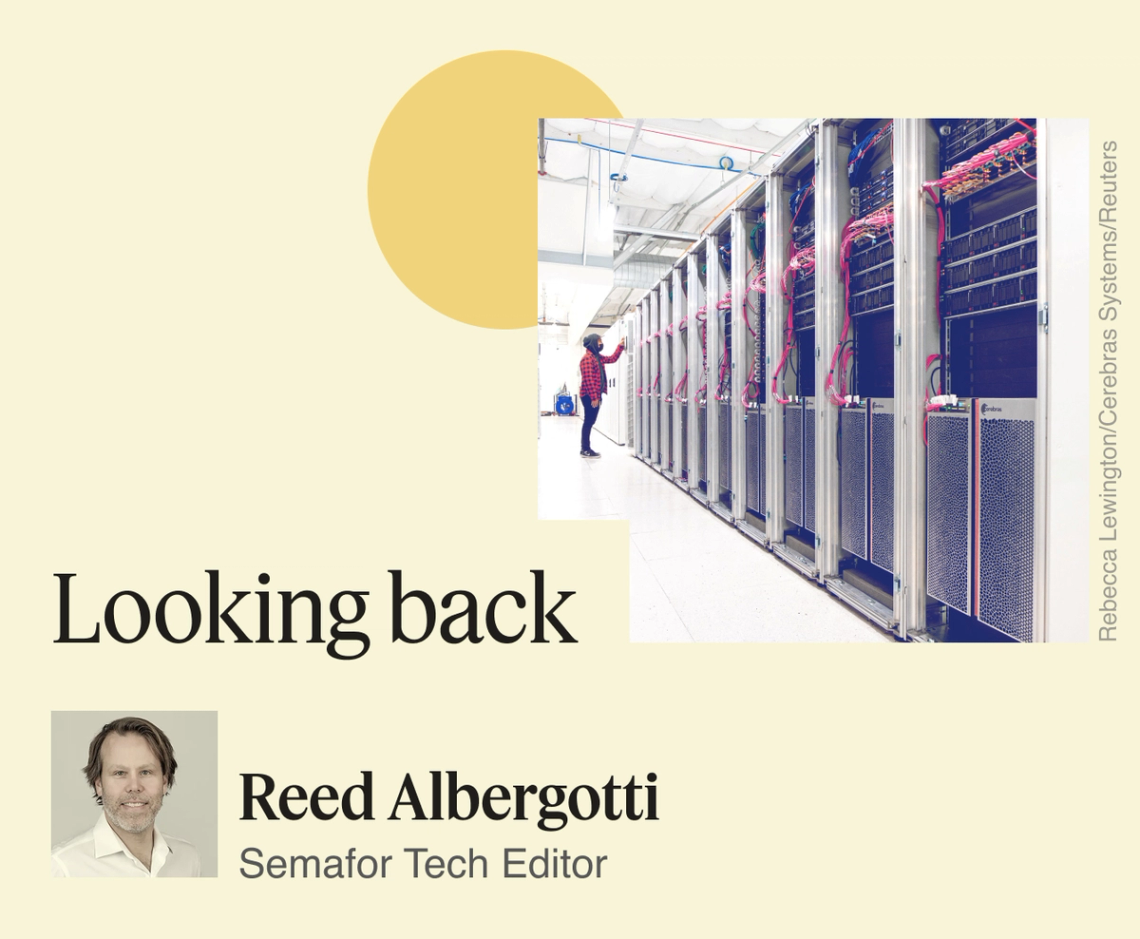
Looking back.

There’s no better season for nostalgia. So we’re taking a moment to reflect on the biggest stories in 2025 that Semafor helped shape, and hopefully convey the most critical news that our readers got first.

We kicked the year off with a fascinating yarn about Australian legendary hacker, Chris Wade, who was pardoned by President Donald Trump at the end of his first term — but not for the reasons you’d expect. It happened through a chance encounter with Trump backer Ike Perlmutter at a tropical fish store that ultimately led to the pardon. Some film studios are considering turning it into a movie.

In January, we laid out why Google was poised to take the lead in the AI race — a combination of a multimodal approach to training that meant a slower start but long-term payoff, custom silicon in the form of TPUs, and the application of the company’s models on robotics. Many publications began to understand this late in the year.

We also stayed on top of the Google AI org chart, scooping major personnel moves like Koray Kavukcuoglu’s appointment to chief AI architect, Josh Woodward taking over the Gemini app, and Amin Vahdat’s promotion to chief AI architect.

And we were the first to write about tech giants getting serious about building data centers in space, kicking off a news cycle legacy media soon followed.

We were among the first to draw attention to the growing security issues in the vibe-coding era with this scoop on startup darling Lovable, something that was largely ignored amid the AI hype, and ultimately tamped down some of the vibe-coding wishful thinking.

We also revealed the Treasury Department was reviewing whether Benchmark Capital’s funding of Chinese startup Manus AI violated new restrictions on outbound AI investments to China.

And we drew attention to another major policy issue that most of the public — and even the tech industry — was ignoring: Data center NIMBYism. We expect this one to become an even bigger issue in 2026.

And finally, we’ve launched a series of video interviews, in the spirit of this longform age, sharing our conversations with figures from Brian Schimpf to Eliezer Yudkowsky to Aravind Srinivas and Mustafa Suleyman. We’ve heard from a lot of you that you enjoy these, and we plan to do more.

That’s still just the tip of the iceberg. Here are more of our biggest stories from this year, and the impact they continue to have.

1

H200 chips soon off to China

Nvidia CEO Jensen Huang.
Evelyn Hockstein/Reuters

Earlier this month, we scooped that US President Donald Trump greenlit the sale of Nvidia’s powerful H200 chips to China, attempting a middle ground among the various outspoken parties with differing opinions on how US export controls impact Chinese AI advancement. The move opens a huge market for Nvidia while still limiting China’s access to the company’s more powerful processors available in the US. The impact of the decision likely won’t be felt for many years — Nvidia plans to start shipments in February — as China continues to build out its domestic semiconductor industry while still relying in part on American chips.

2

Anthropic’s rocky start with Trump

Dario Amodei.
Chance Yeh/Getty Images for HubSpot

Cast your minds back to when the One Big Beautiful Bill was on the table, and the moratorium on state AI lawmaking was included. While many AI companies prefer to follow one set of federal rules, Anthropic lobbied members of Congress to vote against the bill, we scooped in May. The bill passed without the ban, but the whole episode started a contentious relationship between Anthropic and the Trump administration, which has come to see the company — and its CEO’s sober AI predictions — as an obstacle.

Anthropic’s reputation in the White House and the moratorium are still relevant today, with AI Czar David Sacks recently accusing the company of “running a sophisticated regulatory capture strategy based on fear-mongering,” revolving around its disclosures of safety concerns. CEO Dario Amodei met with lawmakers in Washington earlier this month, as we also first reported, in a trip that served to repair strained relationships. Amodei leaned into something both he and Trump could agree on: the importance of American tech leadership.

3

Data centers receive cold welcoming

The outside of a data center.
Leah Millis/Reuters

We were early to report on the problems that data centers brought to residential areas — a story that is quickly developing into a focal point in local and national politics. The central concerns revolve around costly energy and water usage, which continue to be opaque, and a NIMBY-adjacent attitude regarding the perceived unsightliness of the buildings. With few lawmakers willing to advocate for slowing or rethinking development — a view that is gaining traction with constituents — the divide between how the government and public see AI is likely to widen. As the 2026 midterms approach, we expect this conversation to be even more central in politics. It also gives way for moonshot ideas like data centers in space, which would have fewer neighbors to protest.

Semafor at Davos
Davos graphic.

AI is set to reshape the modern enterprise. What separates leaders is how they translate promise into performance. Join us in Davos on Tuesday, Jan. 20 as Semafor editors sit down with senior executives to examine how companies are using AI to drive growth, gain advantage, and stay competitive in the next era of global business.

Jan. 20 | Davos | Request Invitation

4

The key to the Meta-Scale deal

Mark Zuckerberg.
Reuters/Xavier Collin/Image Press Agency/NurPhoto

In June, we broke a piece of the Meta-Scale AI investment story that changed how the deal was perceived. The hidden perk in Meta’s $15 billion investment was access to Scale AI’s rich pool of data, used to train Meta’s AI models. The unusual arrangement highlighted what companies are willing to pay for proprietary data that could improve their models over competitors’ as the existing supply of available data runs dry.

5

Reddit considered eye-scanning orb

Stickers handed out to people who signed up for WorldCoin are seen at a sign-up site in Shoreditch, East London, Britain.
Elizabeth Howcroft/Reuters

We’ll be keeping our eye on the ball in 2026, but first, an honorable mention. Reddit was in discussions to use World ID’s iris-scanning orb to verify user identities earlier this year, we scooped. While that partnership hasn’t yet materialized, it points to the growing market for stronger identity verification technologies, which have become increasingly relevant as governments institute social media bans for children and as embedded AI blurs who, or what, users engage with.

Semafor Spotlight
Semafor Spotlight graphic

The News: Beyond the latest 60 Minutes controversy, many CBS News staffers are skeptical of Bari Weiss’ background in opinion journalism, not hard news. →

Semafor
You’re receiving this email because you signed up for briefings from Semafor. Manage your preferences or unsubscribe hereRead our privacy policy.
Was this email forwarded to you? Sign up now to get Semafor in your inbox.
Semafor, Inc. 228 Park Ave S, PMB 59081, New York, NY, 10003-1502, USA
LiveIntent LogoAdChoices Logo