Hi! Dead letters: US Secretary of State Marco Rubio has banned the Calibri font — a sans-serif typeface that was the Windows default for 17 years — ordering staff to “restore decorum and professionalism” with Times New Roman instead. Today we’re exploring: |
- Well, who else? TIME just named the “Architects of AI” as their Person of the Year.
- Cartbreaker: Exploring the tight-margined grocery delivery business of Instacart.
- Flight club: American Airlines has an exclusive new $5,000 loyalty pass.
|
P.S. Keep an (A)eye out for our AI special edition on Monday! Have feedback for us? Just hit reply - we'd love to hear from you! |
TIME names the “Architects of AI” as its Person of the Year for 2025 |
TIME just announced its Person of the Year… and it’s not a single person.
The magazine selected the “Architects of AI” as its 2025 honoree, spotlighting the executives and engineers behind the year’s AI boom. One of the two covers features eight tech leaders perched on a steel beam — recreating the iconic “Lunch Atop a Skyscraper” photo from 1932 — including Meta’s Mark Zuckerberg, AMD’s Lisa Su, xAI’s Elon Musk, OpenAI’s Sam Altman, and Nvidia CEO Jensen Huang at the center, whose chips power many of today’s AI models.
The magazine frames 2025 as the year when AI’s “full potential roared into view,” with data center constructions surging and companies crossing new valuation thresholds — while also noting bubble fears, debt-funded build-outs, and lawsuits over chatbot harms.
Prediction markets had been leaning nonhuman, with Polymarket (47%) and Kalshi (55%) both assigning the highest odds not to any one person but to “AI,” ahead of Huang, Altman, or even Pope Leo XIV, per Business Insider. Many of those bettors weren’t far off in the end — though that may be of little consolation given that the market for “Artificial Intelligence” on Polymarket resolved to “No.”
|
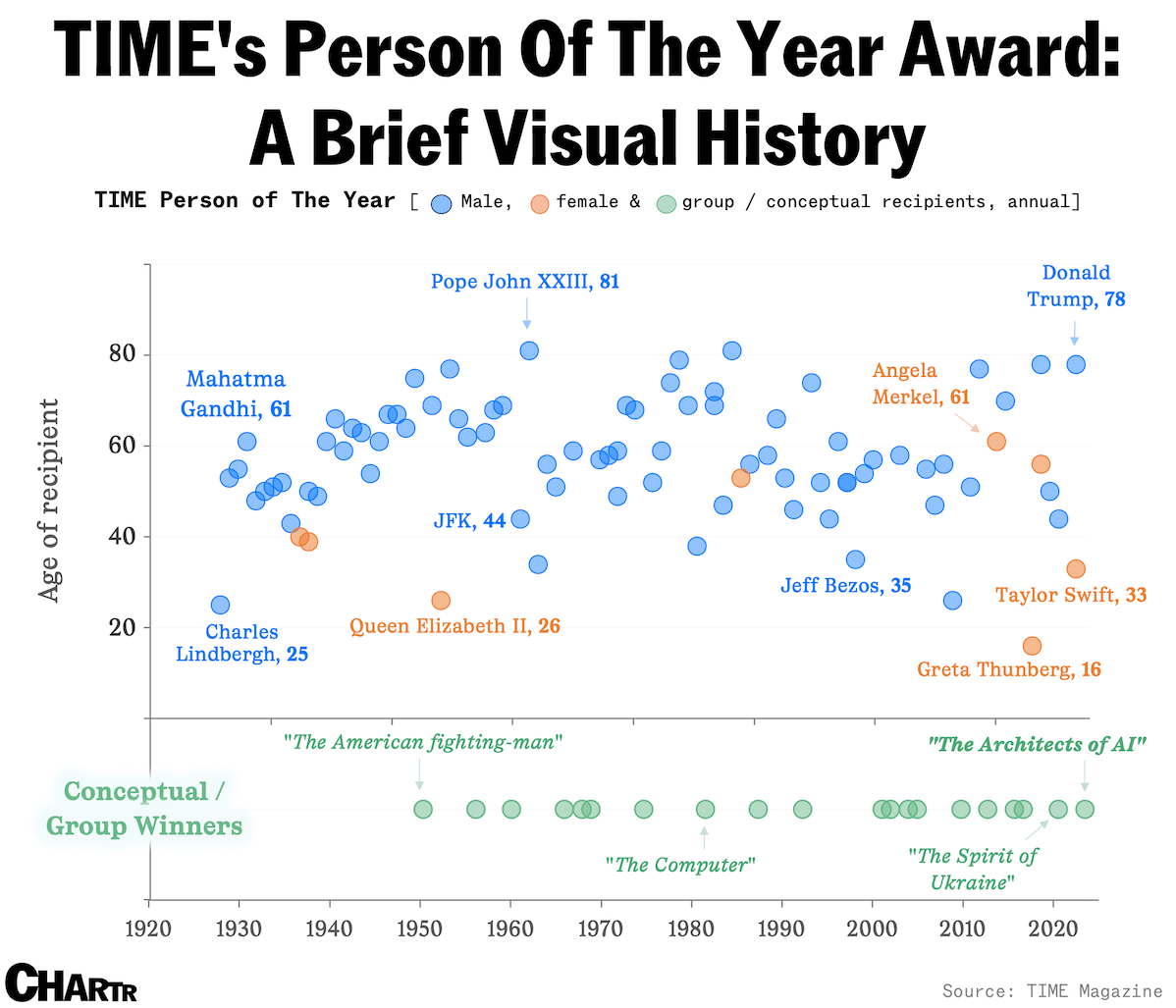
Indeed, the 102-year-old magazine has chosen groups of people or even nonhuman concepts before, as TIME has long defined the award as recognizing “the person or persons who most affected the news and our lives, for good or ill,” according to former Managing Editor Walter Isaacson.
Across its selections since 1927, 20 awards have gone to group or conceptual forces, including “The Apollo 8 astronauts” in 1968; “The Computer” in 1982, when TIME first broke tradition to honor the rapid rise of personal computing; “The Whistleblowers,” who exposed corporate fraud at Enron and WorldCom, in 2002; and “The Spirit of Ukraine” in 2022.
Previously titled the “Man of the Year” award until 1999, the accolade has been given to a handful of women so far, such as Queen Elizabeth II in 1952, Angela Merkel in 2015, and Taylor Swift, the most recent female recipient, in 2023. |
A new pass to access American Airlines’ loyalty program will set you back $5,000 |
If you’ve ever sat around at the departure gate waiting to get onto an American Airlines flight, eyeing priority boarding members with envy, we’ve got some news: you can now gain access to the carrier’s AAdvantage loyalty program at entry level… for a cool $5,000.
According to Travel Weekly, cash-flush fliers can skip the usual process required to obtain AAdvantage Gold status — notching 40,000 or more loyalty points by clocking air miles, using AA co-branded credit cards, or spending via their various partnership schemes — by paying the fee up front to enjoy perks such as “priority check-in and boarding, a free checked bag, complimentary preferred seat selections, upgrades when available within 24 hours of departure, and 40% accrual bonuses for miles and loyalty points.”
|
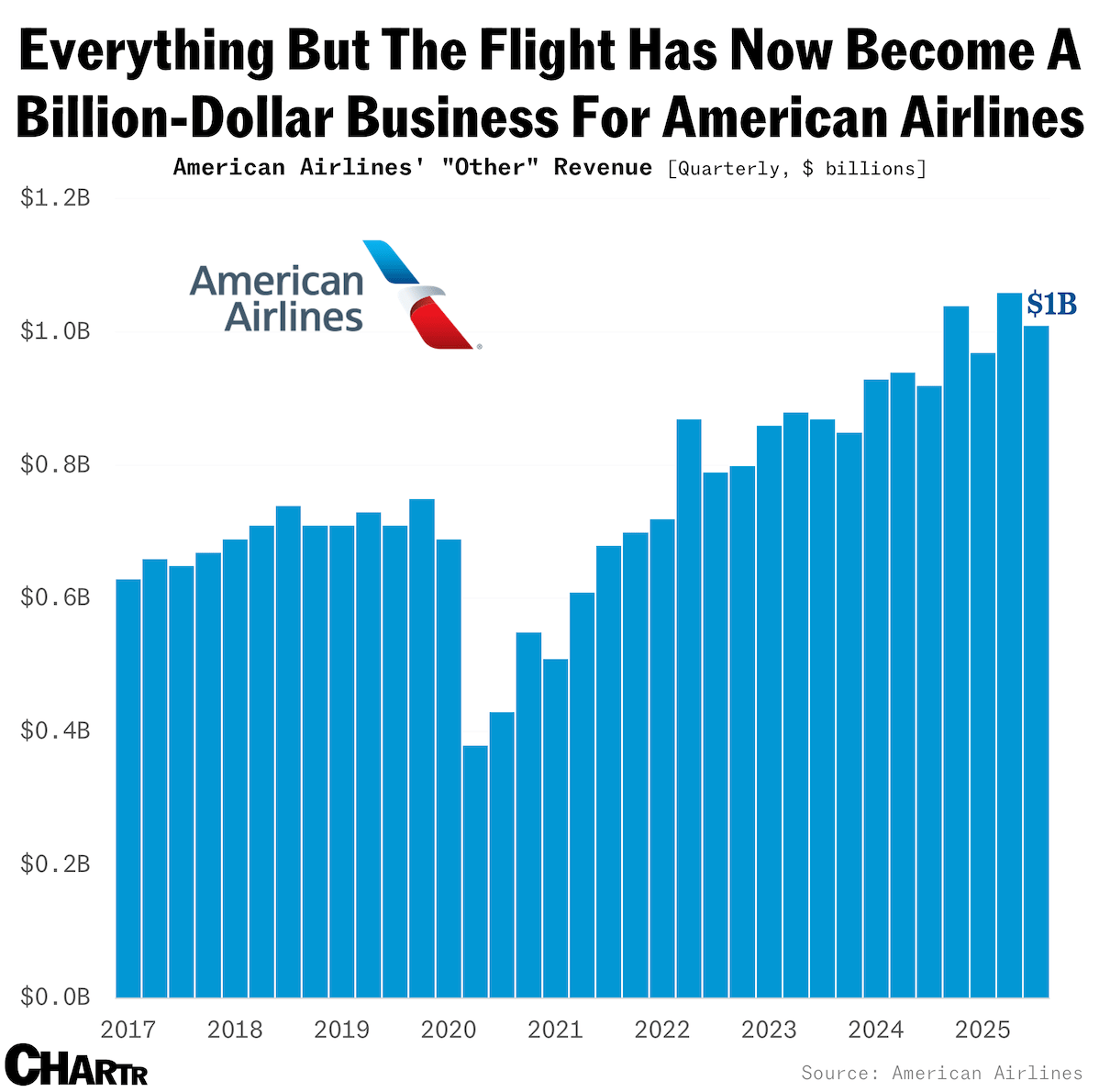
Even before this new pay-to-play scheme, the airline’s loyalty program and its other activities that aren’t directly flying people or things around the world have become a billion-dollar part of its operations each quarter. |
Last year, American Airlines’ “Other” revenue accounted for some 7% of the company’s overall annual sales, or about $3.83 billion. For the first three quarters of 2025, the division, which is predominantly made up of marketing revenue from its loyalty program — or the money that American makes from selling mileage credits to co-branded credit card merchants and other AAdvantage partners — has consistently pulled in revenues that hover around or above the $1 billion mark.
Of course, that’s just the direct, measurable impact of the program. What’s not captured is the intangible value, which makes someone choose American over another airline just because they have some status with the carrier already. |
AI Spending Is Growing, and Investors Are Assessing Where the Lasting Opportunities May Be |
AI adoption continues to expand, but the path forward is unlikely to be uniform. Investors are assessing which parts of the value chain capture the most durable demand and how leadership across semiconductors may evolve as workloads scale. Even with this variability, chips remain central to AI progress. Demand spans chip design, manufacturing, memory, and packaging, creating multiple potential drivers as the ecosystem matures. For diversified exposure across this landscape, VanEck offers two semiconductor ETF options: |
The economics of Instacart’s grocery delivery |
This week was a rollercoaster ride for Instacart investors. Traders loved the announcement on Monday that the grocery delivery app will be embedded in ChatGPT, becoming the “first company to offer [a] new instant checkout app experience” on the leading AI chatbot.
But AI can be a double-edged sword. Indeed, a separate report released Wednesday took some of the shine off, with the company’s AI-enabled experiments allegedly charging consumers different prices for the same items — by as much as 23% in one case. |
Instacart has been doubling down on an AI-centered strategy this year, like offering personalized recommendations to consumers and deepening its partnership with OpenAI, in the hope of improving the economics of a grocery delivery business that runs on pretty tight margins.
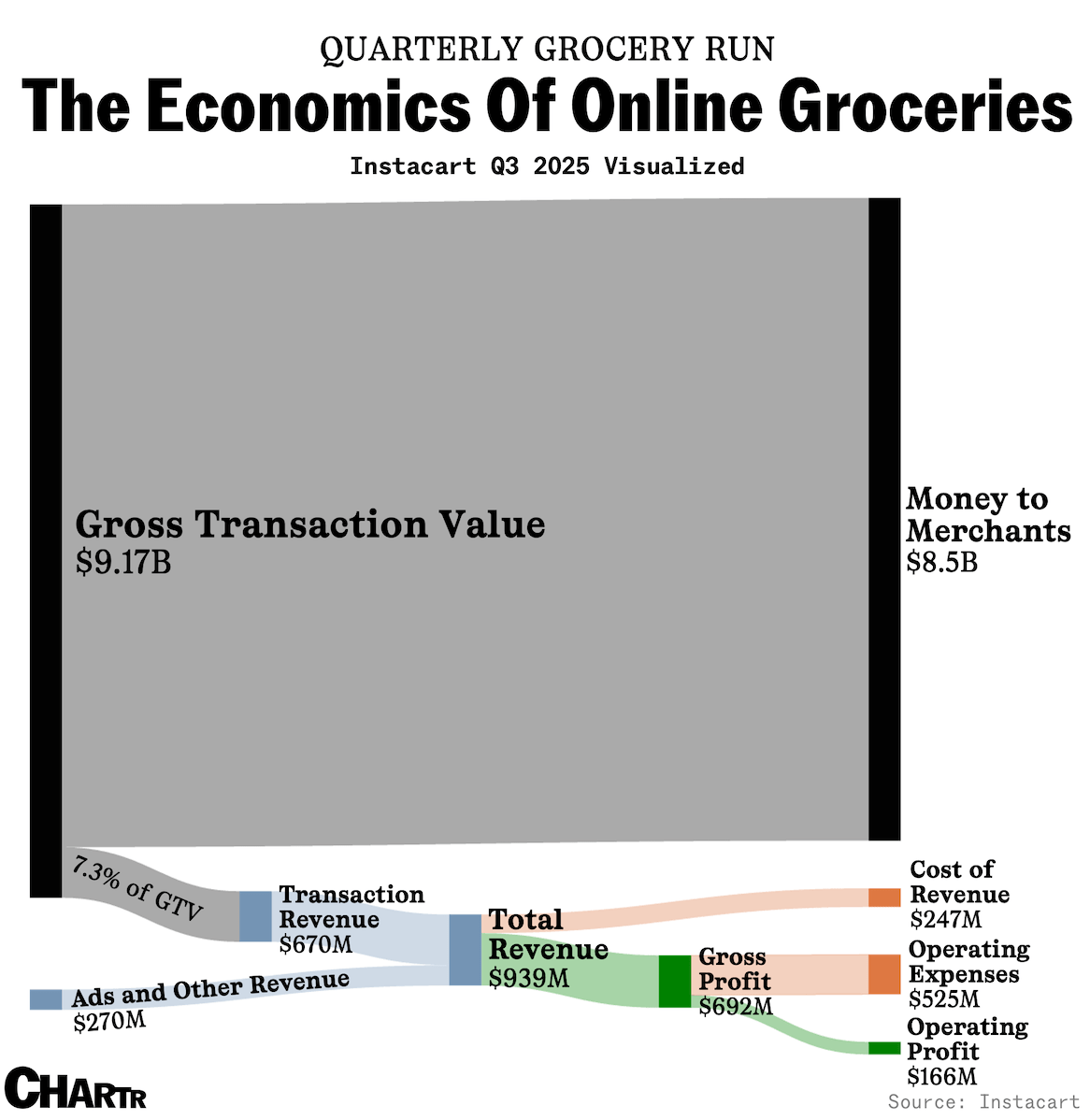
The company made a whopping $9.17 billion in orders through its marketplace, most of which was passed through to merchants. CART took a ~7% slice of that revenue, worth some $670 million in Q3, as well as a cool $270 million from advertising and other fees, which are much higher margin — helping the company eke out a total of $166 million in operating profit. |
But profit growth has slowed at Instacart, and the company has some increasingly scary competitors. Amazon, for instance, now looms large in the space, having expanded same-day grocery delivery to over 2,300 cities and towns in the US, leveraging millions of its members by offering a free-for-Prime service.
No wonder Instacart is looking to AI as a tool to fight back. The problem is, some observers think the company could actually be more hurt by the new technology than helped. Analysts at Wedbush noted that AI might more quickly improve delivery routing and cost efficiency in ecosystems with already established customer relationships, like Amazon, moving customers away from intermediaries like Instacart.
|
|
|
-
Disney will let OpenAI use 200+ characters from Marvel, Star Wars, and Pixar movies as part of a new $1 billion investment deal with Sam Altman’s company.
-
MacKenzie Scott — America’s third most generous philanthropist, per Forbes, and ex-wife of Jeff Bezos — has given away $7.17 billion in 2025, taking her total giving to $26 billion since 2019.
- Weekly jobless claims just climbed the most they have since March 2020, to 236,000 for the week ending December 6.
-
Initial spark: Humans might have been making fires as early as 400,000 years ago, about 350,000 years earlier than previously thought, per a new study co-led by the British Museum.
-
What is it you do again? One in five Americans has a job that didn’t exist in the year 2000, per LinkedIn estimates cited in the WSJ.
|
|
|
Chips remain central to AI progress. Demand spans chip design, manufacturing, memory, and packaging — creating multiple potential drivers as the ecosystem matures. For diversified exposure across the landscape, discover VanEck’s semiconductor ETFs. |
|
|
-
Neal.fun’s stunning “Size of Life” project contextualizes the scale of different forms of life on Earth.
-
Hit piece: Charts on whether music artists actually write their own songs anymore from Stat Significant.
|
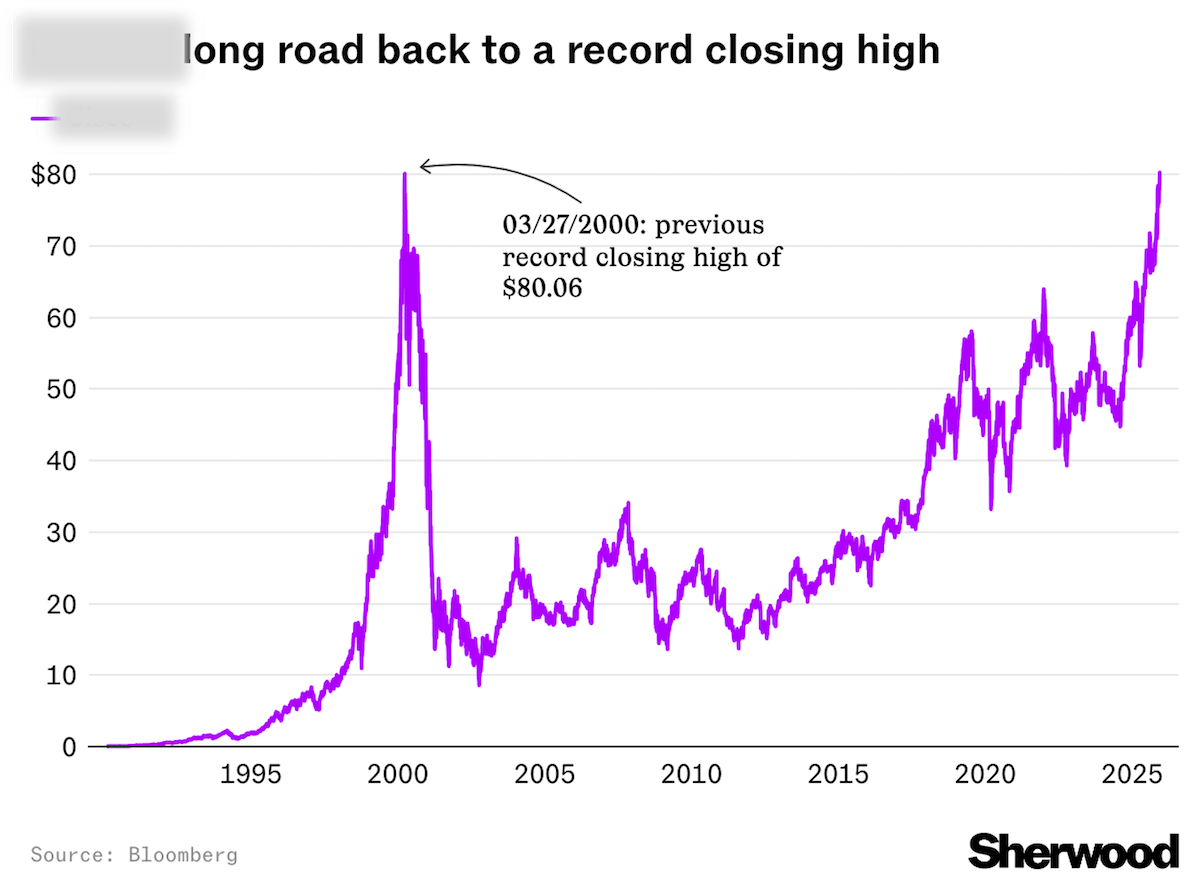
Off the charts: Which tech hardware maker has finally seen its stock get back to where it was during the dotcom bubble? [Answer below]. |
Not a subscriber? Sign up for free below. |
VanEck's Disclosures:
This is not an offer or recommendation to buy or sell any security or digital asset, nor personalized investment, financial, legal, or tax advice. Forward-looking statements are illustrative, subject to change, and not predictive. Third-party data is believed reliable but not verified or guaranteed. Views are those of the author(s), not necessarily VanEck or its other employees.
Investing involves substantial risk and high volatility, including possible loss of principal. Visit vaneck.com to read and consider the prospectus, containing the investment objectives, risks, and fees of the funds, carefully before investing. Past performance is no guarantee of future results. VanEck mutual funds and ETFs are distributed by VanEck Securities Corporation, Distributor, a wholly owned subsidiary of VanEck Associates Corporation. |
|
|
|