| | In today’s edition: What to make of the Tennessee special.͏ ͏ ͏ ͏ ͏ ͏ |
| |  Nashville Nashville |  Austin Austin | Indianapolis |
 | Americana |  |
| |
|
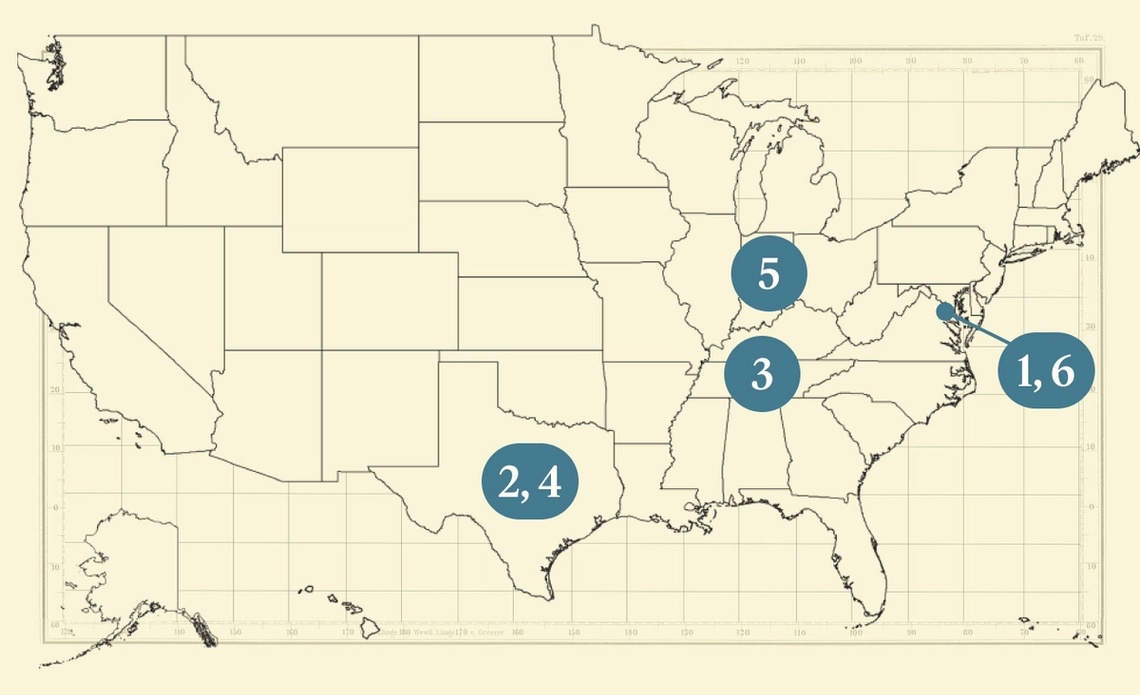 - Good luck, Chuck
- Trump’s Texas stunner
- The Behn game
- Texas Senate troubles
- Redistricting knives out
- Unpredictable ‘New Entrants’
|
|
| |  | Burgess Everett |
| |
 Jonathan Ernst/Reuters Jonathan Ernst/ReutersDave is off this week, so I’m filling in with a dispatch from the corridors of the Senate. A tricky part of my job is figuring out whether what’s captivating the online political world is having any effect on the alternate universe of the US Capitol, which operates under its own logic. And on this note: Just how much trouble is Chuck Schumer in? It’s clear that nearly eight years into his tenure, the minority leader is in the hot seat compared with Senate Majority Leader John Thune or House Minority Leader Hakeem Jeffries. Speaker Mike Johnson’s job seems secure enough for the moment, though upheaval is always a threat under this narrow Republican majority. But if you scroll X, listen to Democratic talking heads, or even read too much into commentary from House Democrats, you’d think Schumer is in huge trouble after eight of his members defected last month to end the government shutdown. I have some new reporting on this topic coming out for tomorrow’s DC briefing. Without spoiling that, here’s a reality check: Let’s start with why he’s safe. First, Senate Democrats aren’t discussing a challenger to Schumer right now. In fact, most of them don’t even want to talk about whether there could be a challenger. And even if a member of his caucus was ready to try, there’s no realistic way to oust him right now. To remain leader after the midterms next year, Schumer just needs a majority of Democrats in the caucus to support him, and he has many friends. Sure, there are lots of new senators with less allegiance to Schumer, and some of his allies are now gone from the Senate, like Jon Tester and Bob Casey. But toppling Schumer in a leadership election next year, especially if Democrats pick up seats, will be a tough task. On to his problem. Democratic primary candidates like Graham Platner in Maine and Mallory McMorrow in Michigan are saying they won’t support Schumer as leader if they win, and some members of his own caucus are supporting candidates at odds with his preferred Senate picks. That’s unusual, but Semafor readers knew this was a problem back in September. The real issue is what happens if Democrats lose seats next fall. Then things could get pretty spirited in the ornate LBJ Room where Democratic senators privately meet each week. Schumer made his bones by being an astute political mind, flipping the Senate in 2006 as party campaign chair and winning it again in 2020 under challenging circumstances. His stewardship of the ensuing 50-50 Senate will be remembered as an uncommonly successful period of legislating. But while midterm elections tend to be referenda on the sitting president, leadership races are often all about one simple question: What have you done for us lately? And there will be clarity on that one year from now, when Democrats select their leader for two more years. Did Schumer lead the party to victories in battleground states like North Carolina, Georgia and Maine, or did he preside over defeats? The answer to that question will tell you a lot of what you need to know about his future. Even a worst-case midterm scenario, though, might only cause a few defections in a leadership race. |
|
Trump shakes up battleground race with pardon of Democratic incumbent |
 Michael A. McCoy/Reuters Michael A. McCoy/ReutersPresident Donald Trump delivered the electoral equivalent of a screwball pitch on Wednesday by pardoning Texas Rep. Henry Cuellar, one of the Democratic Party’s most conservative lawmakers — and a top target for defeat next fall by House Republicans. The pardon wipes charges of bribery, conspiracy, and money laundering off the board for Cuellar and his wife, who were scheduled for a spring trial. It also promises to boost his hopes of reelection to Texas’ 28th Congressional District, just one day after a top Republican recruit entered the race to replace him. The district is in line for a GOP-friendly redraw under new Texas maps that are awaiting a critical decision by the Supreme Court, but the 11-term Cuellar has considerable cross-aisle appeal. The anti-abortion Democrat has voted with Trump’s party on several high-profile measures in recent years, including bills to end the government shutdown and to block federal funding from schools that allow transgender athletes to play girls sports. So, why boost an embattled Democrat Republicans had a real chance of defeating? Trump attributed the pardon to Cuellar’s opposition to Joe Biden’s border policies, blaming that stance for the Biden-era investigation of the congressman. Some campaign analysts immediately wondered if the next twist in the district would be Cuellar switching to the GOP. In the immediate wake of the pardon, however, he posted on X to thank Trump, told reporters in the Capitol that “nothing has changed,” and filed for reelection as a Democrat. — Elana Schor |
|
The narrative battle over Tennessee’s special election |
 Jon Cherry/Getty Images Jon Cherry/Getty ImagesDemocratic candidate Aftyn Behn either overperformed in Tuesday’s House special election in a ruby-red Tennessee district — or she failed, thanks in part to her left-leaning record, to take advantage of prevailing national headwinds. Those dueling narratives are still playing out in Washington as final tallies put Behn’s loss closer to double-digit percentage points. The truth, as it often does, lies somewhere in between. As Ben Jacobs wrote in Slate, Democrats needed a “perfect storm” to win a district that Trump claimed by 22 percentage points last year. What they got instead was a “steadfast progressive with a long history of intemperate online comments” — perfect ammunition for 30-second anti-Behn attack spots. She faced the “platonic ideal” of a Republican candidate in Matt Van Epps, a veteran who adorned all of his yard signs with a Chinook helicopter. As Jacobs noted, contrary to assumptions about off-year elections when the GOP is in power, stalwart Republican voters did turn out in large numbers for Van Epps, whom Republicans viewed as their strongest candidate. On top of a heavy 11th-hour investment of national GOP resources, those factors blunted Democrats’ national advantage but did not nullify it: Behn overperformed, and she also fell short. Democrats don’t need to win districts as GOP-friendly as Tennessee’s 7th to win the House next year. But as the Cook Political Report’s Amy Walter observed, the real missed opportunity for Democrats might be that an actual nail-biter would’ve thrown a stink bomb into the Republican conference, generating panic and infighting — rather than what ultimately happened. — Brendan Ruberry |
|
Democratic group touts trouble for Cornyn in Texas primary |
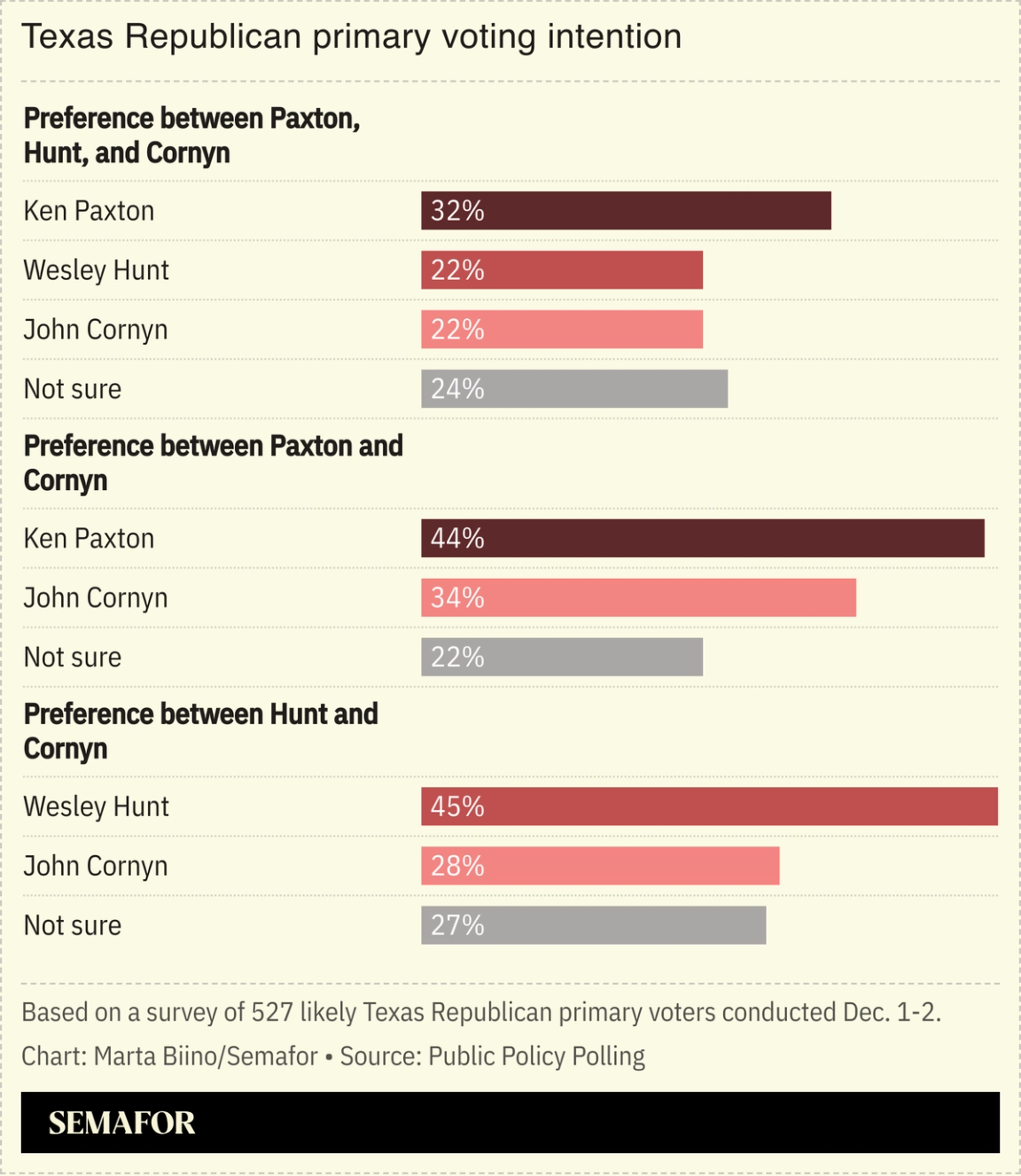 It’s not every day that Democrats needle a sitting Republican senator when they have their own competitive primary to deal with, but that’s what happened in Texas this week. According to new polling from Public Policy Polling commissioned by the Democratic Senate Majority PAC and shared first with Semafor, Sen. John Cornyn may still have work to do in his primary against Texas Attorney General Ken Paxton and Rep. Wesley Hunt, R-Texas. In a three-way matchup, the new survey showed, Paxton gets 32% of the vote while Hunt and Cornyn each pick up 22%, with 24% undecided. Both Paxton and Hunt also led Cornyn in head-to-head matchups, with roughly a quarter of voters still unsure. Cornyn has led several recent polls and is working to dispatch his opponents by locking in an endorsement from Trump, though it’s not clear he’ll get one. Cornyn campaign adviser Matt Mackowiak said the incumbent senator will win and that “Democrats are desperate to run against fatally flawed homewrecker Ken Paxton and cost the GOP a critically valuable Senate seat and as much as $200M in the general election.” Lauren French, a Senate Majority PAC spokeswoman, called that response “weak, half-hearted spin.” Democrats are currently contending with their own tricky Texas Senate primary between former Rep. Colin Allred and James Talarico, a Texas state lawmaker with a big online following. Republicans would be delighted if another potential candidate, Texas Rep. Jasmine Crockett, jumps in soon. — Burgess Everett |
|
New conservative ad in Indiana casts Newsom as villain |
 Club for Growth/YouTube Club for Growth/YouTubeIndiana has become a bigger-than-expected obstacle to Republicans’ mid-decade redistricting hopes, but the party isn’t done pushing. The state Senate there is unlikely to pass a map that would eliminate Indiana’s two Democratic members of the US House, thanks to a pocket of Republican opposition that isn’t budging. Despite Trump threats to primary them, followed by anonymous swatting attacks — and at least one pipe-bomb threat — Indiana’s GOP state senators continue to oppose a mid-decade redraw. One of them pointed to Trump’s use of derogatory language for people with disabilities to explain his resistance. Yet the conservative group Club for Growth is still trying to turn the tide with this ad, depicting California Gov. Gavin Newsom as a Dr. Moreau-like figure with scalpels and surgical gloves who wants to “carve up” maps and “gut Trump’s agenda.” (Newsom launched a successful mid-decade redistricting ballot measure in response to Texas’ effort.) The stakes are higher, with more seats at play than when the Club ran its earlier Kansas redistricting spot. And it ratchets up the tone accordingly, raising the specter of a “do-nothing” Indiana. — Brendan Ruberry |
|
Getting to know the most unorthodox bloc of Trump’s coalition |
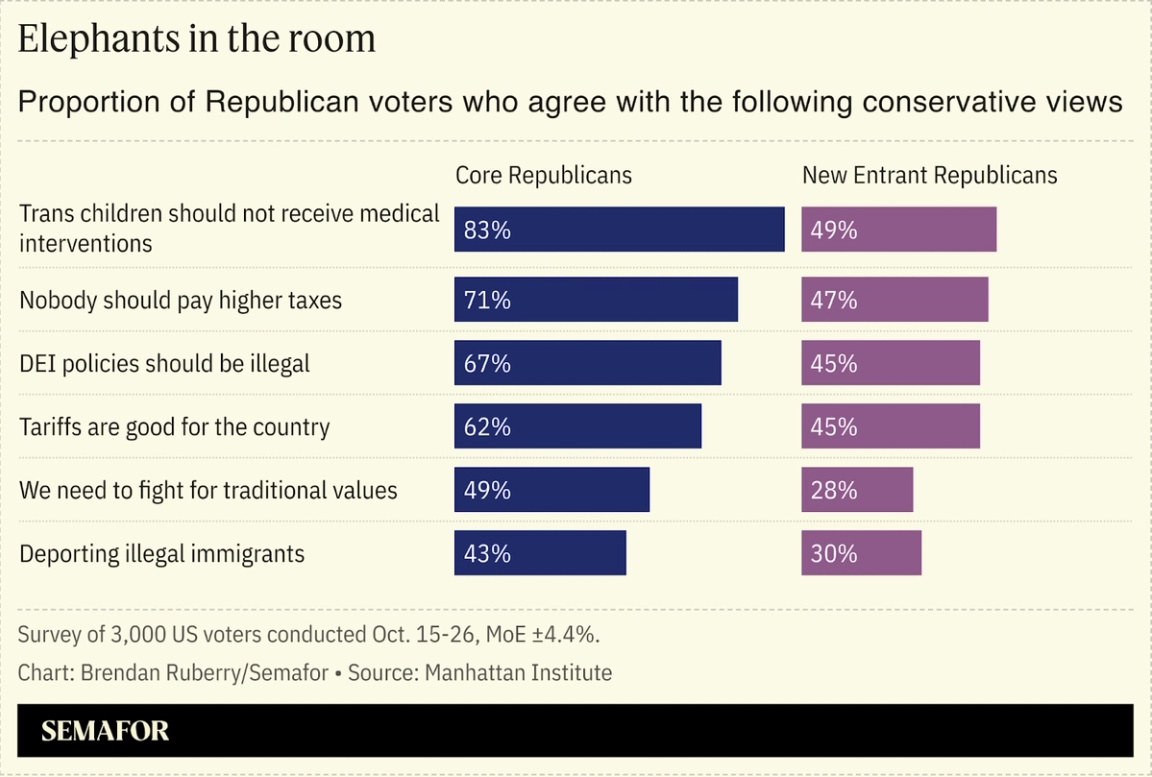 This newsletter has written about Trump’s successful courtship of the “weird” vote — those come-lately elements of the electorate that trended Republican in 2024. This bloc has tended to be more racially diverse, ideologically heterodox, and more conspiracy-minded. The Manhattan Institute, a conservative think tank, calls these voters “New Entrant Republicans,” and among the 3,000 voters it surveyed in a new poll, they constitute about 29% of Trump’s 2024 coalition. This subset of Trump’s base is more skeptical of established institutions and public figures, and less reliably conservative than more consistent Republican voters. People in this bloc are also more likely than firmer GOP voters to support higher taxes and more high-skilled immigration. The New Entrants are 50-50 on DEI policies and more critical of Israel than consistent Republican voters, per the Manhattan Institute’s analysis. They are also more likely to believe that not only Jewish Americans, but an array of ethnic and immigrant groups, are more loyal to a foreign country than to the US. These newly minted Republicans are a critical part of the ideologically and electorally unstable coalition that Trump cobbled together last fall, as Dave has observed in the past. And as opposed to what the Manhattan Institute poll calls “Core Republicans,” these voters are less likely to choose the GOP in the next election. — Brendan Ruberry |
|
 In Washington, economic power no longer follows party lines. The old frameworks — left vs. right, House vs. Senate, Republican vs. Democrat — no longer fully explain how economic power moves in the Capitol. Today’s influence moves through a wide network, from traditional power brokers to ideological outliers, dealmakers, and policy entrepreneurs. Join us December 10 for one-on-one conversations with leaders including Sen. Josh Hawley (R–Mo.), Rep. Suzan DelBene (D-Wash.), and Sen. Mark Warner (D–Va.), as we map the people moving capital, shaping policy, and redrawing the blueprint of economic power. |
|
|


