| |  | | | | |  | By Megan R. Wilson | Did you get this newsletter forwarded to you? Sign up here to get it in your inbox. - FDA shockwave: Richard Pazdur’s sudden retirement announcement from his role as top drug regulator jolts Washington and renews concerns about churn inside an already turbulent FDA.
- Vaccine panel preview: The Washington Post spoke with incoming ACIP chair Kirk Milhoan about plans for the panel’s upcoming meeting and concerns from public health experts about changes to the childhood vaccine schedule.
- Expert Q&A: Leland Miller of the U.S.-China Economic and Security Review Commission talks with WP Intelligence about the role China plays in the drug supply chain — and the relevance as a national security threat.
Hello everyone, welcome to Health Brief. What a week, huh? What’s that, it’s only Tuesday? Great. There’s a lot going on, but I’m always craving more. Do you have any health policy intel, scoops or tips? Email me at megan.wilson@washpost.com, or message me securely on Signal at megan.434. This newsletter is published by WP Intelligence, The Washington Post’s subscription service for professionals that provides business, policy and thought leaders with actionable insights. WP Intelligence operates independently from the Washington Post newsroom. Learn more about WP Intelligence. | | | |  | The Lead Brief | Richard Pazdur, a 26-year veteran of the Food and Drug Administration who’d taken a job leading the nation’s drug approval office three weeks ago, will likely be out by the end of the month, report Dan Diamond and Rachel Roubein in The Washington Post newsroom. Pazdur, who had initially turned down the role atop the Center for Drug Evaluation and Research before ultimately accepting, has decided to retire. Although he could change his mind and reverse course, a source familiar with his decision told my colleagues, it’s unlikely. Make sure to read their full story for all the details. Why it matters: Pazdur’s sudden exit removes one of the FDA’s most trusted and experienced hands at a moment when the agency is already under political strain. I reported last month about concerns from industry, investors and patient advocates about brain drain at the agency, overall staff turnover and feelings about unpredictability. (Within that same Health Brief issue is Dan and Rachel’s scoop about Pazdur’s unease with FDA’s various plans to expedite drug approvals.) THE REACTION The news took Washington by surprise. Industry players, patient groups, health experts and analysts had all welcomed Pazdur’s appointment — which had been announced on Nov. 11 — and viewed it as a stabilizing force at the FDA, an agency that’s been in tumult throughout the second Trump administration’s first year. John Crowley, who leads the Biotechnology Innovation Organization, praised Pazdur’s “steady leadership,” expressing concern about the agency’s direction. The group represents about 1,000 biotech companies, including drugmakers. Pazdur’s departure “raises serious concerns about the repeated turnover in key leadership occurring at the FDA,” Crowley said in a statement. “This constant turmoil is undermining America’s leadership in biotechnology.” Pazdur had been at the FDA for more than two decades, including founding its Oncology Center of Excellence in 2017. “This is a very sad day for science and for patients,” said Ellen V. Sigal, chairperson and founder of advocacy group Friends of Cancer Research. “Rick was our guiding light, and this loss is profound.” STAT first reported Pazdur’s decision to retire. “The reality is that FDA has more drama than the Real Housewives shows and at some point, political leaders at HHS or the White House will have had enough,” said Chris Meekins, an analyst at Raymond James and Department of Health and Human Services alum, in a note to clients on Tuesday. The White House and HHS did not immediately respond for comment. A FDA spokesperson said that Pazdur’s years of “leadership, vision and dedication” will continue to shape the agency, according to a statement reported by Dan and Rachel. “We respect Dr. Pazdur’s decision to retire and honor his 26 years of distinguished service at the FDA,” the statement said. “As the founding director of the Oncology Center of Excellence, he leaves a legacy of cross-center regulatory innovation that strengthened the agency and advanced care for countless patients.” | 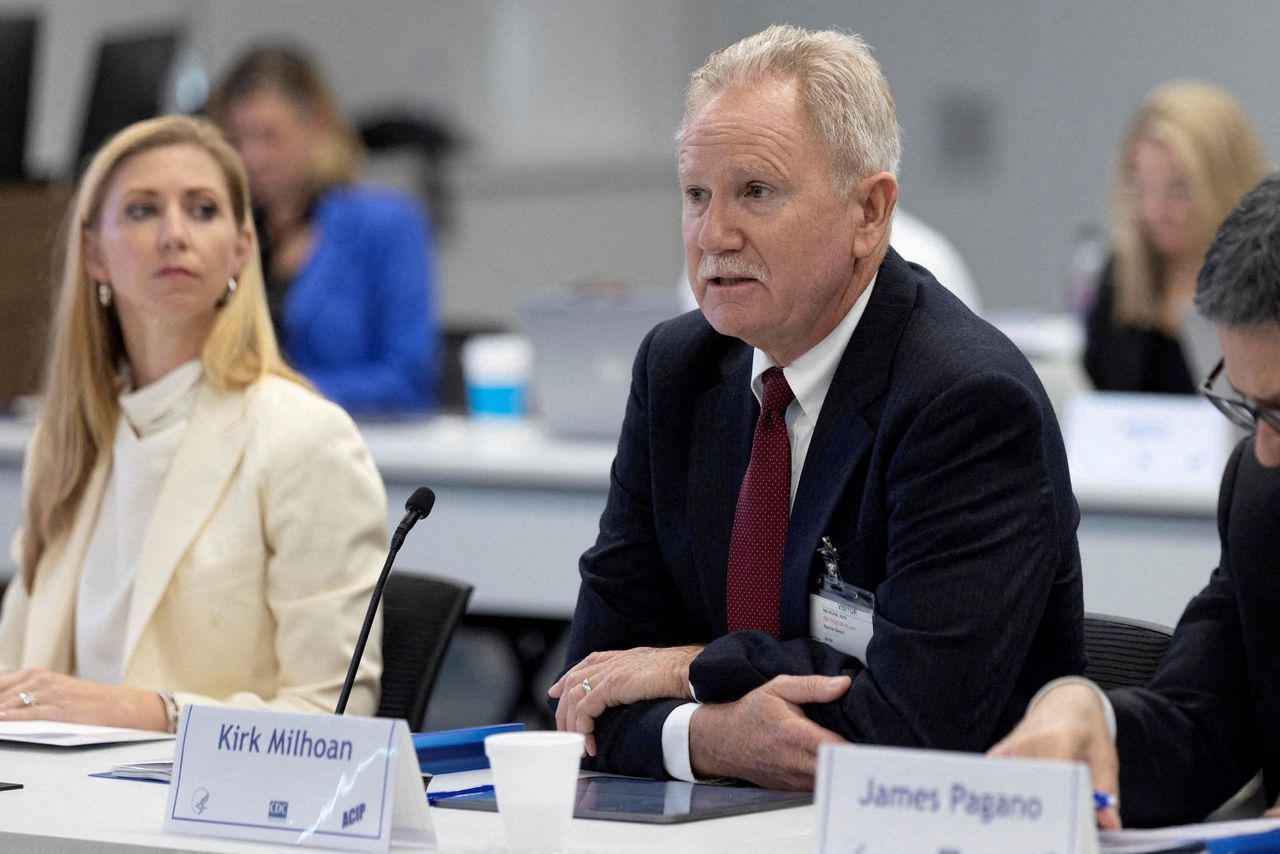 | | Kirk Milhoan is the new chair of the Advisory Committee on Immunization Practices, which is set to meet later this week. (Alyssa Pointer/Reuters) | | | | | | Immunization Update | The Advisory Committee on Immunization Practices is set to meet later this week in a set of meetings that could pave the way for massive changes to the childhood vaccine schedule, including plans to vote on whether to delay the hepatitis B shot given to babies at birth — a shift that health experts worry could lead to an increase in the disease. ACIP provides recommendations to the Centers for Disease Control and Prevention on vaccine use that can ultimately impact health coverage. The Post’s Lena H. Sun talked to ACIP’s new chair, Kirk Milhoan, about the panel’s upcoming meeting. He was appointed to the position yesterday after the previous chair, Martin Kulldorff, moved to a role at HHS. They spoke about the panel’s agenda this week, including what’s on ACIP’s agenda — namely, discussions surrounding the timing and ingredients of vaccines for children. Be sure to read the full story, but here are some nuggets from their discussion: - At their September meeting, ACIP mulled whether to delay the hepatitis B shots for newborns by a month, but tabled the vote amid disagreement. This week, the panel is weighing a delay in that first dose by an interval that is “still being finalized,” Milhoan told Lena. Giving the dose within a baby’s first 24 hours is credited with a 99 percent reduction in hepatitis B infections since the practice was recommended in 1991.
- The panel will focus on aluminum in vaccines, which the CDC touts have been used safely for more than 70 years as an ingredient to boost a person’s immune response. Clinicians and public health experts worry ACIP will eventually move to recommend only vaccines without the ingredient. However, Milhoan, a pediatric cardiologist and critic of coronavirus vaccination, told Lena that the panel is not calling for the removal of aluminum from vaccines. “We’re not saying that at all,” he said. “We’re just starting to have the discussion.”
→ A key point from Lena’s report: “The FDA generally has the responsibility to direct manufacturers to remove ingredients from vaccines. Some high-level FDA officials think that it would be infeasible to take aluminum adjuvants out of vaccines and that it cannot be done on any practical timeline, according to a senior federal health official who spoke on the condition of anonymity to be candid.” - ACIP’s meeting agenda doesn’t include any presentations about vaccine effectiveness, access, equity or practical consequences of disrupting well-established schedules — which Lena mentions had always been standard fare prior to Health Secretary Robert F. Kennedy Jr. overhauling the panel with all-new, handpicked members. Milhoan said that vaccine benefits are well known and have been extensively discussed: “Not enough attention is being paid to risk,” he told her.
| | | | | | Questions With… | Earlier this year, the U.S.-China Economic and Security Review Commission — a bipartisan panel that reports to Congress — issued a stark warning: U.S. reliance on Chinese pharmaceutical exports is a major national security weakness. My WP Intelligence colleague Nour Wood spoke with USCC Commissioner Leland Miller, about these threats, the geopolitical dynamics in the supply chain of medications and how companies should be positioning themselves. Miller, who was appointed to the commission by Speaker Mike Johnson (R-Louisiana), said at a recent WP Intelligence briefing that the advisory body will be looking deeper into the issue, adding: “There are real life and death questions being decided by whether China can control the supply chain.” Here are a few of Miller’s top-line points: How China has become a dominant player: “China has been producing more of the world’s pharmaceuticals because it’s the lowest-cost producer. China is the factory of the world: It has subsidized production and cheaper labor, so pharmaceutical manufacturing went away from the U.S. and the West. That’s particularly true when it comes to generic pharmaceuticals, which is just a question of cost: You’re given a recipe and have to turn it into a drug as cheap as possible.” How it’s become a national security issue: “Anything that has to do with pharmaceuticals and medicines certainly is now in the national security bucket. Because if you give China, for instance, a leverage over our supply chains, they can simply say, ‘We’ll cut this off if you don’t do what we want on X or Y policy issue.’ It’s an extremely powerful thing to weaponize the supply chain. A lot of people didn’t want to believe [that was possible], but with rare earths and critical minerals, as we’ve seen in the last year, it’s not hypothetical anymore. Now Congress and other policymakers are looking around and saying, ‘Wow, we have to deal with this right now.’” How to handle it: “Part of the solution to this is going to be subsidies from the U.S. government and other Western governments in order to get a model that’s cost-competitive with China — or to get a production line up and running. In other cases, the solution might be a price floor set. The Chinese have gotten very good at flooding the market and then crashing prices when they see a competitor coming in on the manufacturing side.” Congress [has] to decide it is a national security priority to make companies do what’s required to keep America safe and secure. Hopefully, pharmaceutical companies can have more foresight going forward, but, at the end of the day, it is the responsibility of Congress to get their act together and get this done.” But there’s a lot more in Nour’s Q&A, and we’re putting it over the paywall for you: “China’s chokehold on medicines is raising alarms.” → The discussion is happening against the backdrop of Congress mulling a measure that aims to restrict or prohibit Chinese-owned biotech companies from operating in the U.S., called the BIOSECURE Act. I’ll have more on that this week, so stay tuned. | | | | | | Enforcement Watch | The American Medical Association is under heightened bipartisan scrutiny over its influence on how doctors are paid — with Sen. Bill Cassidy (R-Louisiana) increasing pressure on the physician trade group that maintains the nation’s medical billing codes. It follows on a letter Casidy wrote to the AMA in October, in which he accused the organization of “abusing its government-endorsed” monopoly over the Current Procedural Terminology, or CPT, code set — the standardized system that underpins how virtually every medical service is billed and reimbursed across the nation. My colleague Dan Diamond in The Washington Post newsroom obtained Cassidy’s letter to the association, which was later released publicly, and which asks the group to provide more detail concerning how it comes up with the codes — and assesses changes to them — in addition to pricing specifics. Dan’s story includes the growing chorus of voices — including progressive Sen. Elizabeth Warren (D-Massachusetts) and Kennedy — that has argued the AMA’s power over the payment system favors higher-cost specialist services, essentially disincentivizing primary care. In an interview, Cassidy told Dan the billing codes had “become somewhat of a cash cow” for the association, adding that the costs were eventually “passed along to somebody” and helped inflate U.S. health care prices. → I looked at the AMA’s most recent tax forms, which report $468 million in revenue in 2023. About 61 percent — or $285 million — attributed to royalty income. Insurance companies, government health programs including Medicare and Medicaid, providers and others pay licensing fees to access CPT codes. Key passage from Dan’s report: “The senator’s focus on the group, coupled with Trump officials’ willingness to smash industry norms, poses a fresh threat to the lobbying organization’s long-standing grip on physician payment rates — often a source of bipartisan frustration but one that has seen little meaningful reform.” Cassidy told Dan that this could become an even larger focus for the committee, depending on what he learns. The AMA said in a statement that it would respond to the letter. | | | | | | Document Drop | The American Hospital Association is leading a lawsuit against the Trump administration over a pilot program impacting the 340B discount drug program, which they argue violates administrative law. Under the pilot set to go into effect on Jan. 1, hospitals would pay for the drugs and request rebates after they’ve been provided to patients — requiring facilities to float the full costs instead of getting discounts upfront. | | | | | | | | | | |


_tstmp_1756933376-1920-1080.png)