| |  | | | | |  | By Megan R. Wilson | - Big ideas, limited timeline: Bipartisan efforts to extend enhanced Affordable Care Act subsidies are colliding with unclear policy directives from the White House and a looming deadline for people to enroll in plans.
- Vaccine policy shake-ups: The Department of Health and Human Services is reshuffling vaccine leadership ahead of a pivotal meeting of federal vaccine advisers this week, while the Food and Drug Administration is poised to impose stricter framework for vaccine approvals.
- Shrinking waistlines and wallets: New data show GLP-1 drugs are reshaping Americans’ spending, from food to alcohol to clothing. A new Washington Post interactive report goes over the details.
Good afternoon, and welcome to the Health Brief newsletter. Hope you were able to relax over the holiday, but we’re back at it. This week, Washington is going to be dominated by discussions around an extension to the enhanced Affordable Care Act subsidies and vaccine policy overhauls. I’ve got details on all of that — plus a catch-up of some of what you may have missed from last week. Let’s get into it. But also — do you have any health policy intel, scoops or tips? Email me at megan.wilson@washpost.com, or message me securely on Signal at megan.434. This newsletter is published by WP Intelligence, The Washington Post’s subscription service for professionals that provides business, policy and thought leaders with actionable insights. WP Intelligence operates independently from the Washington Post newsroom. Learn more about WP Intelligence. | | | |  | The Lead Brief | People who purchase health insurance through the Affordable Care Act marketplaces have 14 days to choose a plan if they want their coverage to kick in — or continue — at the beginning of the year. Meanwhile, lawmakers are (still!) mulling over compromises on how to extend the enhanced subsidies that help many people afford care, as well as counter-legislation that would put subsidy money directly into accounts for customer use. Lobbying firm Tiber Creek Group put together a tracker of the various legislative measures involving an extension of the enhanced subsidies — but policymakers appear to be working on fresh proposals rather than pulling one off the shelf. Rep. Brian Fitzpatrick (R-Pennsylvania), who co-chairs the Problem Solvers Caucus, is reportedly among those working on a bipartisan bill to extend the enhanced subsidies while simultaneously capping who can get them — an attempt to balance demands from both parties. Fitzpatrick told Politico that the proposal is similar to a White House health reform outline that leaked last week, which would have combined a temporary extension of the enhanced subsidies with several conservative policy ideas. An administration announcement was scuttled following backlash from congressional Republicans. Fitzpatrick’s office didn’t immediately respond to questions about additional details, whether he was having conversations with the White House to garner its support, or questions about the partnering with the Senate on a companion bill. → The lack of a clear public message considering what President Donald Trump would support has complicated efforts on Capitol Hill. The White House also didn’t answer questions clarifying what policies Trump would support. Setting the table: “GOP faces a familiar dilemma: What to do about Obamacare?” Dan Diamond, Riley Beggin and Jacob Bogage in The Washington Post newsroom wrote this morning. Last week, Trump told reporters on Air Force One that he’d rather not extend the subsidies, but acknowledged “some kind of an extension may be necessary to get something else done,” while bashing the ACA as “unaffordable.” The Senate is slated to vote on a yet-to-be-determined bill addressing the enhanced subsidies by mid-December, part of the deal a small number of Democrats cut with Senate Majority Leader John Thune (R-South Dakota) to reopen the government. What’s next: On Wednesday, the Senate’s health panel is having a hearing about rising health care costs at 10 a.m. It follows on the heels of a similar hearing held by the Senate Finance Committee two weeks ago, though it could suffer from the same fatal flaw: big ideas but a limited amount of time. Lawmakers are trying to hash out sweeping solutions to the shortcomings of the American health care system, just weeks before millions of people face a deadline to choose insurance coverage amid skyrocketing monthly premiums. Polar opposites: The witnesses include Joel White, a Republican lobbyist and president of the Council for Affordable Health Coverage, which has advocated for broader use of HSAs, and Claudia M. Fegan of the Physicians for a National Health Program, a group that supports a single-payer national health insurance program. |  | | Martin Kulldorf speaks during a September meeting of the Advisory Committee on Immunization Practices. (Brynn Anderson/AP) | | | | | | Immunization Update | Martin Kulldorff has been named chief science officer for the Office of the Assistant Secretary for Planning and Evaluation within the Department of Health and Human Services. Kulldorff has been serving as chair of the panel of federal vaccine advisers, the Advisory Committee on Immunization Practices, which makes recommendations to the Centers for Disease Control and Prevention. ACIP’s actions can impact immunization coverage and access. “Martin Kulldorff transformed ACIP from a rubber stamp into a committee that delivers gold-standard science for the American people,” said Health Secretary Robert F. Kennedy Jr. in a statement. → The announcement comes days before ACIP’s next meeting, scheduled for Thursday and Friday. The panel is scheduled to vote on recommendations on the hepatitis B vaccine, which it had tabled from its previous meeting. ACIP’s leaders had mulled whether to nix the long-standing recommendation to give the hepatitis B shot to babies at birth — instead delaying it by a month. Under Kulldorff’s tenure, ACIP drew scrutiny from public health experts and medical groups. Its last meeting in September — which made the first major changes to the childhood vaccination schedule in years — was marred by dysfunction. Kirk Milhoan, a pediatric cardiologist, has been named as ACIP’s chair. He has blamed vaccines for causing cardiovascular disease. OTHER VACCINE NEWS Ahead of this week’s ACIP meeting, here are some vaccine-related stories reported by my Washington Post colleagues during the newsletter break: — The Food and Drug Administration’s top vaccine regulator said in an internal email obtained by my Washington Post colleagues Dan Diamond and Rachel Roubein that the agency would be taking a stricter approach to vaccine approvals. Dan and Rachel reported that Vinay Prasad, who leads the Center for Biologics Evaluation and Research, said the decision came after finding the coronavirus vaccine has contributed to the deaths of 10 children — though he did not detail evidence that led to that conclusion. My colleagues report: “Prasad told agency officials that the FDA will rethink its framework for annual flu shots, examine whether Americans should be receiving multiple vaccines at the same time, and require vaccine makers to show far more data to prove the safety and value of their products. For instance, he said pneumonia vaccine makers must demonstrate that their products reduce pneumonia, at least after they become available in the market, rather than just generate antibodies to fight infections.” — Ralph Abraham, the Louisiana surgeon general who ordered the state’s health department to stop promoting mass vaccinations this past winter, has become the CDC’s second-highest ranking official, according to Lena H. Sun. | | | | | | Health on the Hill | For your calendar: Organ procurement organizations are under the microscope. The House Ways and Means Oversight Subcommittee is having a hearing tomorrow at 10 a.m. called “Lives at Stake: Holding Tax-Exempt Organ Procurement Organizations Accountable.” Among the witnesses is a woman, Nyckolleta Martin, who claims she was fired after airing allegations to Congress about pressure to remove a patient’s organs while they were alive, according to a Wall Street Journal report. → Next week: On Dec. 11, the Senate Health, Education, Labor, and Pensions Committee is having a hearing entitled “Examining the Future of the U.S. Organ Procurement and Transplantation Network.” | | | | | | Numbers Game | As Americans’ use of GLP-1 weight loss drugs increases, there’s been a ripple effect across the entire economy. Jaclyn Peiser and Flora Bai in The Washington Post newsroom explore how one medication has made an impression on the food, travel and clothing industries — even spurring more activity at thrift stores as people seek to buy new wardrobes on a budget. A key quote: GLP-1 medications are causing a “psychological shift” for the people taking them, said Ali Furman, a partner in PwC’s U.S. consumer markets division. As their bodies change, she said, so are their decisions on how to spend their time and money. Some spending shifts found in Jaclyn’s report: - 10 percent: That’s how much GLP-1 users decreased their overall spending — across 100 categories including groceries, quick-service restaurants and tobacco purchases — compared to households without someone taking a GLP-1 medication, according to data company Numerator.
- 38 percent: The amount GLP-1 patients increased spending on vegetables compared to the year before, according to NielsenIQ.
- 148 percent: The increase in purchases of pregnancy tests among a cohort of GLP-1 users over one year, according to NielsenIQ. Some studies suggest the medications boost fertility.
- 14.5 percent: The decrease in spending on alcoholic beverages among GLP-1 patients after starting the treatment, which can suppress alcohol cravings, according to NielsenIQ.
- 1,158 percent and 935 percent: The corresponding increases in spending on nonalcoholic wine and beer, respectively, among those GLP-1 patients, according to NielsenIQ.
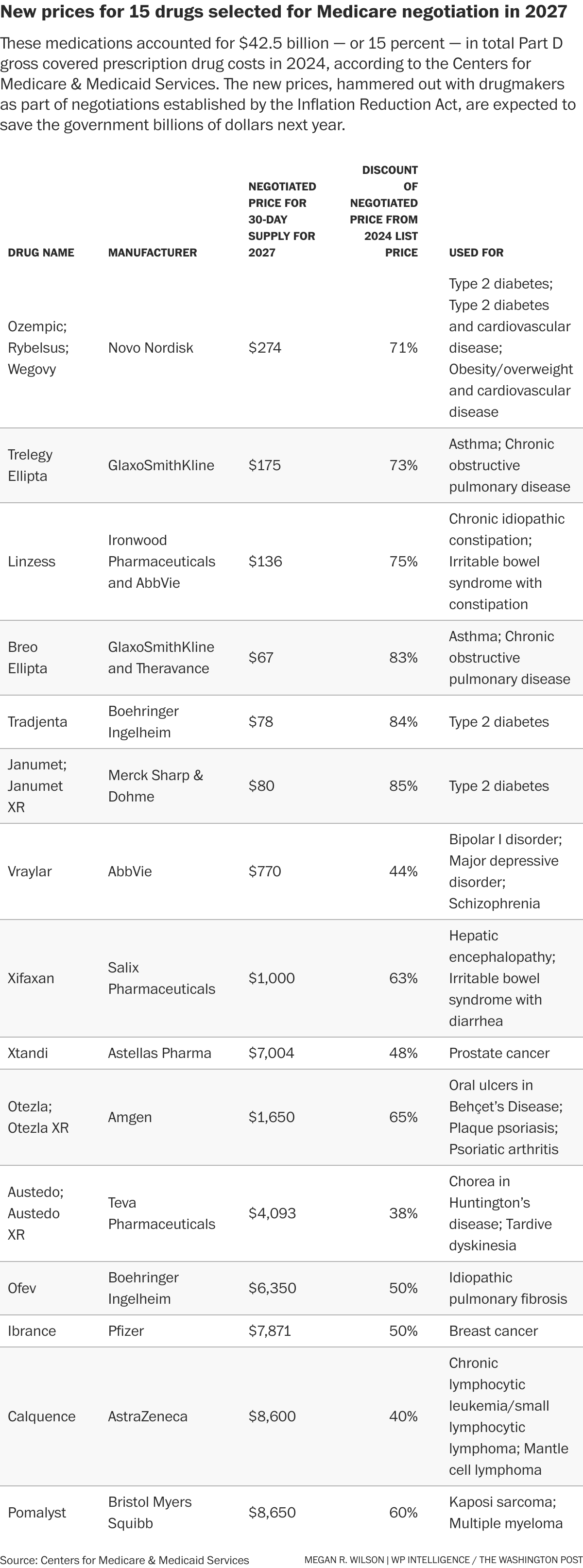
Why it matters: Food companies and other companies are adapting their product offerings to appeal to the shopping habits of GLP-1 users — and the increasing availability of the medications could make these spending shifts even more stark. → On the point of expanding access: The Post’s Daniel Gilbert has an overview of the pipeline of anti-obesity drugs — including oral options (so people don’t have to jab themselves), and versions with fewer side effects or that need to be taken less frequently. | | | | | | Document Drop | The federal government is appealing a court decision that struck down a Centers for Medicare & Medicaid Services rule, finalized during the Biden administration, that would allow regulators to audit Medicare Advantage plans. | | | |  | Chart check | The Trump administration last week released the negotiated prices that Medicare hashed out with drugmakers for 15 costly medications used in the program for seniors and people with disabilities. The new prices would have saved the government $8.5 billion if they were in effect last year, according to CMS. Here is a chart with the new prices, ranked by the number of Medicare beneficiaries who took the medications last year — organized from most to least. CMS calculated the negotiated price discounts from the list price, which doesn’t account for any of the rebates or discounts drugmakers provide. The net prices can be difficult to pin down, but a study published in the Journal of Managed Care & Specialty Pharmacy estimated them based on government and industry data. The negotiated prices are lower than the estimated net prices, underscoring the savings to Medicare. | | | | | | What We’re Reading | “Medicaid Work Rules Exempt the ‘Medically Frail.’ Deciding Who Qualifies Is Tricky,” Samantha Liss and Sam Whitehead write at KFF Health News. “Some celebrities swear by peptides, but doctors warn of serious risks,” Leo Sands reports at The Washington Post. “As a doctor, here’s my simple, science-backed schedule for a healthier day,” Trisha Pasricha writes in a column for The Washington Post. “UK agrees to boost drug prices to dodge US pharma tariffs,” Jonathan Gardner reports at BioPharma Dive. “Premier closes $2.6B take-private deal,” Emily Olsen reports at HealthCare Dive. “SNAP Benefit Rules Spark Legal Challenge From 21 States,” Aliss Higham writes at Newsweek. “F.D.A. Withdraws Rule to Require Testing Cosmetics Made With Talc for Asbestos,” Roni Caryn Rabin reports at the New York Times. “Not Serious Enough To Turn on the Siren, Toddler’s 39-Mile Ambulance Ride Still Cost Over $9,000,” Tony Leys reports in KFF Health News. | | | | | | | | |


_tstmp_1756933376-1920-1080.png)