
|
The $300K Engineer: How AI Is Rewriting Cloud Salaries
Forward Deployed Engineers are entering a new compensation tier, AI specialists are earning more than traditional infrastructure engineers
|

| |||||||||||||||


Granola for face-to-face conversations. Now on Apple Watch.
 |
Some important conversations happen away from your laptop. Start a Granola note from your wrist, stay present, and finish with the context you need.
Start a note from your wrist. Keep eye contact. Leave with notes.
Free 1 month with the code SCOOP
For more than a decade, cloud computing has been one of the most lucrative career paths in technology. Engineers who mastered AWS, Azure, Kubernetes, and distributed systems could command six-figure salaries by helping companies modernize infrastructure and operate applications at scale.
The biggest compensation opportunities are increasingly appearing at the intersection of cloud infrastructure, artificial intelligence, and real-world deployment.
OpenAI is advertising Forward Deployed Engineer (FDE) positions with base salaries ranging from $185,000 to $300,000, excluding equity. Meanwhile, established cloud architecture positions at AWS carry substantial but often lower advertised base salaries.
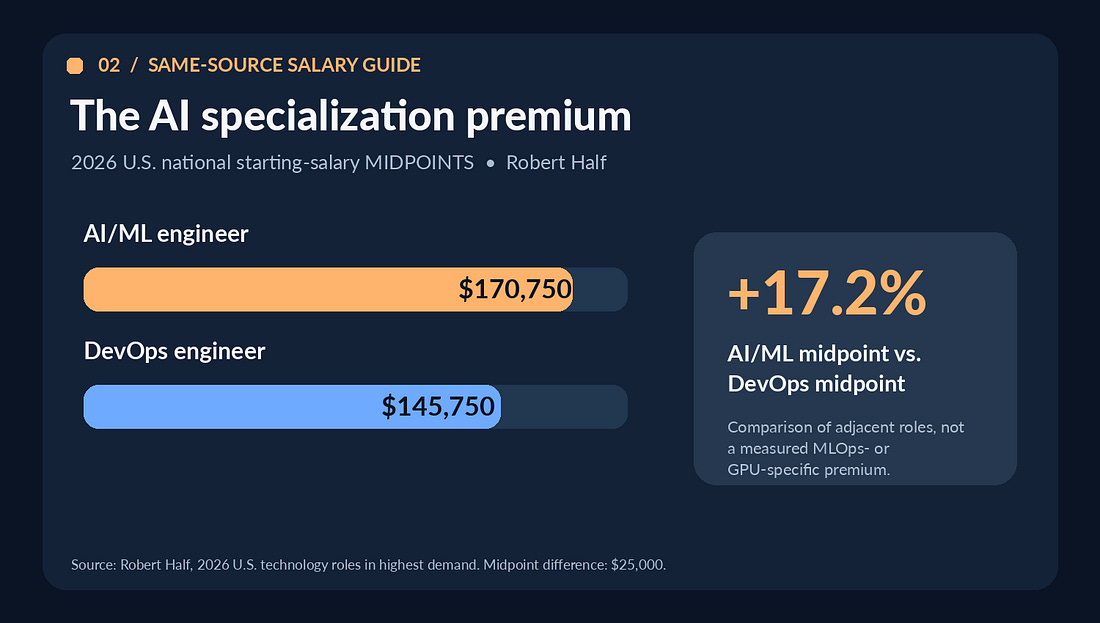
The divergence extends beyond customer-facing AI engineers. Recruiter salary benchmarks suggest that AI/ML engineering now commands a meaningful premium over conventional DevOps, while demand for specialists who can operate production AI systems is changing which infrastructure skills employers value most.
This is not simply another cycle of technology salary inflation. It reflects a shift in what companies are paying engineers to accomplish.
Cloud engineering is still valuable. But engineers who can turn that infrastructure into measurable AI outcomes are gaining a new form of negotiating power.
1. FDE and its $300K AI Deployment Role
The clearest example of this shift is the Forward Deployed Engineer.
Unlike an engineer focused primarily on internal infrastructure, an FDE embeds with customers to solve business problems using software, data, and increasingly, frontier AI models.
At OpenAI, these engineers handle technical discovery, system architecture, implementation, production rollout, and evaluation. Their work can influence both customer adoption and the company’s underlying product roadmap.
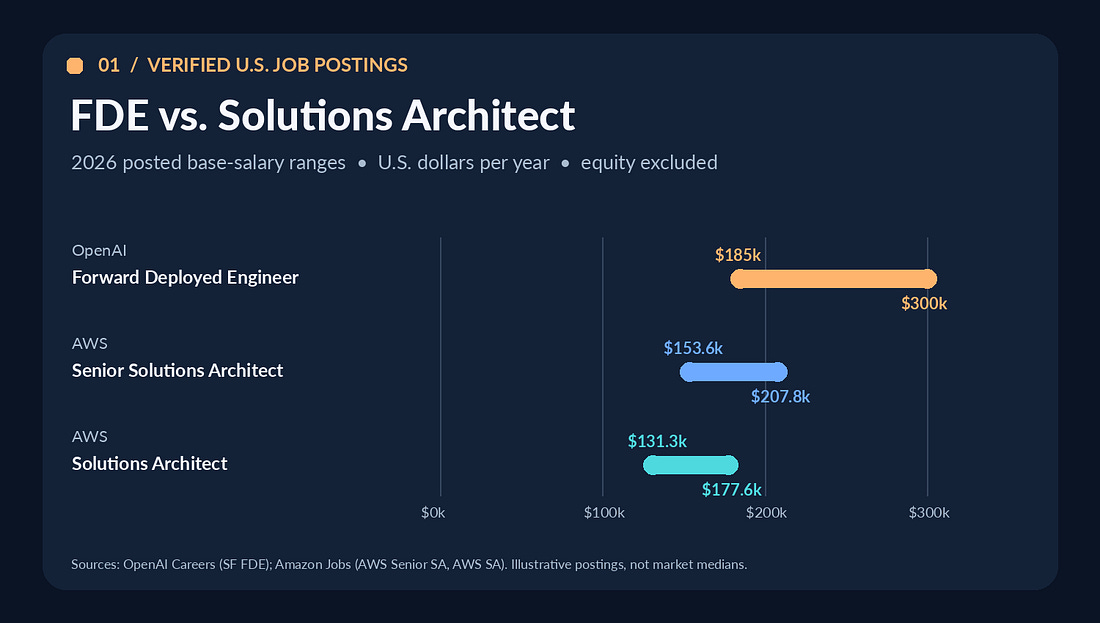 |
Forward Deployed Engineer versus AWS Solutions Architect salary ranges
The numbers are striking. OpenAI’s advertised FDE range reaches $300,000, compared with $131,300–$177,600 for an AWS Solutions Architect role in several US locations and $153,600–$207,800 for an AWS Senior Solutions Architect position in markets including Arlington and Bellevue.
The comparison is revealing, although these are selected openings at different companies and responsibility levels, not occupation-wide salary medians.
It would also be inaccurate to assume every FDE earns an OpenAI-level salary. Palantir, a pioneer of forward-deployed engineering, advertises an established FDE position in New York at $135,000–$200,000 in base pay.
The important distinction is that elite AI companies are willing to offer unusually high compensation for engineers who combine deep technical skills with customer-facing execution.
Why are companies paying so much?
The traditional Solutions Architect is responsible for helping organizations make sound technical decisions: selecting services, designing scalable architectures, evaluating trade-offs, and supporting implementation.
A Forward Deployed Engineer may perform those same activities but is also expected to build custom integrations, troubleshoot production systems, guide deployment, and demonstrate that the resulting AI system creates measurable value.
Consider a financial institution deploying an AI assistant across compliance workflows. Designing the cloud architecture is only part of the challenge. Someone must connect the model to enterprise data, implement authorization and auditability, evaluate accuracy, address latency, integrate existing workflows, and prove that the deployment performs reliably enough for actual users.
That combination of software engineering, infrastructure knowledge, AI understanding, and business judgment is difficult to replace with a narrowly specialized role.
 |
This is where the economics change.
An architect might establish the foundation of a system. An FDE can become directly accountable for bringing that system into production and making it useful to the customer.
That gives employers a reason to value engineers who can operate across several disciplines. They reduce handoffs between architecture, implementation, operations, and customer delivery while helping organizations reach usable production deployments.
However, the title alone does not guarantee higher compensation. AWS Solu