
|
The Next CI/CD Primitive Might Be AI Code Review
The bigger story isn’t another Copilot feature. It’s that AI code review is becoming programmable infrastructure.
|

| |||||||||||||||


Granola for face-to-face conversations. Now on Apple Watch.
 |
Some important conversations happen away from your laptop. Start a Granola note from your wrist, stay present, and finish with the context you need.
Start a note from your wrist. Keep eye contact. Leave with notes.
Free 1 month with the code SCOOP
GitHub has made a deceptively important change to Copilot Code Review.
As of October 2026, developers can request a Copilot code review through REST and GraphQL APIs. More importantly, the API request can specify how much effort Copilot should spend reviewing the pull request.
At the same time, GitHub has changed its built-in review default from Lite to Balanced, pushing Copilot toward deeper reasoning unless teams explicitly configure otherwise. The default change took effect on September 28, 2026.
Individually, neither announcement sounds revolutionary.
Together, they signal something much bigger.
GitHub is turning AI code review from a feature developers manually invoke into a programmable component of the software delivery pipeline.
That matters because software creation itself is becoming increasingly automated.
Coding agents can already take an issue, inspect a repository, write code, run tests, modify multiple files, and open a pull request. If code generation becomes autonomous while review still depends on someone clicking a button, verification becomes the bottleneck.
GitHub’s new API begins removing that bottleneck.
From a Review Button to a Review API
Previously, the most visible Copilot Code Review workflow happened inside GitHub.
A developer opened a pull request, selected Copilot as a reviewer, and waited for feedback.
That workflow still exists.
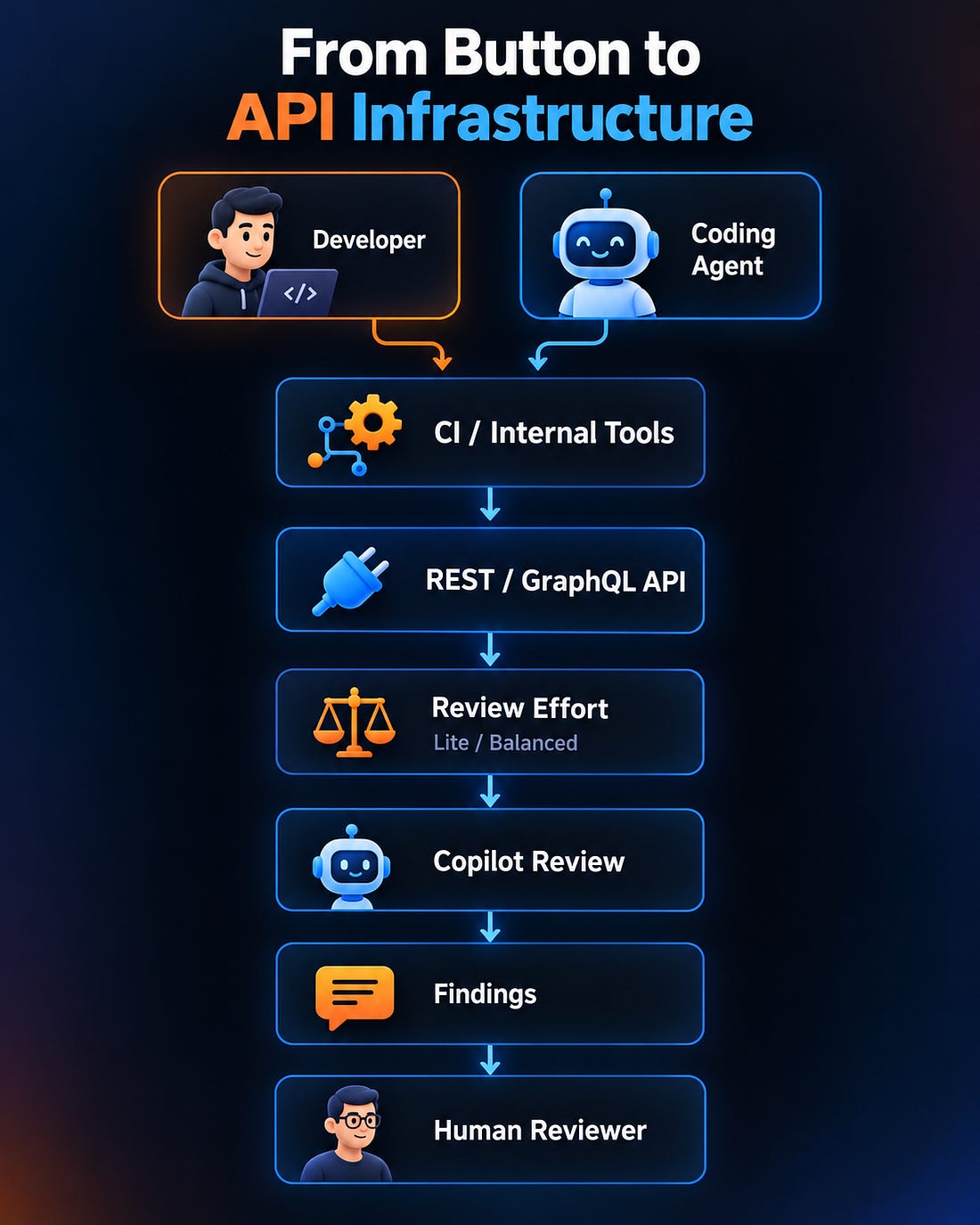
But Copilot review can now be initiated from systems outside the pull request interface.
A CI workflow could request it.
An internal developer platform could request it.
A security automation system could request it.
An AI coding agent could potentially trigger a review after opening a pull request.
GitHub explicitly says the REST and GraphQL APIs allow organizations to bring Copilot Code Review into their own scripts, workflows, and internal tools.
That changes the architecture.
 |
The important new component is not Copilot itself.
It is the orchestration layer around Copilot.
Once review can be called programmatically, engineering teams can decide when reviews happen, which changes deserve deeper inspection, and which systems are allowed to trigger them.
In other words, code review becomes something software can request from software.
Why This Matters More in the Agentic Coding Era
Consider what happens when coding agents become responsible for a larger share of software changes.
A typical workflow could eventually look like this:
An issue is assigned.
An agent investigates it.
The agent edits five files.
It runs unit tests.
It opens a pull request.
Then what?
If a human still has to notice the PR, manually request an AI review, interpret everything, and then decide what happens next, much of the automation advantage disappears.
API-triggered review makes a different workflow possible.