This is a longer, personal message—because becoming a clinical thinker deserves more than a quick tip.
Your Patient Needs More Than a Protocol. Your Patient Needs a Clinical Thinker.
Dear Colleagues,
Today, I want to pause our case series and speak to you personally.
Tomorrow, we’ll return to the cases. Today, I want to explain why this work matters deeply to me—as a clinician and as the founder of Functional Medicine University.
I want us to take pride in becoming clinical thinkers.
If you already approach your patients with careful clinical reasoning, I respect that commitment. I also want to speak with humility: I have fallen into the very patterns I’m describing.
I was confident in my recommendations and sincerely believed I was doing the right thing.
Over many years, experience taught me that I needed to question my assumptions
and change how I made decisions. That shift changed my entire approach to patient care, and it is what I want to share with you.
My goal is to help all of us—including myself—continue strengthening our judgment as we work toward the best possible clinical outcomes for our patients.
Think about the satisfaction of working through a difficult case and being able to say:
“Here is what deserves attention first. Here is why. And here is what would make me change course.”
That ability matters because, across the desk, a patient is waiting for someone to help them make sense of what is happening.
Someone who may already have spent months searching, thousands of dollars testing, and countless hours trying to follow advice.
Someone who needs our judgment.
You may recognize the situation.
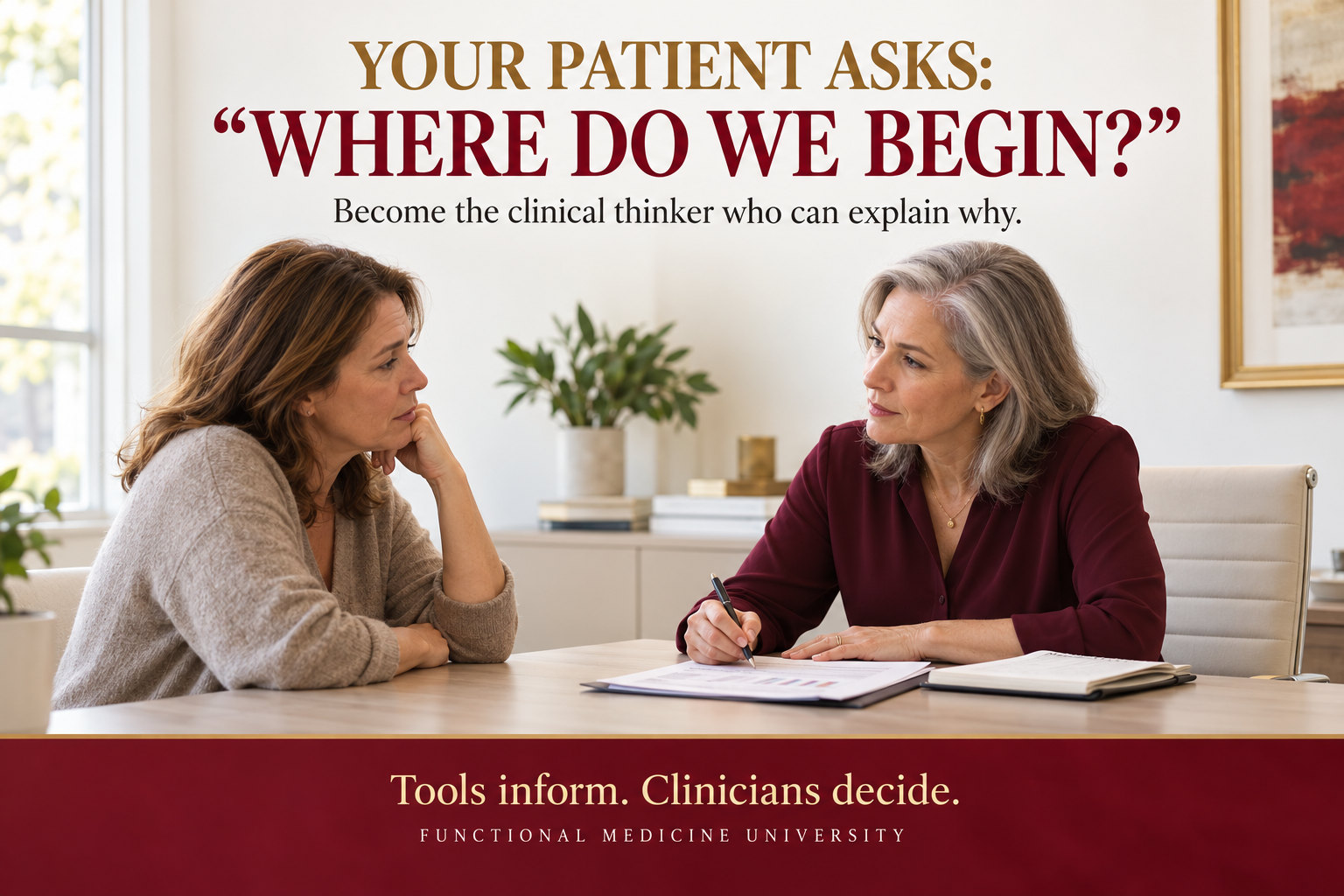
A woman arrives carrying a folder filled with laboratory reports.
She is exhausted. She cannot concentrate. She sleeps poorly. She has a history of spending time in a water-damaged building.
Among her reports is a urine mycotoxin test with several flagged results.
She has watched videos, read conflicting opinions about mold, purchased supplements, and followed recommendations.
Her kitchen counter has become a small dispensary.
As she places the folder on the
desk, she says:
“I’ve been told mold explains everything. But I’m not getting better, and I don’t know what to do anymore.”
The clinician listens and reviews the reports.
There are symptoms to assess, exposure questions to clarify, and findings to interpret.
Soon, however, the conversation turns to treatment.
A flagged result leads to a binder. Another recommendation
adds a supplement. A protocol introduces several more steps. Her diet becomes more restrictive.
The plan grows. The explanation does not.
The clinician wants to be thorough. The patient wants to believe that someone has finally
connected the dots.
Then, as the visit ends, she asks:
“How do we know what is causing my symptoms? And which of these things should I do first?”
Pause there.
If she were sitting across from you, what would you say?
Could you explain what the findings establish, what remains uncertain, and why your first recommendation deserves
priority?
Those are the questions that turn information into a clinical decision.
Two weeks later, she reports that she feels worse.
More nausea. More fatigue. Less sleep.
She has started so many things that she cannot tell what caused the change.
Now the clinician faces another decision.
Continue with the original explanation?
Or reopen the case?
What changed? Could an intervention be causing harm? Was the plan too burdensome? Did something important get missed? What needs to be paused, clarified, or
evaluated?
Before we explain away a patient’s worsening, we owe that patient a fresh assessment.
Calling a response “detox” does not settle those questions.
A clinical thinker investigates them.
That willingness to reconsider—to let the patient’s response challenge our explanation—is a habit I want us to take pride in developing.
Because
the patient lives with the consequences of our decisions.
This story troubles me because a plan can look comprehensive while its priorities remain unclear.
Every recommendation may have a plausible rationale. The clinician may know the science and
sincerely want to help.
Yet a question remains:
Why does this patient need this intervention now?
“Why this?” asks us to justify the intervention.
“Why now?” asks us to justify its timing.
Both deserve an answer.
The erosion of clinical thinking can happen quietly.
A protocol saves time, so we use it again.
A presentation offers a compelling explanation, so we begin finding it in more patients.
A laboratory result is flagged, so we
feel compelled to address it.
Gradually, we spend less time examining the step between receiving information and deciding what it means.
“What could explain this patient’s condition?” becomes “What do I give for this finding?”
A flagged result can capture our attention. It cannot make the decision for us.
That responsibility remains ours.
Guidelines, protocols, testing, and clinical education give us valuable tools. Using them responsibly requires judgment about the evidence, the limitations, and the person receiving care.
A patient’s history may challenge our favorite explanation.
An abnormal
result may require clarification before treatment.
An unexpected response may require us to change the plan.
We must remain willing to listen to all three.
Here are questions I want every FMU clinician to practice asking:
Safety: What must I address before proceeding?
Explanation: What best explains the meaningful features of this case?
Challenge: What does not
fit my explanation?
Priority: Which finding changes what I should do first?
Readiness: What can this patient reasonably tolerate and manage now?
Reassessment: What response would make me pause or change course?
These questions affect what we recommend, what we defer, when we refer, and how we follow up.
They also help us answer the patient who asks, “Where do we begin?”
Imagine
returning to the woman in our story.
This time, the clinician carefully reviews her symptoms, exposure history, previous evaluations, and treatment response.
They examine what the testing can establish and what remains uncertain. They consider other
explanations that deserve attention.
They recognize how overwhelmed she has become.
Then they say:
“There are several things we need to
understand. Here is the priority I recommend addressing first, because this part of your history changes our next decision. These other findings need clarification. We’ll track your response, and here is what would prompt us to reassess sooner.”
Now the patient can understand the purpose of the next step.
The clinician can evaluate whether it helped.
Uncertainty remains, but the uncertainty has been acknowledged and given a place in the plan.
A patient should not have to carry the
uncertainty alone.
This is the professional confidence I want clinicians to develop: the ability to make a reasoned decision, explain it clearly, and revise it responsibly.
I also want to speak honestly about
shortcuts.
We all understand their appeal. Clinical work is demanding. Time is limited. Ready-made recommendations can feel like relief.
But when a shortcut bypasses an assessment, overlooks a referral concern, ignores an interaction, or encourages
us to continue despite unexplained deterioration, the patient bears the cost.
That is why I feel strongly about this.
When a patient places trust in our judgment, exercising that judgment becomes our responsibility.
As the founder of FMU, I want that responsibility reflected in how we teach.
Clinicians need substantial knowledge of physiology, disease processes, nutrition, lifestyle, laboratory interpretation, and appropriate interventions.
FMU teaches that comprehensive foundation.
We are strengthening it through advanced clinical sequencing: helping clinicians organize what they know, establish priorities, assess readiness, and adapt to the patient’s response.
Functional medicine gave clinicians the tools. Sequenced Functional Medicine teaches the order.
And the principle at its heart is simple:
A patient
may need many things—but they cannot all be first.
Sometimes several actions must occur together. Sometimes an intervention should wait. Sometimes the first responsible decision is to clarify, refer, or pause.
Sequencing asks us to explain
those choices.
What deserves attention now?
What should wait?
What needs to happen before the next step becomes appropriate?
I want FMU clinicians to be able to say:
“Here is what I think is happening.”
“Here is what remains uncertain.”
“Here is why I recommend this step first.”
“And here is what would make me change course.”
Become a clinician who can explain the decision behind the recommendation.
Practice that ability. Strengthen it. Take
pride in it.
This is also the purpose behind The Clinical Thinker, the publication I am developing.
I want it to become a place where we examine decisions, work through uncertainty, and ask questions that challenge familiar
assumptions.
Each case should help you notice something you might otherwise miss—and carry that insight into your next patient encounter.
I am writing today because I want you to understand where I stand.
Clinical education should develop judgment alongside knowledge.
Questions that challenge our explanations deserve our attention.
And patients deserve
care whose purpose we can explain and whose effects we are prepared to reassess.
If you have ever looked at a complicated case and thought, “I know many things I could do, but I need a clearer reason for what comes first,” I want you to know that this is a skill we can practice together.
Recognizing that need is a meaningful first step.
Before your next recommendation, ask yourself:
“Why this intervention, for this patient, at this point in their care—and what would make me
reconsider?”
Tomorrow, we’ll put that question to work in a case involving mold and mycotoxins.
Different schools of thought offer different explanations, testing strategies, and treatment approaches.
We’ll examine the reasoning behind those recommendations, including what happens when a finding leads directly to a protocol before the necessary questions have been answered.
What does the patient’s history support?
What does the test establish?
What remains unanswered?
How should possible ongoing exposure affect the next decision?
What other explanations deserve attention?
Before choosing a treatment, we’ll examine the thinking that makes the choice defensible.
Here is the question I want you to carry into tomorrow’s case:
“If a patient brings me a positive mycotoxin result, what do I know—and what am I assuming?”
The answer may change what you do first.
Today, I invite you to make this a deliberate professional
commitment:
Become a clinical thinker who welcomes the question, explains the decision, and reopens the case when the patient’s response calls for it.
That is a professional identity worth
building.
That is the responsibility I want FMU to help you fulfill.
Warmly,
Dr. Ron Grisanti Founder, Functional Medicine University
Tools inform. Clinicians decide.
PS: Explore FMU’s professional recognition and educational credentials, review the curriculum, and meet the
instructors:Explore FMU
2123 Old Spartanburg Road #348 Greer South Carolina 29650 USA