
|



More AI code. More CI. Bigger CI bills. (Sponsored)
 |
AI agents write more code. More code means more commits, more CI runs and bigger CI bills. For many teams, GitHub Actions is now the bottleneck.
WarpBuild fixes that. Teams at Braintrust, Raycast, OpenRouter, Comcast and Jane Street run their CI on it.
Twice as fast at half the cost
One line change to runs-on, nothing else to migrate
Linux, macOS and Windows on x86-64 and ARM64
Unlimited macOS concurrency
Use code START50 for $50 in free credits.
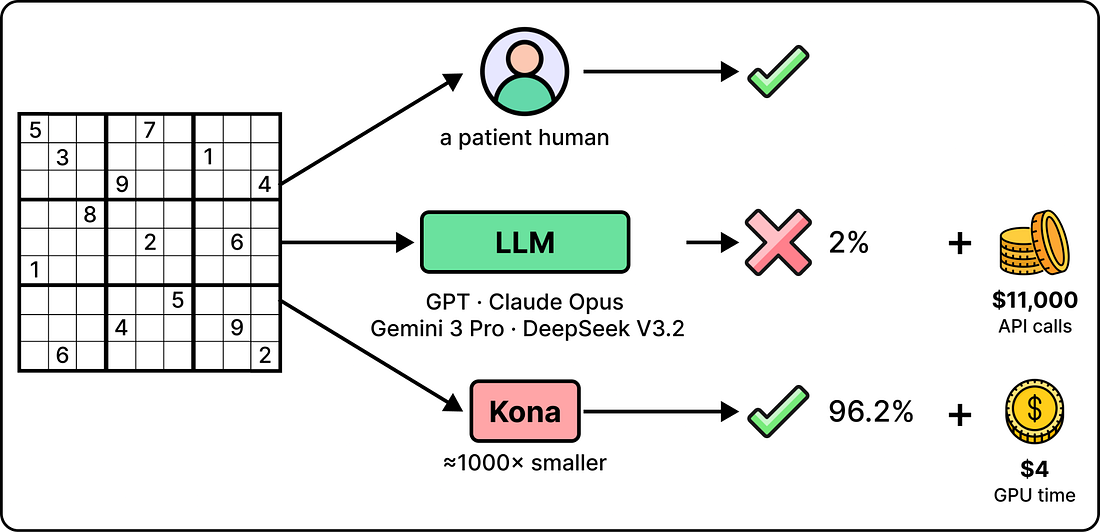
Something unusual happened in a public Sudoku experiment early this year. According to Logical Intelligence, a panel of frontier large language models (LLMs), including OpenAI’s GPT-5.2, Claude Opus 4.5 and Sonnet 4.5, Gemini 3 Pro, and DeepSeek V3.2, collectively only solved 2% of the puzzles and burned around $11,000 in API calls. Interestingly, a model named Kona, about a thousand times smaller, solved 96.2% for only $4 in GPU time [1].
At first glance, the result of the demo may seem strange or unexpected, because Sudoku is not a particularly hard game to play. A ten-year-old can learn the rules and solve a puzzle after some practice. The rules are well-defined, and there is little ambiguity. It is the kind of problem that LLMs should handle easily.
 |
This gap is not really about puzzles like Sudoku. LLMs are the most capable AI models we’ve ever built around language, but many tasks require intelligence that goes beyond language. In fact, most of the tasks we face every day are not language problems. Some of them require spatial or dimensional reasoning. Others may depend on logic, planning, or just emotional awareness. And much of what we do cannot even be fully verbalized. The ability to extrapolate, to be creative, not repetitive, is what makes intelligence feel alive rather than mechanical [2].
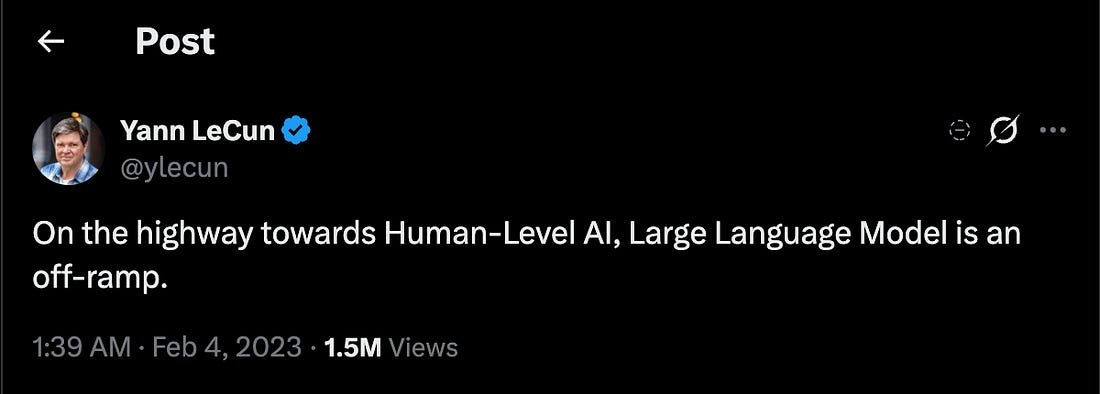
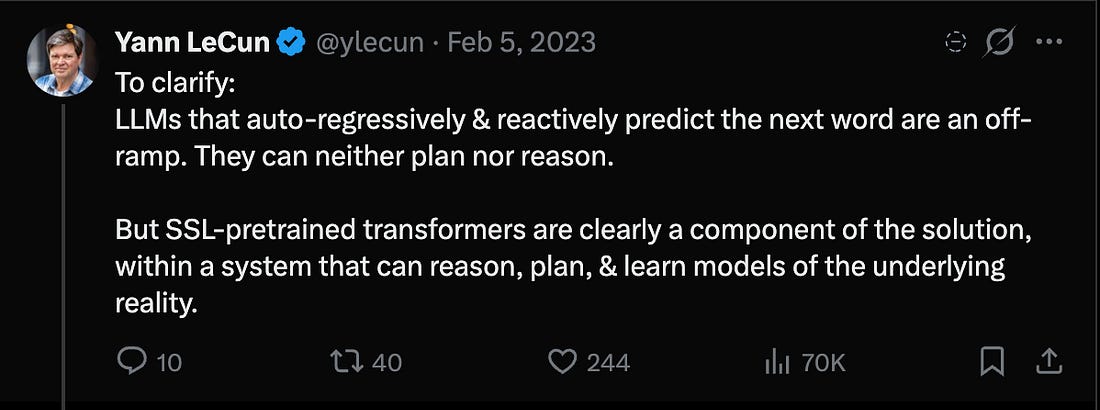
Yann LeCun, a Turing Award winner and one of the pioneers of deep learning, has argued for years that text alone will not give us real intelligence.
 |
 |
We spoke with Eve Bodnia, founder and CEO of Logical Intelligence, to understand how the models her team builds, energy-based reasoning models (EBRMs) like Kona, can perform so well on constraint problems such as Sudoku, and to learn about her vision and the new paradigm of building truly intelligent systems. We thank Eve for taking the time to walk us through the work in detail.
In this article, you’ll learn:
Where LLMs fail on constraint problems, and why.
What energy-based latent reasoning means, and how it works.
What EBRMs can and cannot do, and why a model like Kona works so well on certain tasks.
Why latent reasoning with EBRMs is more reliable, and how verification and safety work differently in those systems.
How the industry and the hardware that drives it are likely to develop.
Language Models and Their Limitations
At its most basic, a large language model is a system designed to predict the next item in a sequence. It reads as input a sequence of previous tokens, then it selects as output the most plausible token to continue that sequence.