Hey Ala,
An 8-figure founder asked me on a recent call: "should my content be polished, or raw?"
It's the wrong first question. Here's the conversation we actually had, because I think it will change how you look at your brand.
First: stop creating. Start documenting.
His company is genuinely fascinating. The Sunday planning sessions. The whiteboards. The client wins. The late-night launches. To him it's just Tuesday. To every founder a level below him, it's pure magic. You always wish you could have seen inside Apple or Shopify in the early days. So build the brand that lets people see inside yours.
That flips the whole content problem. You don't need to invent anything. The story is already written. You need an engine that captures what's already happening and ships it. Camera in the room, everyone mic'd, and a filter in post-production.
Second: the filter is the strategy.
Capture everything, then curate. Weird stuff you might have said gets cut in post-production. Product, craft, hiring, strategy, culture, family: that ships. You're not performing a character. You're choosing which true things to share. And having one set of eyes on that filter means you live your life without ever thinking "oh no, is that going out?"
Peace of mind is the ultimate byproduct of a proper operating system.
Third: pick your spot on the polish spectrum, on purpose.
Every brand lives somewhere between Apple (fully polished) and Jackass (fully raw). Both work. What kills brands is drifting randomly between them. For most founders selling something premium, the answer is the middle path: raw, real moments, captured and edited beautifully.
Why does the polish matter? Because your content quality is a proxy for your product quality. A stranger can't inspect your delivery, your team, or your customer success. They can inspect your last Instagram reel. If it's sloppy, they assume the product is sloppy. Fair or not, that's how it works.
Fourth: remember what a brand actually is.
A brand is a feeling. You're engineering one emotion: do these people care more than anyone else in their space?
Obsession, made visible. When someone watches everything you put out and thinks "I would hate to compete with them, and I'd love to build with them," the brand is working. Everything else is decoration.
Document, filter, polish the middle path, and let the obsession show.
That's the $1M-a-month brand. My organic content operating system funds 97% of our cash and takes 60 minutes of my time a month.
Want to see what documenting your business would look like, mapped on your actual calendar?
Book your Brand Strategy Call at founderos.com/apply.
Let's win together,
Matt
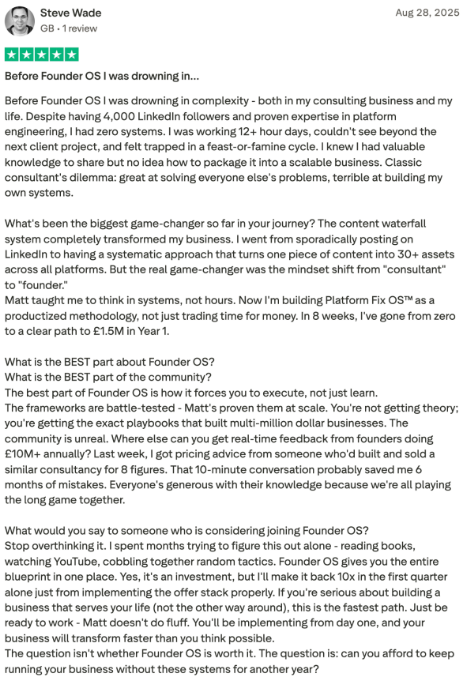
P.S. Steve Wade did £125k in 14 days off one owned channel, teaching for free every month. Nobody bought because he was famous. They bought because they could feel how much he cared.