| | In this edition: Zambia agrees to US health deal, FBI releases file on Nigeria’s president, and a So͏ ͏ ͏ ͏ ͏ ͏ |
| |  | Africa |  |
| |
|
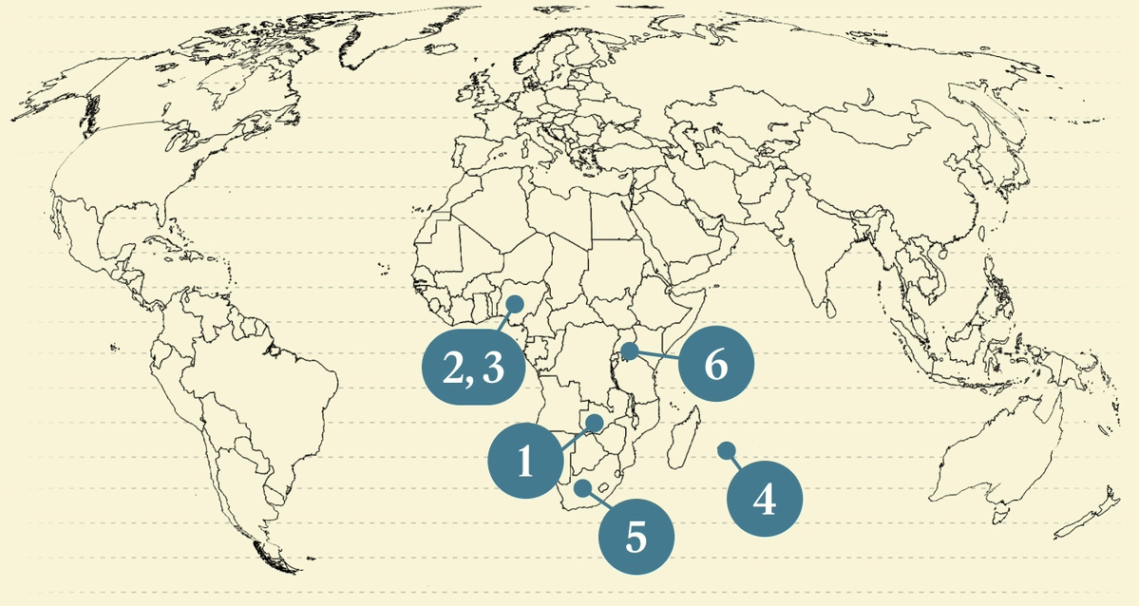 - Zambia agrees health deal
- Nigeria leader’s FBI file
- Abuja caps petrol price
- Ratings agency appoints CEO
- Pillay wins Nobel Peace Prize
- Rwanda set for F1 Grand Prix
 A Zimbabwean author wins the prestigious Caine Prize for African writing. |
|
 This month, Togo invited citizens to contribute texts, recordings, and translations to help AI models understand the West African country’s 50 local languages. The absence of African languages from large language models has become a major concern for the continent’s policymakers and tech leaders. But initiatives like Togo’s suggest the future of AI in Africa may hinge less on who builds the biggest model than on who makes the technology useful to the most people. Global AI investment is expected to hit $2 trillion this year, according to research firm Gartner, as tech giants race to build computing power and infrastructure. But few African companies are capturing the cloud computing spending, and even then the numbers are tiny: Africa has 18% of the world’s population, but only 0.6% of global data-center capacity, the World Bank says — and just 5% of that is equipped for advanced AI workloads. For now, the continent’s main link to the boom is demand for minerals such as copper and cobalt. The bigger prize is productivity, from how farmers reach markets to how governments deliver services. The African Development Bank estimates inclusive AI adoption could add up to $1 trillion to Africa’s GDP by 2035. But without the infrastructure and energy to deploy it, AI is unlikely to add meaningfully to growth. That’s why the World Bank argues in its biannual Economic Update, published this week, that most African economies should adopt and adapt AI rather than build frontier models from scratch — an expensive use of limited resources. Togo shows what adaptation looks like: A model that can’t understand citizens’ languages is of little use in delivering government services. African countries don’t need to win the race to build the biggest model, but they do need to make AI productive across their economies. They also can’t afford to merely be suppliers to the AI revolution or just consumers of finished AI products; they need to become places where that revolution delivers its biggest gains. |
|
Zambia and US agree health deal |
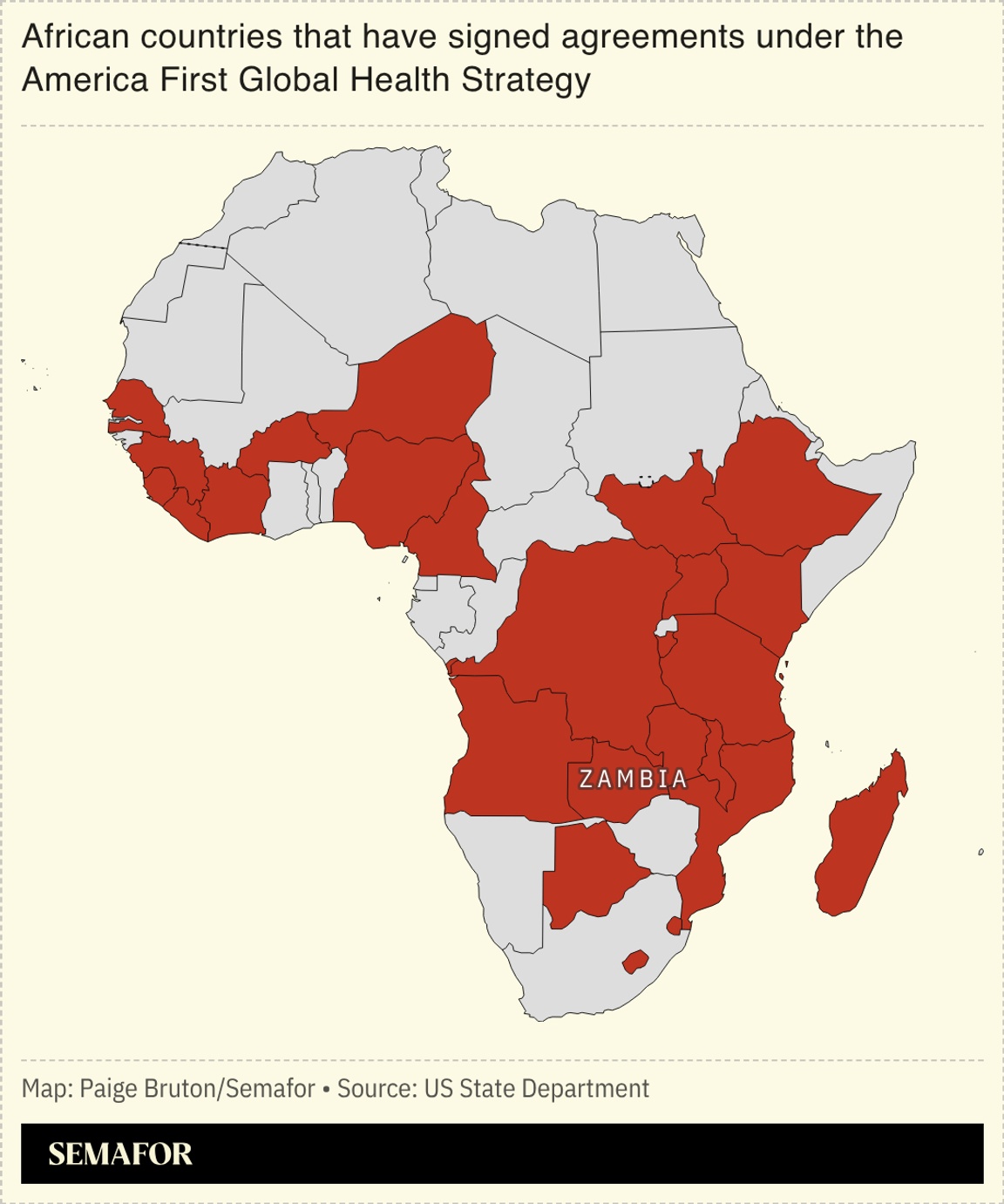 Zambia signed a health financing agreement with the US that had been jeopardized both by privacy concerns over the sharing of citizens’ data as well as concurrent talks over a critical minerals deal. It is among several African countries that have signed bilateral health deals under the Trump administration’s America First Global Health Strategy, but Africa’s second-largest copper producer stands out for having publicly resisted key provisions and winning changes. Foreign Minister Mulambo Haimbe said at the signing ceremony that the two memorandums of understanding — over health and minerals — “needed to be decoupled and this has been done.” Zambia joins 35 countries, including several in Africa, to agree to the White House’s health plan. Kenya was among the first to approve a deal, but courts suspended it on privacy and parliamentary approval grounds. Ghana and Namibia, meanwhile, objected mainly to US demands requiring them to hand over biological specimens and patient data, while Zimbabwe lost all US health aid last month. — Tiisetso Motsoeneng |
|
| |  | Adrian Elimian |
| |
 Illustration: Kevin Zweerink/Semafor, Photos: Adriano Machado/Tom Brenner/Reuters Illustration: Kevin Zweerink/Semafor, Photos: Adriano Machado/Tom Brenner/ReutersUS law enforcement has acknowledged it holds a file on Nigerian President Bola Tinubu over a 1990s-era heroin-trafficking investigation, shedding new light on an episode that has been a mainstay of recent Nigerian election campaigns. Lobbyists and lawyers working for Tinubu have tried to dismiss the FBI dossier, while the president’s critics have tried to disseminate it, but the latest revelation comes as a result of a freedom of information filing by a US transparency activist with no apparent connection to Nigeria. The fight now underway is over whether the FBI has gone far enough in releasing a partially redacted file. Atiku Abubakar, one of the main opposition candidates taking part in Nigeria’s January election, has tried to use the dossier as a political weapon ahead of the vote. Another of Tinubu’s opponents called it “profoundly embarrassing” that the president was asking a foreign court to withhold his records. However, the president was not convicted of any crime and in any case, the upcoming vote is likely to be largely fought over cost-of-living and security issues. |
|
Nigerian fuel subsidy returns? |
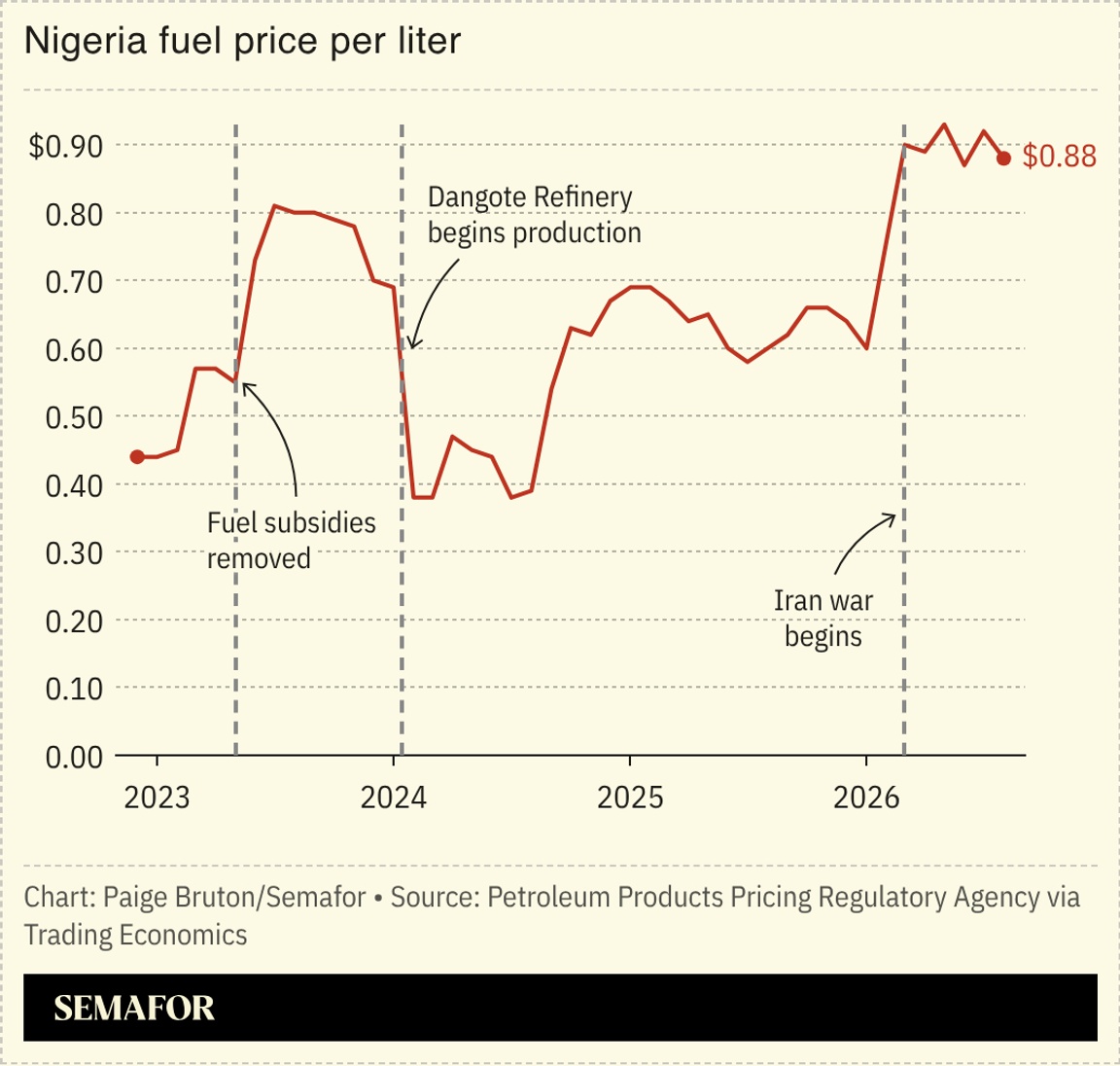 Nigeria introduced a new discount on fuel, reigniting fierce debate over the wisdom of terminating a long-running subsidy program three years ago. The move comes ahead of January’s presidential election, with high energy prices among the key campaign issues. Finance Minister Taiwo Oyedele announced a 30-day discount on petrol sold at government-owned pump stations, insisting that it was not a subsidy. But that framing, which was widely rejected by analysts, has opened a window of criticism for President Bola Tinubu’s top challengers. Tinubu ended the subsidy following years of recommendations by the IMF and other economists that the program, whose $10 billion cost in 2022 exceeded the combined budgets for health and education, was wasteful and corrupt. But its removal raised fuel prices sharply, pressure that was exacerbated by the Iran war curtailing energy supplies. — Alexander Onukwue |
|
Africa credit agency names CEO |
 Nairametrics/X Nairametrics/XAfrica’s new credit rating agency named its interim chief executive and revealed his Johannesburg research house was its only named shareholder as it launched the continent’s attempt to bring down borrowing costs. The organization is the continent’s most concrete response yet to years of complaints that New York-based ratings agencies Fitch, Moody’s, and S&P Global overstate African risk, unfairly inflating the cost of borrowing. “We are not here to give favorable ratings,” Sifiso Falala, the interim CEO, said at the launch event in Mauritius, addressing concerns that perceived favoritism would undermine AfCRA’s credibility. The creation of AfCRA comes as global agencies face growing criticism for relying on offshore models that some African leaders and policymakers say misread local realities. — Tiisetso Motsoeneng |
|
South African wins Nobel Peace Prize |
 Valentin Flauraud/File Photo/Reuters Valentin Flauraud/File Photo/ReutersNavi Pillay, a South African jurist who was the UN’s longest-serving human rights chief, was awarded the Nobel Peace Prize “for her efforts to promote peace and international law.” Pillay, 85, was a pioneer long before taking on major international roles: She was the first non-white woman to serve as a judge in South Africa’s high court after a legal career defending victims of apartheid laws. But it has been her time on the global stage — and her particular focus on genocide — that has won her most plaudits, beginning with the tribunal investigating the Rwanda genocide, where she helped establish that rape and sexual assault could constitute crimes against humanity. That focus has also made her a controversial figure, particularly in countries she argues have carried out the crime; she told The Guardian last year that she saw echoes of the Rwandan killings in Israel’s war in Gaza, findings Israel has dismissed. |
|
Rwanda’s F1 goal set for green light |
 Edgar Su/Reuters Edgar Su/ReutersRwanda looks set to host the continent’s first F1 Grand Prix race in more than 30 years, beating rival South Africa to the honor, according to sources quoted by AFP. President Paul Kagame launched a bid to host two years ago as part of efforts to raise Rwanda’s international status through sport, which has included welcoming the road cycling world championships and sponsoring high-profile European football teams. The government said the strategy has boosted inbound tourism. Rights groups have, however, accused the country of sportswashing to cover up its reputation for silencing critics, including accusations of killings and disappearances, allegations the government denies. South Africa’s sports minister appeared to confirm reports that his country had lost out, saying on social media “we are happy for Rwanda” and suggesting the race would take place in 2030. He is, however, now lobbying for a second F1 race to go to Africa. — Damian Zane |
|
 - The world’s longest-serving president, Equatorial Guinea’s Teodoro Obiang Nguema Mbasogo, is enjoying a slew of wins as he prepares to hand over power to his sports-car-loving son, Teodorín. Once considered a Western pariah, Equatorial Guinea has been at the heart of the Trump administration’s lucrative third-party deportation deals, Enrique Martino writes in The Republic. At the same time, the country has bet big on a global natural gas boom, and is increasingly cosying up to Russia and China. “Franklin Roosevelt’s old quip about the Nicaraguan President Anastasio Somoza Debayle — a dictator, but ‘ours’ — has found its Equatorial application,” Martino says.
- China’s Transsion Holdings dominates the African phone market, developing nearly half of all handsets sold on the continent. How did a company that is little-known in China gain so much power in Africa? Lu Miao, from Hong Kong’s Lingnan University, explains the phenomenon in an interview with Shanghai-based outlet Sixth Tone. Lu calls Transsion’s model one of “technology translation”: The company adapted its offerings based on local needs, including long battery life, cameras adapted for darker skin tones, and dual SIMs to compensate for patchy networks.
- Africa’s investment boom is a long-term success story that will significantly improve the lives of millions of people. However, in reality, the impact is fragmented, Goldman Sachs’ Jared Cohen writes for Foreign Affairs: Over 80% of foreign direct investment in Africa is concentrated in just 15 countries, meaning the region’s poorest or least stable nations may not benefit. “There is unlikely to be a single African economic story,” Cohen writes. “The countries that open themselves up … are the ones that will likely fare best.”
- Religious leaders are assisting governments and the press across Africa to combat Russian and Chinese disinformation on social media ahead of elections, according to The Christian Science Monitor. While foreign actors also target the West to sow falsehoods and influence democracy, Africa typically relies on more traditional forms of community, pushing religious leaders to the forefront of verifying information.
|
|
|


