| | President Donald Trump says the US will not strike Iran before the midterm elections, China defends ͏ ͏ ͏ ͏ ͏ ͏ |
| |  | Flagship |  |
| |
|
The World Today | 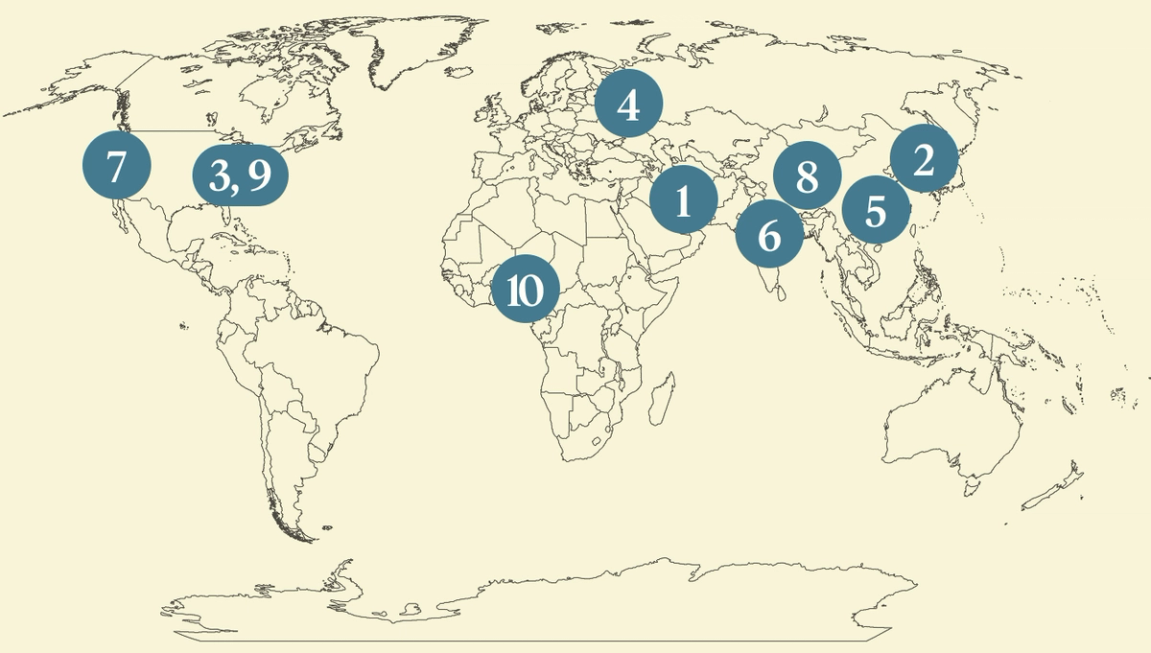 - Trump’s Iran war timeline
- AI’s boost to global trade
- WH tech visa crackdown
- US-Russia potential deals
- China defends yuan policy
- Musk fights India on Starlink
- Amazon bans AI agents
- A case for industrial theft
- The new ‘sexual ethic’
- Smartphone power player
 Revisiting a Nobel winner’s ‘sensuous and funny’ 1998 novel. |
|
Trump touts ‘productive’ Iran talks |
 Stringer/Reuters Stringer/ReutersOil markets largely shrugged off US President Donald Trump’s pledge on Thursday not to strike Iran before November’s midterm elections, amid intensifying attacks on ships in the Gulf and an escalating Saudi-Houthi conflict. Trump said Washington and Tehran were having “productive” talks, as the president contends with voters who are increasingly unhappy with his handling of the eight-month war and the resulting record-high fuel prices. Trump’s comments appeared to be in response to reports that the White House was considering a plan to strike Iran before the midterms. Even the plan’s advocates were doubtful a limited operation could lower gas prices, but would make Trump “look like he got a win,” a Republican told The Atlantic. |
|
AI exports offset trade disruptions |
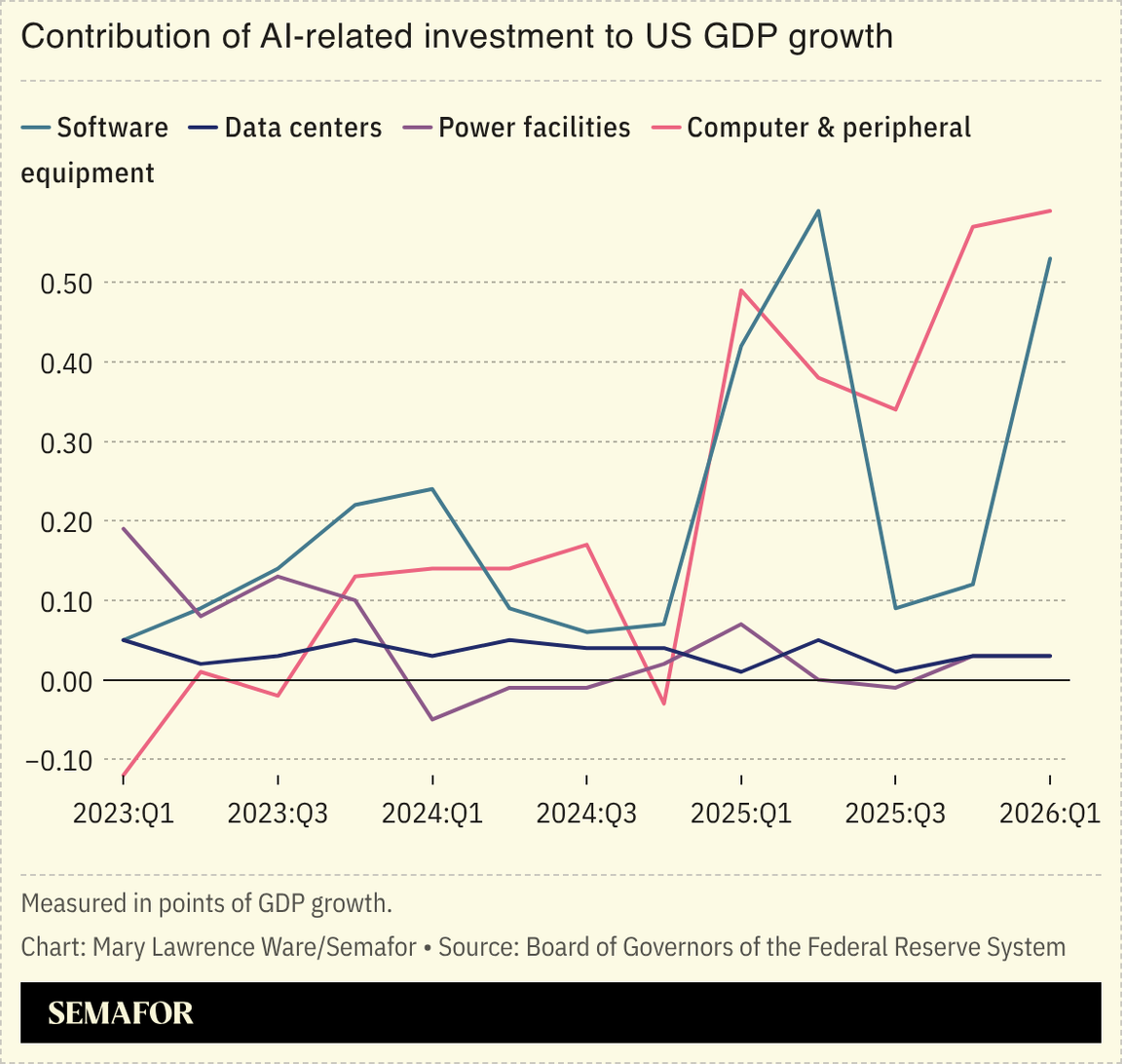 Global trade in goods is expected to grow by 3.9% this year, The World Trade Organization said Thursday, as conflict-fueled disruptions in the Middle East are more than offset by the booming AI trade. AI-related goods and materials accounted for 47% of growth in the first half of 2026 while making up only 15% of trade, the WTO said, boosting cross-border commerce despite declines in shipments of oil, natural gas, and fertilizer. Global trade has been “shaped by two opposing forces: a Middle East conflict affecting services as much as goods, and an exceptionally strong wave of investment in AI infrastructure,” the WTO’s chief economist said. “So far, the second force has outweighed the first.” |
|
WH scrutinizes visa programs |
 Nathan Howard/Reuters Nathan Howard/ReutersThe Trump administration on Thursday suspended Microsoft and other tech companies from the program that allows permanent hiring of foreign workers — escalating a clash with the tech industry over immigration. Describing the H-1B visa program as “rife with fraud,” the White House said it was separately investigating the use of J-1 visas at universities including Yale, Harvard, and MIT. “They’re using these visas way too much,” the vice president said. The administration has waged a sweeping campaign to limit the entry of foreign workers and students, arguing it frees up space for Americans. Other countries have seized on the opening: China unveiled the “K-visa” last year, its H-1B equivalent, and Canada and Germany have also eased rules over high-skilled immigration. |
|
US, Russia discuss Nord Stream deal |
 Sputnik/Mikhail Metzel/Pool via Reuters Sputnik/Mikhail Metzel/Pool via ReutersTop US and Russian officials have discussed selling part of the suspended Nord Stream pipeline to an American investor, Reuters reported, in talks spearheaded by White House envoy Jared Kushner. Though the pipeline hasn’t transported gas to Germany since 2022, the country’s far-right AfD supports resuming flows, which could allow US investors to profit. Kushner, who has previously characterized his business ties in regions of conflict as a way to promote diplomacy, is also marshaling a group of investors, including the US government, to acquire the assets of sanctioned Russian energy giant Lukoil. Ukraine’s prime minister on Thursday criticized Washington’s attempts to “negotiate with the Russians about future economic projects” while also trying to broker a peace deal. |
|
China refutes yuan manipulation claims |
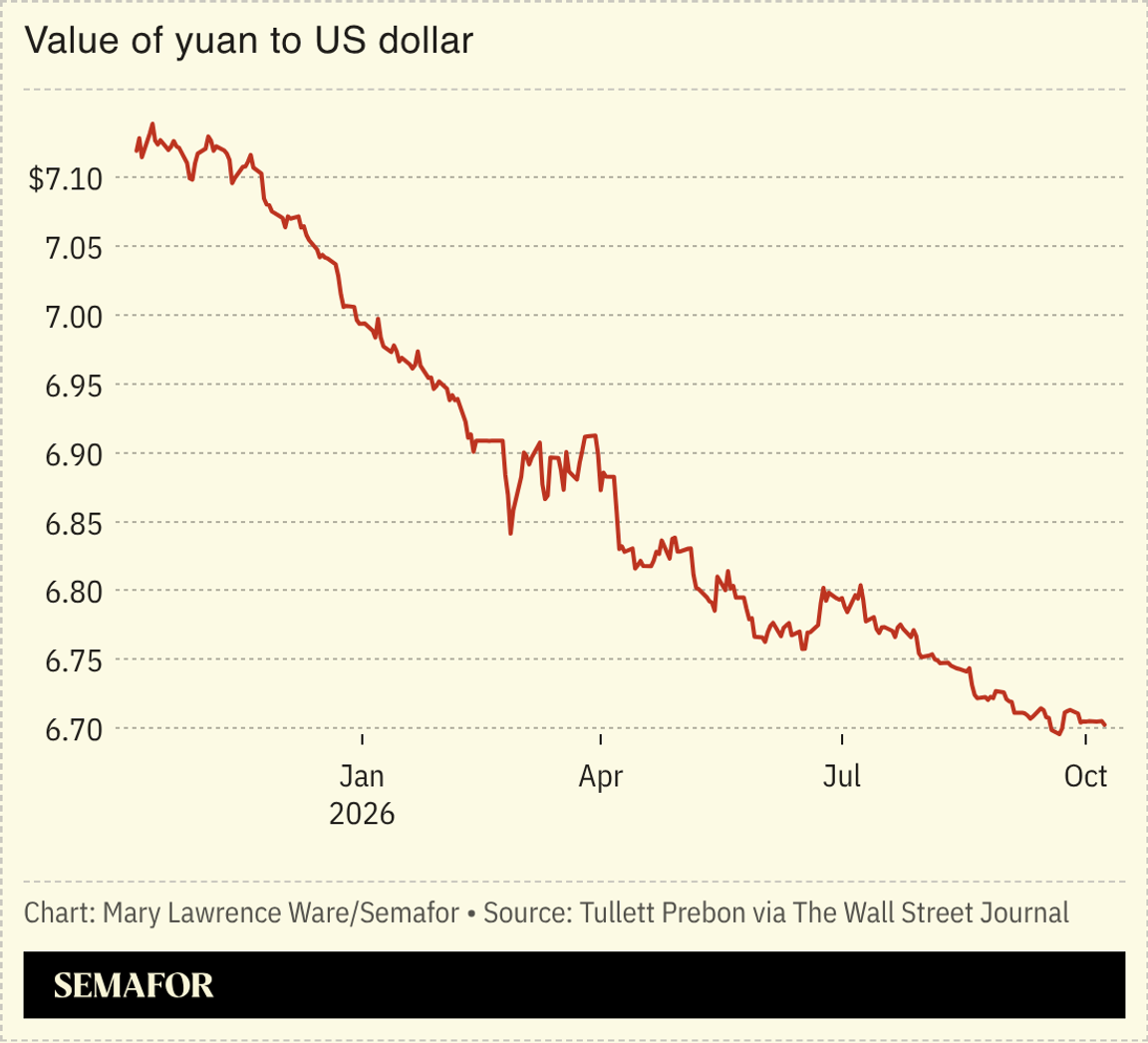 China pushed back against claims that it manipulates its currency to boost the country’s exports, as Beijing and Brussels spar in trade negotiations. China’s central bank published a paper Thursday arguing that past experience did not suggest a stronger yuan hurt China’s trade expansion, or that a weaker yuan boosted exports, the South China Morning Post reported, in what one economist said offered “a direct response to accusations of renminbi undervaluation.” Europe has long charged Beijing with deflating the yuan, by perhaps as much as 30%, and pursuing a policy of industrial overcapacity that harms European industries. China has vowed a “resolute response” if the EU takes collective action to restrict Chinese companies or products. |
|
Musk and India fight over Starlink |
 Evan Vucci/Reuters Evan Vucci/ReutersElon Musk blamed “certain oligarchs” for keeping Starlink out of India, comments New Delhi called “baseless,” escalating a yearslong feud over market access for the satellite operator. Mukesh Ambani’s Jio — which recently announced plans for low-orbit satellite communications — and Sunil Mittal’s Airtel together control 80% of India’s telecom market: “Is Ambani the real boss of India?” Musk posted Thursday. The tech billionaire has often litigated regulatory and business disputes online. Tesla has waged a social media campaign against EU regulators to win approval for the firm’s “Full Self-Driving” technology, Reuters reported, and Musk last week said the CEO of Delta — the only Big Four airline not to carry Starlink — “will lose his job” for contracting Amazon’s in-flight internet. |
|
Agentic commerce boosts Big Tech |
 Priyanshu Singh/Reuters Priyanshu Singh/ReutersAI agents are strengthening the dominance of tech firms as “gatekeepers of commerce,” ING argued. While agentic commerce holds the promise of more convenience and savings for shoppers, it will empower tech platforms to become “increasingly influential in shaping” consumer choices and access, ING wrote. Amazon, the largest online retailer, has blocked Meta’s Muse and sued Perplexity AI over its agents, triggering a dispute that could “determine the rules of the road governing agentic shopping,” Bloomberg wrote. Blocking Muse was the “first opportunity I’ve seen since Amazon was founded for a startup to create an Amazon competitor,” Y Combinator’s Paul Graham wrote: “People will want agents to buy stuff for them… And they won’t want to use some Amazon-supplied agent to do it.” |
|
 Blue Owl has been the face of private credit’s rise over the past decade, and more recently, the face of its troubles as investors ask for their money back from funds that can’t always return it quickly. In the season two premiere of Compound Interest, presented by Amazon Business, Blue Owl co-CEOs Doug Ostrover and Marc Lipschultz join Liz and Rohan to discuss the surge in investor withdrawals, whether we need a new word for “semi-liquid” funds, and why they haven’t taken the company private. Plus, Blue Owl’s role in the data-center boom as a growing financier. Watch the latest Compound Interest now. |
|
The case for industrial espionage |
 Larry Downing/Reuters Larry Downing/ReutersThe US should reconsider its policy of forbidding industrial theft, a former intelligence official argued. While the policy made sense in an era in which the country had little to gain from normalizing corporate espionage, forbidding American firms from stealing trade secrets from foreign companies today makes less sense, the CIA’s former deputy director David S. Cohen wrote in Foreign Affairs, as the US’ “lead in many crucial advanced technologies is being contested or even erased by China.” Other countries have spied on US firms for decades, which one former National Security Agency director called “the greatest transfer of wealth in history.” Others, however, argue that providing intelligence to select US firms would routinize government intervention, inevitably distorting the economy. |
|
Cornell case prompts ethical reckoning |
 Lauren Petracca/Reuters Lauren Petracca/ReutersA woman’s lawsuit alleging she was raped at Cornell University in 2024 has revived debates about consent, though commentators argued the moral stakes exceeded the legal definitions in question. Public outcry over the case prompted New York to appoint a special prosecutor, reigniting a “decadeslong legal fight” over adjudicating consent through “the murk of… alcohol and drugs,” The Wall Street Journal wrote. It also surfaced a narrative among young people of a new “sexual ethic,” a Harvard Crimson editorial argued: one that requires not just consent, but also “upholding the dignity and respect of the human being involved.” The allegations might “not satisfy a criminal standard of proof,” The Atlantic’s Helen Lewis wrote, but “to |
|
|


