Nearly two-thirds of The Information’s subscribers surveyed last month said their organizations develop AI applications, and a third of subscribers said they receive a return from AI that is a “multiple of what we spend.” The result suggests enterprises have made some progress since the Massachusetts Institute of Technology study last year that indicated just 5% of custom-made enterprise AI tools reached production. The new result, first shared during AI Agenda Live last month, likely reflects recent advancements, including AI models’ ability to access other applications to handle complex tasks, work in the background for hours at a time, and the general improvement of AI-produced code. It could also reflect The Information’s subscriber base, which is weighted toward enterprises that have experience developing software.
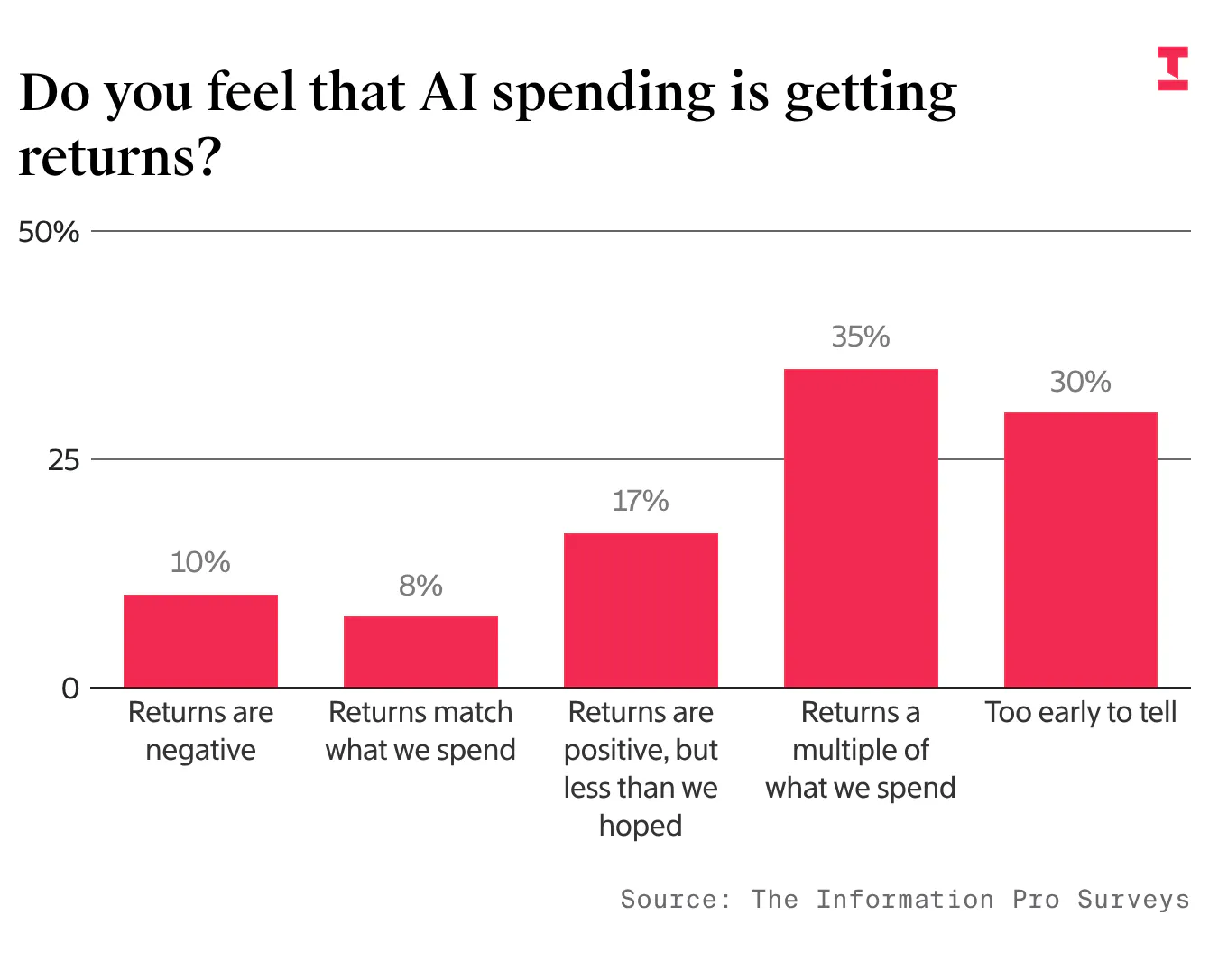
Nearly two-thirds of The Information’s subscribers surveyed last month said their organizations develop AI applications, and a third of subscribers said they receive a return from AI that is a “multiple of what we spend.” The result suggests enterprises have made some progress since the Massachusetts Institute of Technology study last year that indicated just 5% of custom-made enterprise AI tools reached production.
The new result, first shared during AI Agenda Live last month, likely reflects recent advancements, including AI models’ ability to access other applications to handle complex tasks, work in the background for hours at a time, and the general improvement of AI-produced code. It could also reflect The Information’s subscriber base, which is weighted toward enterprises that have experience developing software.
Another 17% of subscribers said they have positive returns from AI spending but those returns are lower than what they hoped, while 30% said it’s too soon to tell and only 10% said AI spending has been a waste.
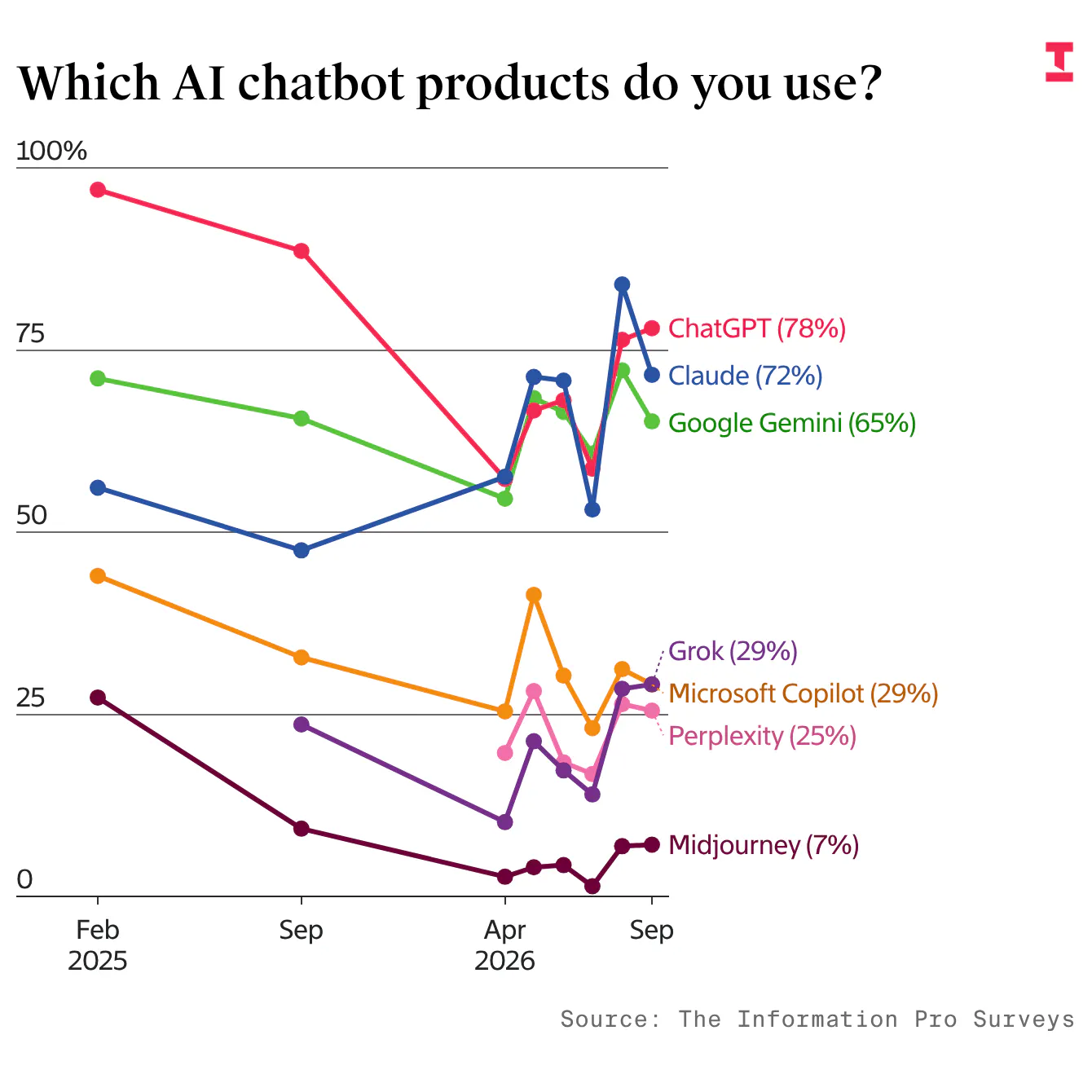
When it comes to specific tools they spend money on, subscribers said their use of Anthropic’s Claude chatbot and Google’s Gemini have risen at the expense of their use of OpenAI’s ChatGPT over the past year. ChatGPT still leads the pack and has regained some ground in recent months versus Claude, however. Gemini’s resurgence is probably due to either Google signing more enterprise deals or its integration of Gemini with its core search engine.
On Wednesday OpenAI launched visual answers in ChatGPT as an effort to catch up to a similar feature from Gemini, which surfaces videos or images in its answers to certain questions.
Our subscribers also tell us they’re using Microsoft Copilot less, even as that company signs up more corporate subscribers.
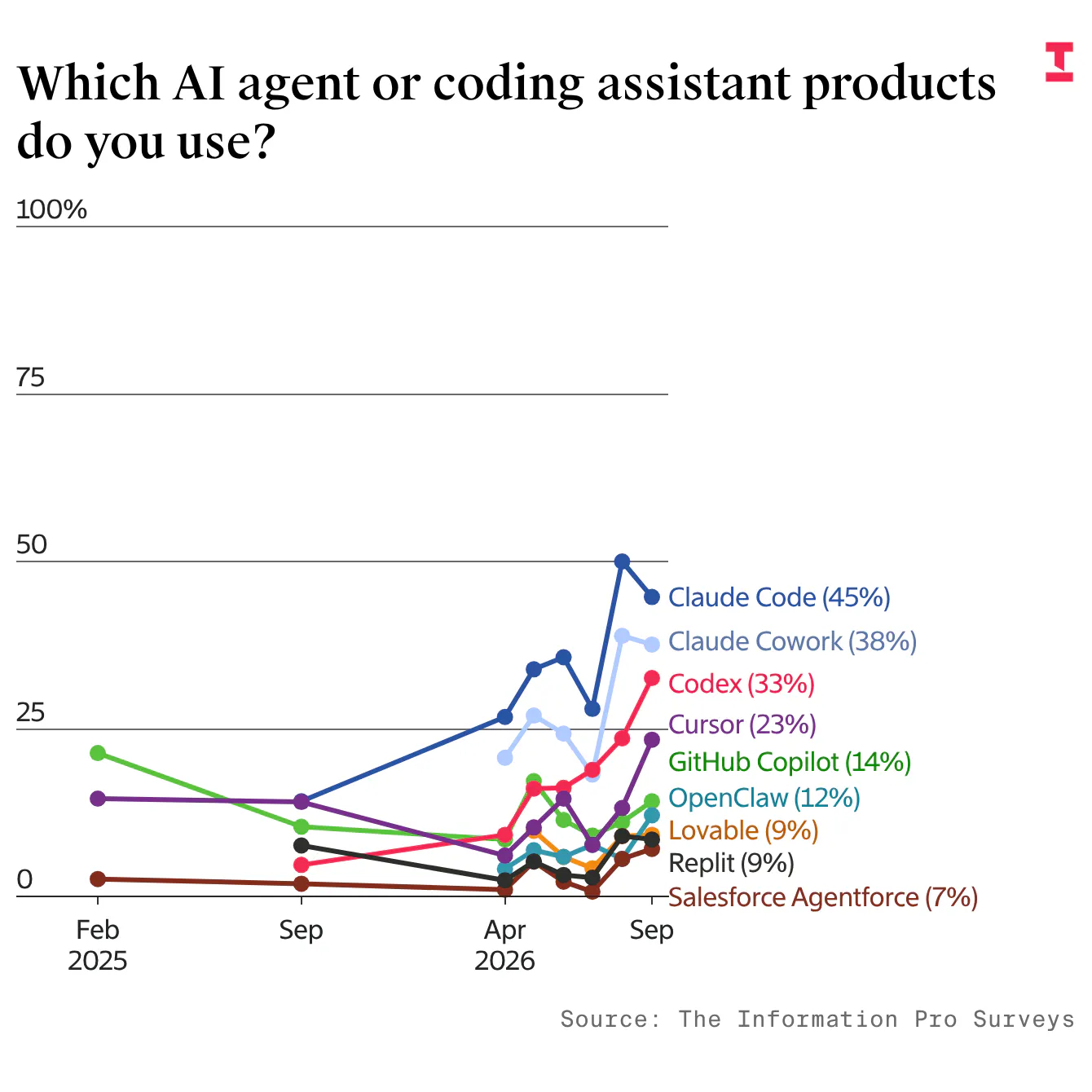
SpaceXAI’s Grok—with its permissive settings, relative to other chatbots—has made a little comeback among subscribers, according to the survey data. Even among our tech-forward readers, only 12% use open-source AI agent technology OpenClaw regularly, though Anthropic, OpenAI and other firms are embedding more OpenClaw-like technologies in their products every week to power so-called persistent agents like ChatGPT Dots, Grok Bot and Microsoft Autopilot. (A future survey will delve into this category.)
In the more specialized market for coding assistants and other agents, our subscriber data show how the early GitHub Copilot and Cursor duopoly has vanished. Today, Claude Code reigns supreme but OpenAI’s Codex has made a surge this year as its capabilities have improved, and Cursor isn’t far behind.
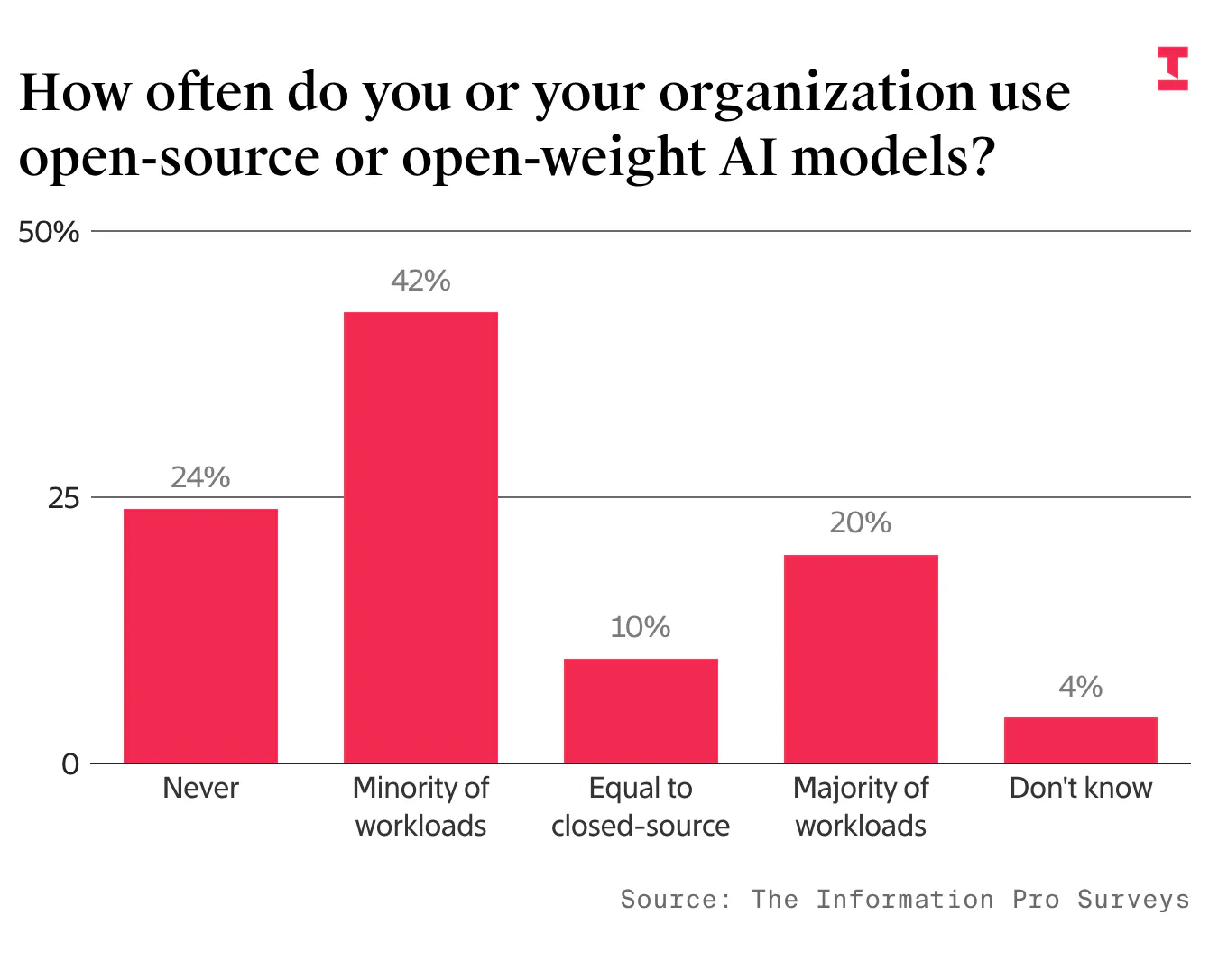
More broadly, a quarter of subscribers said they used Perplexity, which also sells an AI agent for handling complex tasks involving other apps, and models from Chinese developer DeepSeek. About one-sixth of subscribers are using Moonshot’s Kimi K3 regularly, underscoring the rise of Chinese open-weight alternatives to the American closed-source AI developers. In fact, 46% of subscribers said they used at least some open-source AI models for their work, and 21% said they used Chinese ones. That gap suggests some subscribers that aren’t using Chinese models are using open-weight models from American firms such as Nvidia, Google or Thinking Machines Lab. (A future survey will clarify this.)
While open source AI usage is rising, many of those users also heavily rely on closed source models like GPT and Claude. In fact, only 20% of subscribers say they use open source models for a majority of their AI workloads, the data show.
Overall, the survey shows just how much has changed in the past 12 months, when 59% of The Information’s readers said they’d never used an AI agent before. Of course, at the time, one of the most advanced agents was OpenAI’s “deep research” feature, which primarily did web-based information retrieval and analysis. A year ago, more than two-thirds of subscribers said—correctly—that advancements in AI would accelerate.
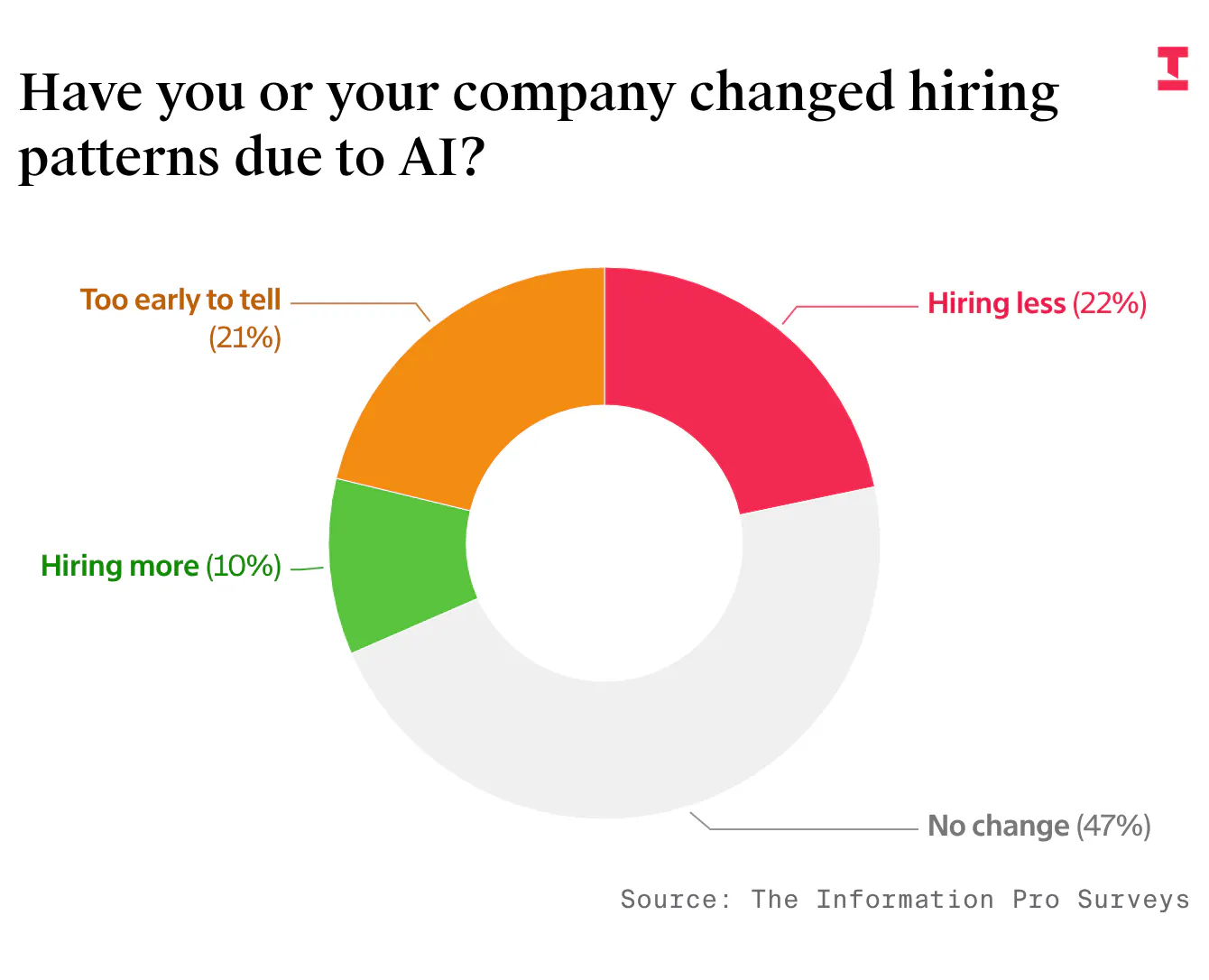
Nearly half of subscribers say they haven’t made any hiring changes due to AI use, though a greater portion—22%—say they are hiring fewer workers than the 10% of subscribers that say they’re hiring more. For now, according to the survey and broader U.S. government data, jobs are not going away, even if AI is changing the nature of existing roles.
As enterprises move beyond AI deployment, where is real value landing? Aaron Holmes moderates this live discussion unpacking AI ROI with executives from Celonis and National Life Group. Register today.
The Information's WTF Summit returns to Napa Valley, bringing together the women shaping tech, media and finance. Confirmed speakers include Whitney Wolfe Herd (Bumble), Anne Wojcicki (23andMe Research Institute), Kim Posnett (Goldman Sachs) and comedian & entrepreneur Whitney Cummings, with more to come. Expect candid conversations and a room built for meaningful exchange. Tickets are selling fast—reserve your spot now.
The Information's Dakin Campbell will host a panel discussion on the evolving landscape of public listings and exit opportunities during SF Tech Week, sponsored by NYSE.