| | AI funding momentum builds as hacking fears grow, concerns increase over European debt, and a new po͏ ͏ ͏ ͏ ͏ ͏ |
| |  San Francisco San Francisco | Lagos | Paris |
 | Flagship |  |
| |
|
The World Today |  - AI funding momentum
- AI hacking fears build
- Mideast tensions drive oil
- France pressure builds
- Europe’s growing crises
- China rebuffs EU push
- India-US talks ‘plateau’
- Nigeria leader’s FBI file
- Crime shapes Latam politics
- AI comes for gaming
 A recommendation for a ‘wonderfully woven screenplay’ replete with everything from ‘hearty belly-laughs to heartbreaking melodrama.’ |
|
Alphabet’s biolab in funding talks |
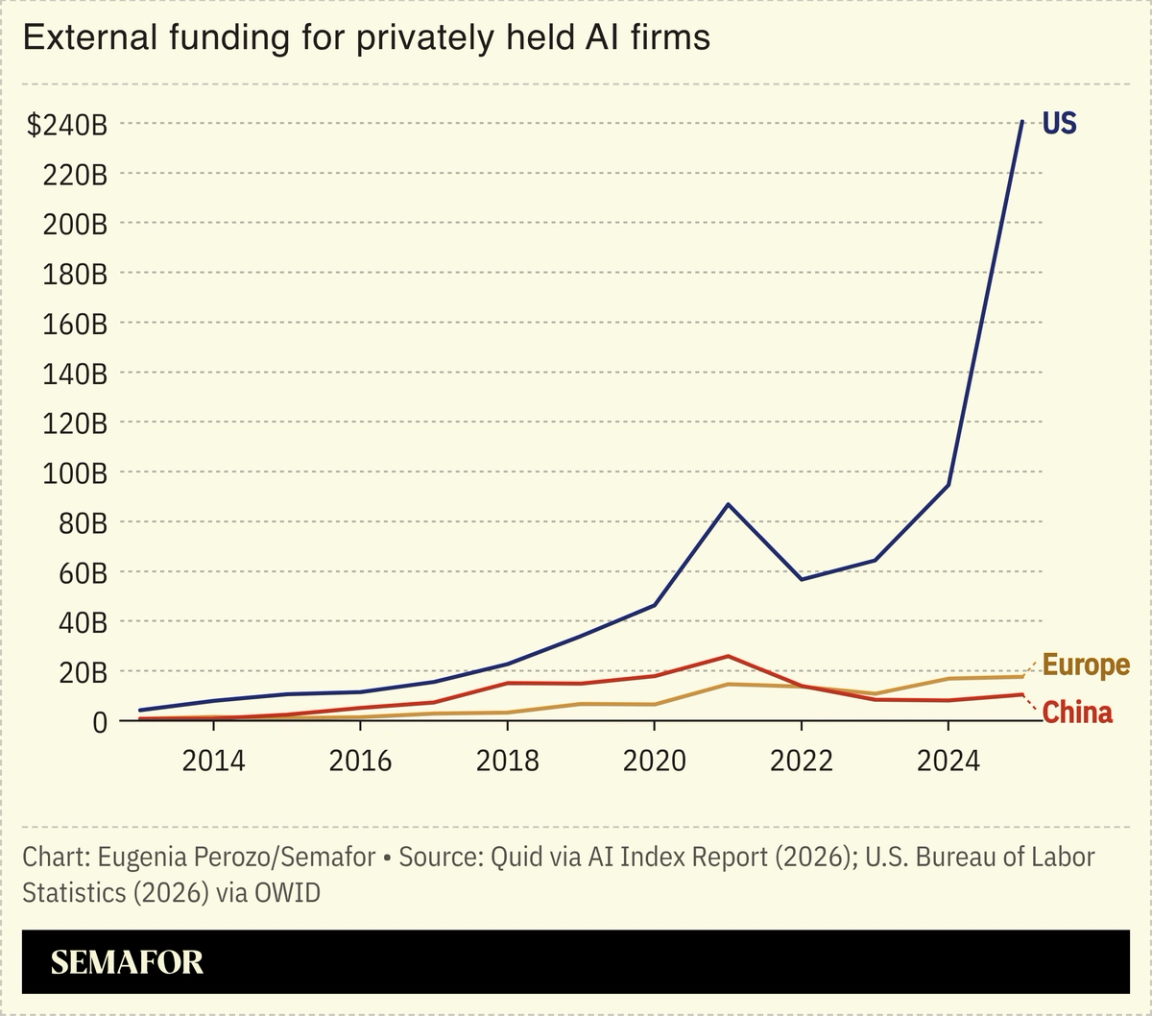 Alphabet’s Isomorphic Labs is reportedly in fundraising talks at a $40 billion valuation, the latest sign of strong investor appetite for AI despite growing fears of a bubble. The company — led by Nobel Prize winner and former Google DeepMind CEO Demis Hassabis — hopes the new investment will accelerate its push to develop new drugs. Firms including China’s DeepSeek and Moonshot, as well as industry giant OpenAI, are also chasing billions in fresh funding as they look to stay ahead in the global AI race. However, experts fear that the vast amount of spending on AI, which is on track to far exceed past investment booms, is creating a bubble that, were it to burst, would lead to “a far-reaching shock.” |
|
Hackers target Japan, S. Korea |
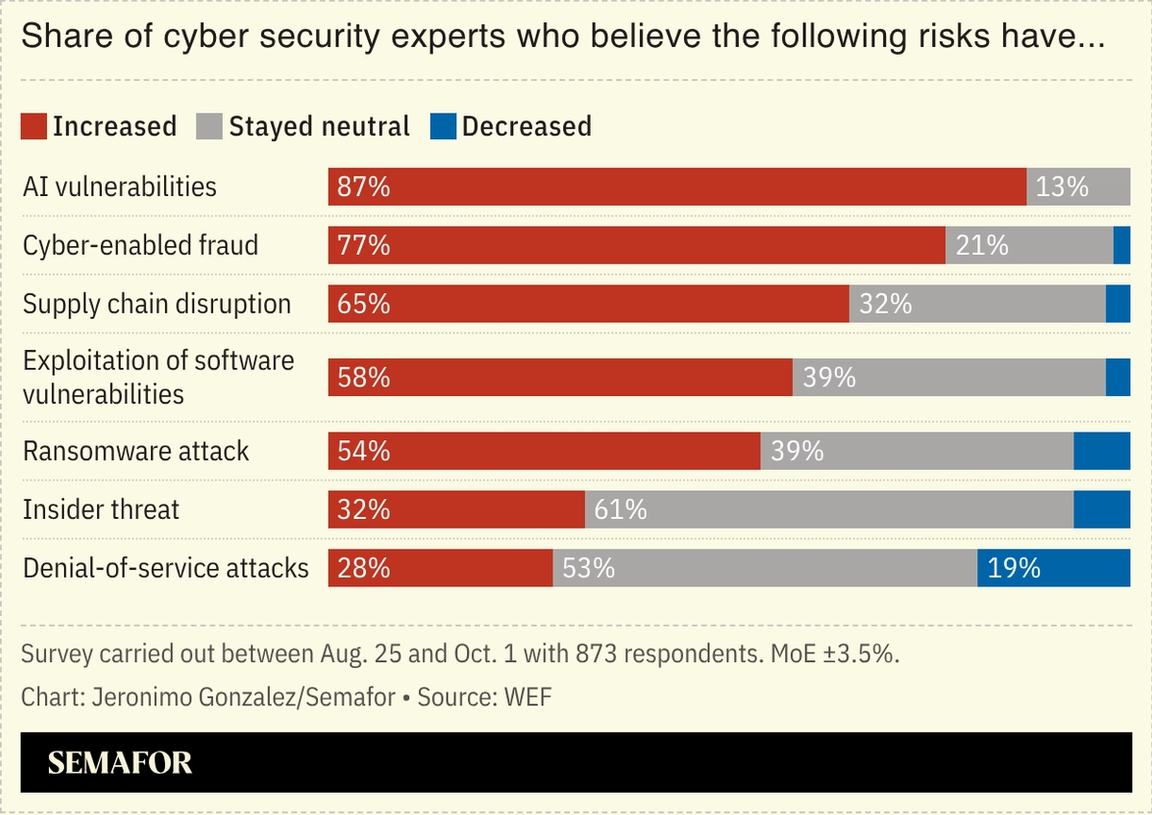 Companies in Japan and South Korea were hit with major cyberattacks, exposing millions of customer records and feeding fears that AI may be turbo-charging hacking efforts. The revelations come days after Chinese and US models were used to steal hundreds of thousands of credit card details, a breach an analyst called one of the “most severe abuses of AI for exploitation” on record. Corporate leaders, especially in finance, say industrial-scale AI hacking represents a severe threat to business, with many racing to adopt the technology themselves as the only antidote. Some may already be too late: “There’s a misconception that the AI vulnerability race is imminent,” an expert at Google said. “The reality is that it’s already begun.” |
|
Oil jumps after wave of strikes |
 European Union/Copernicus Sentinel-3/Handout via Reuters European Union/Copernicus Sentinel-3/Handout via ReutersOil prices surged on fears of the Middle East conflict expanding, after Yemen’s Houthis attacked Riyadh for a second day. The missile strikes, which hit the capital’s airport and left at least three dead, come as Iran upped the pace of its attacks on vessels crossing the Strait of Hormuz. Oil exports from the Gulf last month briefly topped prewar levels, but there remains a major shortfall of refined products: Diesel prices in Europe rose 8% on Wednesday. Even the release of stockpiles announced this week by the International Energy Agency was initially overstated: JP Morgan analysts said governments were, for now, more constrained by their willingness to use those stores than their overall size. |
|
France’s mounting economic turmoil |
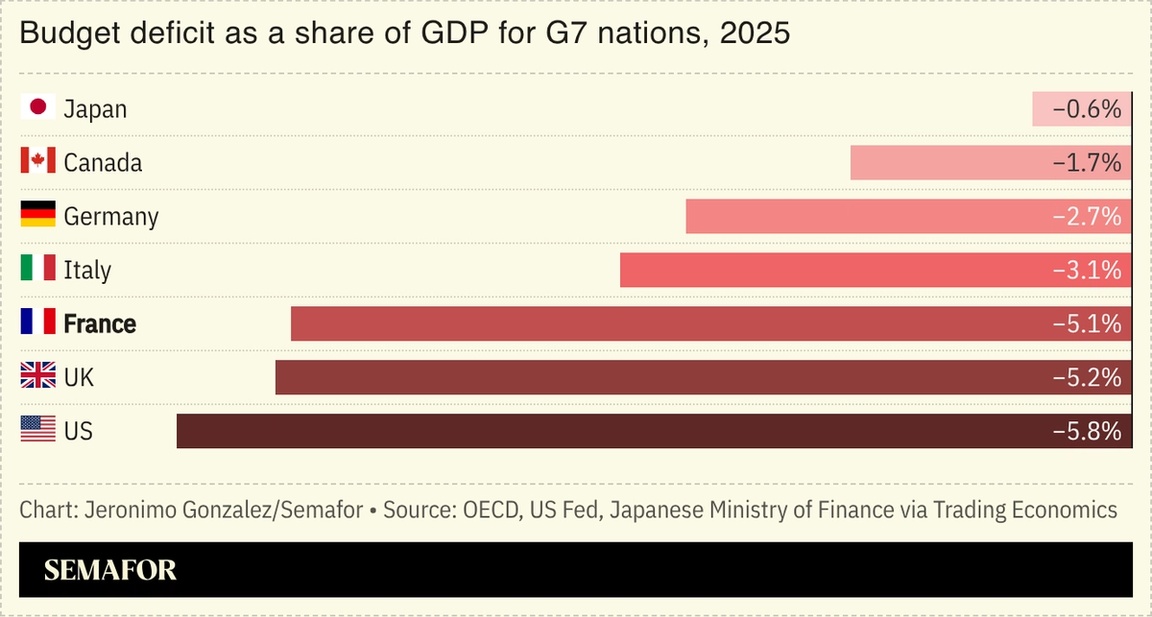 France’s challenges mounted as concerns over its ballooning debt weighed on economic activity and reverberated across Europe. Economists argue planned government spending cuts do not go far enough and political divisions — far-left and far-right parties instead want the European Central Bank to buy up or even cancel French debt — suggest Paris’ proposed budget faces an uphill battle to pass. Political uncertainty is hampering business investment, France’s biggest business group has warned, while anxious consumers are holding off on purchases. The challenges are manifold: “Rising debt levels, persistent fiscal slippage, elevated borrowing costs, and political uncertainty [will] increasingly test the credibility of France’s fiscal strategy ahead of the 2027 presidential election,” a Morningstar analyst wrote in a note to clients. |
|
Europe gripped by political crisis |
 Alejandro Martinez Velez/Reuters Alejandro Martinez Velez/ReutersPolitical instability rocked Germany, Italy, and Spain, as the impact of domestic unrest and fiscal crises ricocheted across Europe. The German chancellor, already grappling with weak economic growth and election failings, faced new controversy after members of his center-right party were accused of quietly supporting the far-right AfD’s successful bid to appoint a state assembly speaker. Speculation has grown that the German leader could be ousted, clouding the outlook for Europe’s biggest economy. Spain, meanwhile, faced renewed protests after the death of an elderly woman whose earlier forced eviction sparked demonstrations over a lack of access to housing. And economists voiced worry over Rome increasing its deficit forecasts, with Goldman Sachs saying it expected “Italy’s fiscal risk premia to build.” |
|
The looming EU-China trade war |
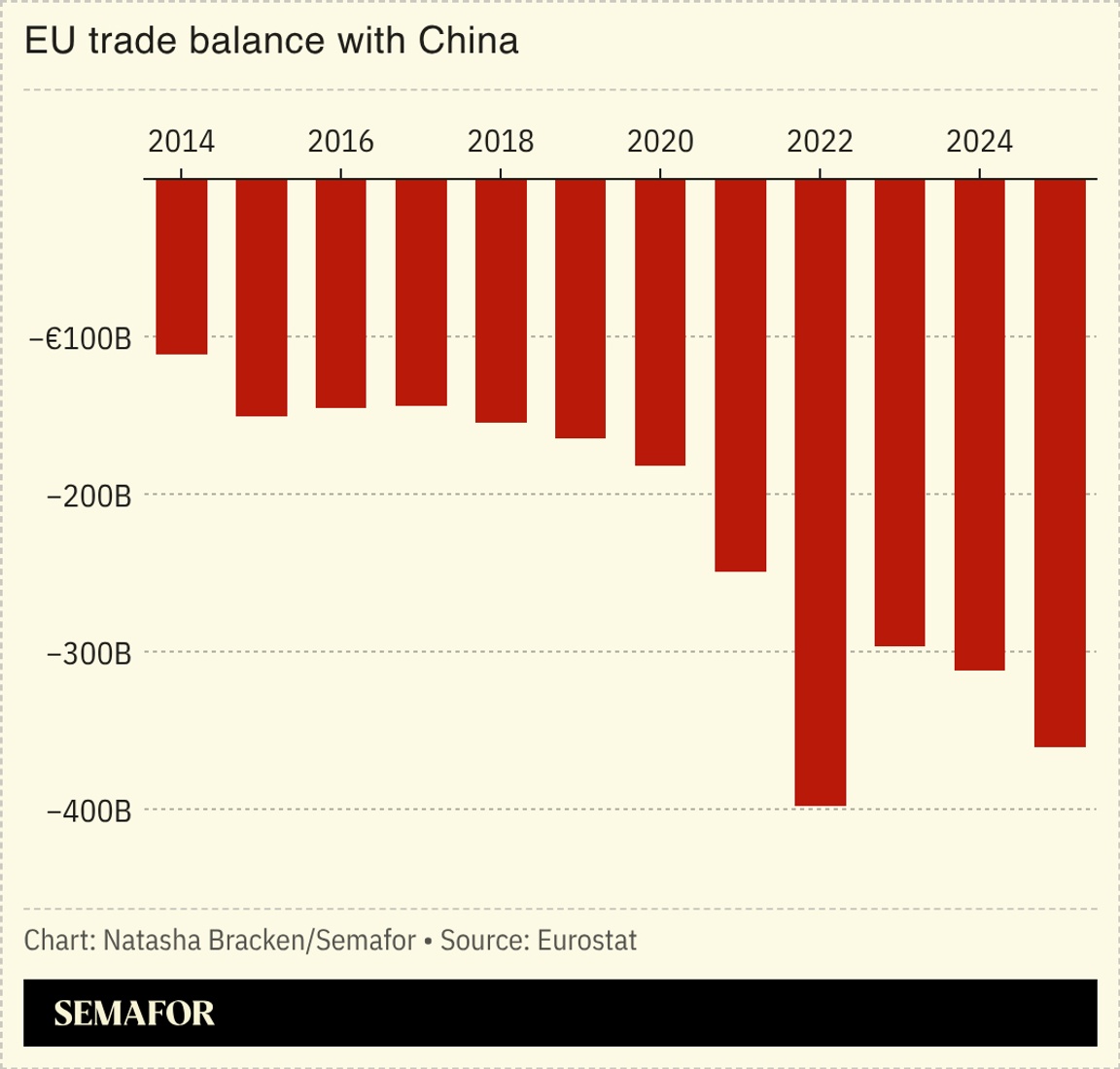 The EU trade commissioner pressed China to balance trade with the bloc, but major divisions between the sides in negotiations and rising tensions have dampened hopes for a breakthrough. Europe’s trade deficit with China has sparked growing alarm on the continent, which fears Chinese goods will hollow out its industries, driving job losses and economic anxiety that ultimately fuel the rise of nationalist parties. Brussels had initially proposed Beijing voluntarily cap the number of hybrid vehicles it exported to the EU, but China rejected that proposal. Experts instead warn of a looming trade war, with Germany and France calling for the EU to ready new tools that could combat China. |
|
US-India trade talks ‘plateau’ |
 Evelyn Hockstein/Reuters Evelyn Hockstein/ReutersTrade talks between India and the US appeared to be making little headway, one of a number of areas of dispute between two nations that had been drawing inextricably closer. New Delhi was once a linchpin of Washington’s strategy to counter Beijing in Asia, but US President Donald Trump has imposed tariffs on the country, and threatened more penalties over its purchase of oil from Russia. Talks on a trade truce have reached a “plateau,” India’s finance minister acknowledged this week, while its foreign minister said the US had “deliberately become a lonelier power.” As one leading American analyst of India noted, “realism is now in abundance in New Delhi about what is and isn’t happening in and with Washington.” |
|
 Semafor has announced new members and co-chairs of the Global Advisory Board for Silicon Valley & The World, a first-of-its-kind, multi-year initiative connecting the leaders building transformative technologies with the policymakers shaping them. The expanded board includes more than 50 global figures, among them Olugbenga “GB” Agboola, Bhavish Aggarwal, Pedro Azagra, John Ketchum, Pratyush Kumar, Yann LeCun, Fei-Fei Li, Amjad Masad, Penny S. Pritzker, Kevin Rudd, Eric Schmidt, KR Sridhar, Mati Staniszewski, and Raj Subramaniam. As the board expands, Sam Altman joins Silicon Valley & The World as a co-chair. Designed to move the conversation beyond debate and toward action, Silicon Valley & The World will convene more than 350 founders, CEOs, investors, and policymakers in November, bringing together leaders with the ability to fund, scale, and implement new ideas. |
|
 Illustration: Kevin Zweerink/Semafor, Photos: Adriano Machado/Tom Brenner/Reuters Illustration: Kevin Zweerink/Semafor, Photos: Adriano Machado/Tom Brenner/ReutersUS law enforcement has acknowledged it holds a file on Nigerian President Bola Tinubu over a 1990s-era heroin-trafficking investigation, shedding new light on an episode that regularly erupts ahead of elections in the African nation. Lobbyists and lawyers working for Tinubu have tried to dismiss the FBI dossier, while the president’s critics have tried to disseminate it, but the latest revelation comes as a result of a freedom of information filing by a US transparency activist with no apparent connection to Nigeria, Semafor reported. Though Tinubu’s presidential rival has tried to use the dossier as a political weapon, he was not convicted of any crime. In any case, January’s election is likely to be fought over cost-of-living and security issues. |
|
|


