|
Dear all,
Please find below your weekly update from the UK Health Security Agency (UKHSA) with the latest news, updates and guidance from the Agency.
You can follow UKHSA on X: @UKHSA, Instagram: @ukhsa, Facebook: UK Health Security Agency, LinkedIn: UK Health Security Agency, and YouTube: UKHSA
As always, if you have any questions please get in touch by emailing externalaffairs@ukhsa.gov.uk.
Best wishes,
UKHSA External Affairs Team
New stories:
- Flu vaccine programme rolls out to all those eligible
- MenB vaccine: Freshers urged to get vaccinated with 2 doses
- New blog post: staying healthy at university
- UKHSA & NHS England webinar: communicating vaccines - winter 2026/27 (Monday 5 October)
- Vaccination for people experiencing homelessness: new resources
- UKHSA webinar: Supporting vaccination for people experiencing homelessness (Tuesday 27 October)
Ongoing issues:
- UKHSA and University of Oxford scientists uncover genetic changes in the bacteria causing severe Kent meningococcal disease outbreak
- UKHSA expands wastewater surveillance to strengthen ‘early warning system’ for dangerous pathogens
- UKHSA and PACE make new bacteria available to support research into tackling antimicrobial resistance
-
From our stakeholders: Faculty of Public Health Member Survey
- Latest UKHSA communications toolkits
- Upcoming webinars hosted by UKHSA and partners
UKHSA data, analytics and surveillance
- Statistics at UKHSA
- UKHSA data dashboard
- Notification of Infectious Diseases report
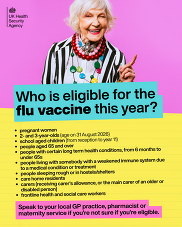
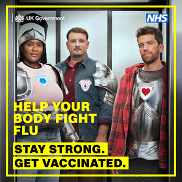
From tomorrow (1 October) the flu vaccination programme begins its rollout to all eligible people. This includes people aged 65 and over, adults with certain long-term health conditions, care home residents, carers, close contacts of people who are immunocompromised, people experiencing homelessness and frontline health and social care workers. Flu vaccinations have already started in September for two and three-year olds, school-aged children, and pregnant women.
Our blog 'Your guide to who’s eligible for the autumn 2026 flu vaccine' runs through what people need to know about who can get vaccinated this year, and what's changed since last autumn.
You can help promote the flu vaccination offer to your audience with our winter vaccines communications toolkit for stakeholders – produced jointly with NHS England. This also includes messaging, resources and further information on the RSV, COVID-19 and pneumococcal programmes.
For further information about our national vaccine campaign and communications please contact: externalaffairs@ukhsa.gov.uk (UKHSA) or england.vaccinations-screening-communications@nhs.net (NHS England).
|
Young adults, particularly university students, remain at increased risk from meningococcal meningitis and septicaemia, with figures from UKHSA showing that Meningitis B (MenB) was responsible for 97% of invasive meningococcal disease cases in 15 to 24-year-olds (93 of 96 cases) in England during 2025 to 2026.
We are continuing to work with partners to urge freshers to ensure they are protected with 2 doses. This is really important because students in their first year of university face a risk of meningococcal disease around 7 times higher than young people of a similar age who do not go to university.
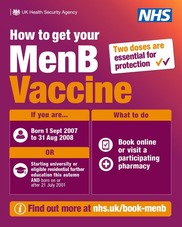
All eligible young people can book their MenB vaccine by booking online or visiting a participating pharmacy.
A reminder that the one-off vaccination programme is being offered to:
- Everyone born between 01/09/2007 and 31/08/2008
- Young people under 25 (born on or after 21/07/2001) who will be starting higher education for the first time, or who will be starting further education for the firsttime as a residential student, in autumn 2026
- International students under 25 entering their first year of university. They should receive their first dose in their home country where possible to give the best chance
of protection ahead of the start of the autumn term.
Stakeholders can support communications on the MenB vaccine offer by using our communications toolkit.
|
As we enter flu season, the UKHSA Communications Team is organising a webinar as part of the Communicating Vaccines series in collaboration with NHS England (NHSE) which will focus on winter vaccines communications. It will take place on Monday 5 October, 2pm - 3.15pm, so this is your last chance to register to listen live, or receive the recording.
The webinar will look back about how last year’s campaign performed and plans for this season, and NHS colleagues will give an update on operational delivery of the vaccine programmes and how communications can support rollout. We will also have a dedicated section on the mis- and disinformation landscape and how communicators can respond, led by UKHSA digital engagement colleagues. We've allocated time for questions at the end to address any questions you may have.
This webinar is designed for:
- Communications professionals working in the NHS, local government, Integrated Care Boards (ICBs), and the voluntary and community sector
- Health professionals who engage in public-facing vaccine communications as part of their role
- Public health teams involved in local and/or regional vaccine promotion
- Anyone responsible for developing or delivering vaccine uptake messages in healthcare settings
You can register for the webinar via this form. You will receive the joining link closer to the event. The webinar will be recorded, and the recording and slides shared with attendees as soon as we can post-event. If you cannot attend the event but would like to receive the recording, please sign up using the same form so we have your details.
|
UKHSA will be hosting a webinar on Tuesday 27th October 2pm – 3pm to launch the materials alongside a toolkit for multi-agency stakeholders to support local systems in improving vaccination uptake among people experiencing homelessness which are due to be published this week.
The webinar is intended for colleagues working in immunisation, public health, inclusion health, health protection, primary care, NHS provider organisations, local authorities, homelessness services and the voluntary and community sector.
It will provide an opportunity to explore how the toolkit and communications materials can be used to support local planning and delivery ahead of the autumn and winter vaccination programme.
If you would like to attend, please sign up via Microsoft Teams.

Scientists from UKHSA, the University of Oxford and a collaboration of academic institutions have used bacterial genome sequencing to understand why the meningococcal disease outbreak in Kent earlier this year was so severe.
Their findings, published as a pre-print yesterday (Tuesday 22 September), reveal that the outbreak bacteria had picked up genetic material from other, less harmful bacteria found naturally in the throats of many healthy people. This process is called ‘horizontal gene transfer’ and allows bacteria to pick up and incorporate small pieces of DNA from other bacteria in their environment, effectively borrowing genetic traits without direct reproduction taking place.
These genetic changes appear to have altered how the bacteria interact with human cells, making this particular strain unusually effective at causing severe disease and potentially less well recognised by human immune responses. However, the same changes that made it so dangerous may also explain why it has not continued to spread widely since the outbreak was brought under control.
The research was presented today at UKHSA's conference and underlines why the UK’s world-leading genomic surveillance and rapid outbreak response capabilities are more important than ever.
|

On Tuesday it was announced that UKHSA in collaboration with Pathways to Antimicrobial Clinical Efficacy (PACE), a partnership between Innovate UK, LifeArc, and Medicines Discovery Catapult, has made 5 new collections of drug-resistant bacteria available for researchers to order. This will allow new treatments and diagnostic tests to be checked against contemporary antimicrobial resistance (AMR) patterns seen in the UK and globally.
To check whether a new treatment is likely to work, researchers can test it against a panel of bacteria. Until now, few of these panels have reflected current resistance patterns, and getting access has often taken a long time before research could begin.
The samples are available through UKHSA’s National Collection of Type Cultures, along with detailed scientific data to support researchers.
|

UKHSA announced today that their wastewater and environmental surveillance programme is expanding to strengthen the UK’s ability to detect pathogens with significant public health threat.
The new programme, called PRISM (Pathogen Risk Intelligence through Surveillance and Modelling), builds on the development programme for wastewater monitoring launched by UKHSA in April 2025. PRISM is expanding into an England-wide system, strengthening existing surveillance and the country’s ability to detect outbreaks.
PRISM has been designed to be pathogen-agnostic, meaning it has the potential to detect known threats, novel variations of known threats as well as previously undetected pathogens, all from a single sample.
Although viruses such as Crimean-Congo haemorrhagic fever, Ebola, Marburg and Lassa fever have not emerged in the UK, this new detection technology has the potential to identify these and other dangerous pathogens at an early stage, strengthening the UK’s biosecurity and pandemic preparedness.
You can read more on UKHSA's wastewater programme in our blog post.
|
The Faculty of Public Health has launched its Member Survey 2026, giving Faculty members the opportunity to share their views on the benefits and services the Faculty offers, and to help shape organisational priorities over the coming years
Faculty members can access the survey by logging in to MyFPH.
The survey takes around 10 minutes to complete and all responses are anonymous.
The UKHSA External Affairs Team prepares a range of communications toolkits to support stakeholders to communicate health security messaging to your networks. You can find the links to all our latest communications toolkits below:
We have a series of webinars coming up which may be of interest to you or your audience. You can find out more information and sign up by clicking the links below:
|