
Dear Colleague,
You entered healthcare because you wanted your work to matter to the person sitting across from you. You wanted to listen carefully, understand why someone was struggling, and help them move toward better health.
Then a complex patient comes through the door.
They bring years of symptoms, several diagnoses, laboratory results, and a long list of things they have already tried. You can see more than one reasonable direction. The patient looks to you and asks, “Where do we begin?”
▶ Listen to Dr. Grisanti’s 90-second introduction
Join the October enrollment priority list
That question carries weight. Recognizing what could be contributing to a patient’s condition is one part of clinical care. Deciding what needs attention now, what can wait, and what information might change your
plan is another.
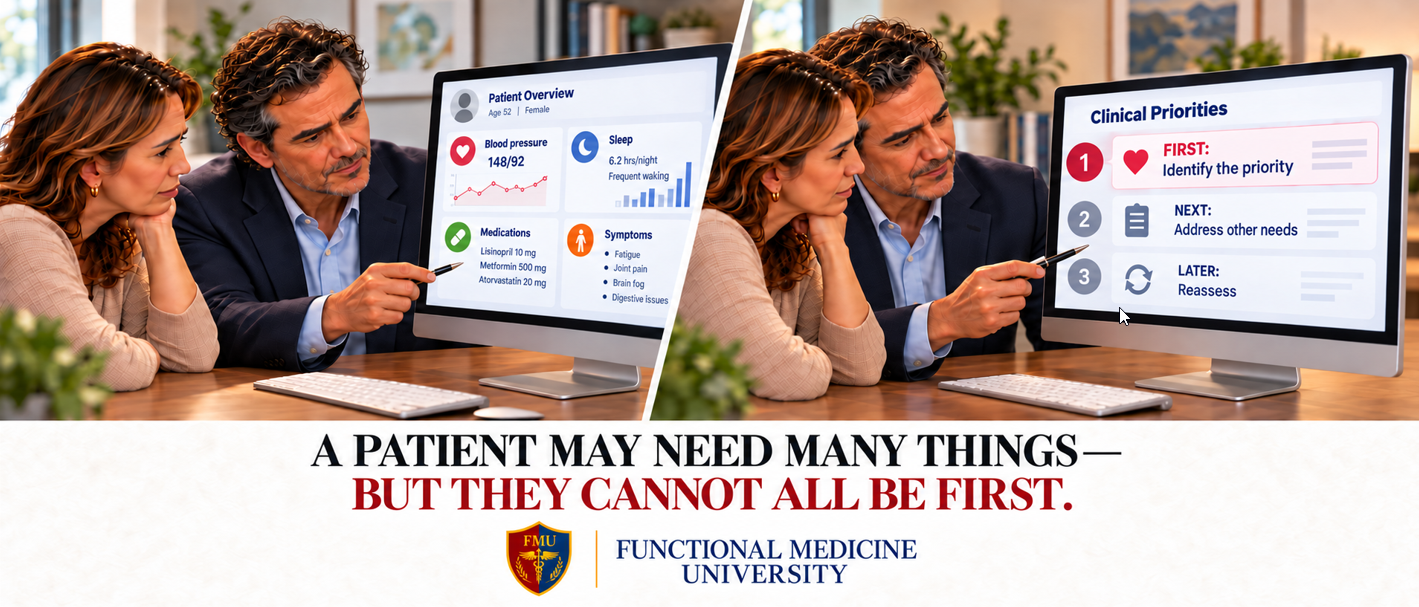
Consider a patient with persistently elevated blood pressure who also reports loud snoring and waking unrefreshed. The blood pressure needs appropriate assessment, and the sleep history raises another important question. What should the clinician clarify first, and how might those answers change the plan?
If you have felt the weight of decisions like this, you are not alone. It does not mean you lack knowledge or dedication. It means you take seriously the responsibility of caring for a person whose health cannot be reduced to one finding or one protocol.
At
Functional Medicine University, we have spent years teaching clinicians to investigate the whole patient. We have also learned that more knowledge does not automatically make the next decision clear.
Clinicians need a way to bring what they know together and apply it to the patient in front of them.
That is why I am beginning a new clinical education series. In the coming weeks, we will explore how to:
- Make sense of multiple findings without trying to address everything at once
- Decide what should lead, what should support the plan, and what
should wait
- Recognize when new information or the patient’s response calls for a different next step
- Turn clinical knowledge into a clearer, more responsible course of action
I will share clinical examples and practical
ways to think through these decisions. As we approach FMU’s October enrollment, I will also show you how we teach this work inside the university.
I want to begin with the purpose that brought many of us into healthcare: making a meaningful difference for the person who needs our help.
A patient may need many things—but they cannot all be first.
In my next message, we will return to the patient with elevated blood pressure and possible sleep-disordered breathing. We will look at what needs to be assessed, why the order of decisions matters, and how to choose a responsible
first step while keeping the whole patient in view.
If this is the kind of clinical reasoning you want to develop, I invite you to join FMU’s October enrollment priority list. You’ll receive the upcoming lessons and be notified when enrollment opens on October 17.
Join the October enrollment priority list
I look forward to working through these questions with you.
Dr. Ron Grisanti
Founder, Functional Medicine University
P.S. If the question “What comes first?” has stayed with you after a complex patient visit, I hope you’ll join me for this series. And if you’re considering
FMU’s October enrollment, [join the priority list to hold your seat]. I’ll share the clinical lessons first, then show you how we teach clinicians to
put them into practice.